Li Bing, Liu Chuan, Li Yang, Yang Han-Feng, Du Yong, Zhang Chuan, Zheng Hou-Jun, Xu Xiao-Xue
Bing Li, Chuan Liu, Yang Li, Han-Feng Yang, Yong Du, Chuan Zhang, Hou-Jun Zheng, Xiao-Xue Xu, Sichuan Key Laboratory of Medical Imaging, Department of Radiology, Affiliated Hospital of North Sichuan Medical College, Nanchong 637000, Sichuan Province, China.
World J Radiol. 2017 Apr 28;9(4):212-216. doi: 10.4329/wjr.v9.i4.212.
To retrospectively compare the outcomes of catheter drainage, urokinase and ozone in management of empyema.
Retrospective study included 209 patients (111 males and 98 females; age range 19 to 72 years) who were diagnosed with empyema. The patients were divided into 3 groups based on the therapy instituted: catheter drainage only (group I); catheter drainage and urokinase (group II); catheter drainage, urokinase and ozone (group III). Drainage was considered successful if empyema was resolved with closure of cavity, clinical symptoms were resolved, and need for any further surgical procedure was avoided. Success rate, length of stay (LOS), need for further surgery and hospital costs were compared between the three groups using the Kruskall-Wallis nonparametric test, with < 0.05 considered significant.
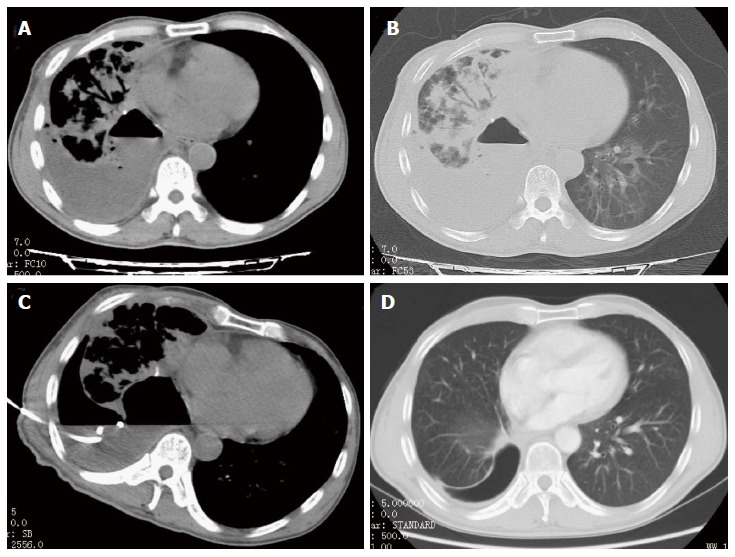
Of the 209 patients with empyema, all catheters were placed successfully under CT guidance. Sixty-three patients were treated with catheters alone (group I), 64 with catheters and urokinase (group II), and 82 with catheters, urokinase and ozone (group III). Group I, group II and group III had success rates of 62%, 83% and 95% respectively ( < 0.05). Group I and group II had statistically longer LOS ( < 0.05) and higher hospital costs ( < 0.05) compared to group III. There were statistically significant differences between the three groups when comparing patients who converted into further surgery.
The combination of chest tube drainage, urokinase and ozone is a safe and effective therapeutic modality in thoracic empyema.
回顾性比较导管引流、尿激酶和臭氧治疗脓胸的效果。
回顾性研究纳入209例被诊断为脓胸的患者(男性111例,女性98例;年龄范围19至72岁)。根据所采用的治疗方法将患者分为3组:单纯导管引流(I组);导管引流加尿激酶(II组);导管引流、尿激酶加臭氧(III组)。如果脓胸通过胸腔闭合得到解决、临床症状消失且避免了任何进一步的外科手术,则认为引流成功。使用Kruskal-Wallis非参数检验比较三组之间的成功率、住院时间(LOS)、进一步手术的需求和住院费用,P<0.05被认为具有统计学意义。
在209例脓胸患者中,所有导管均在CT引导下成功放置。63例患者仅接受导管治疗(I组),64例接受导管加尿激酶治疗(II组),82例接受导管、尿激酶加臭氧治疗(III组)。I组、II组和III组的成功率分别为62%、83%和95%(P<0.05)。与III组相比,I组和II组的住院时间在统计学上更长(P<0.05),住院费用更高(P<0.05)。在比较转为进一步手术的患者时,三组之间存在统计学显著差异。
胸腔闭式引流、尿激酶和臭氧联合应用是治疗胸腔脓胸的一种安全有效的治疗方式。