Carvalho Annelise, Chu Jennifer, Meinguet Céline, Kiss Robert, Vandenbussche Guy, Masereel Bernard, Wouters Johan, Kornienko Alexander, Pelletier Jerry, Mathieu Véronique
Laboratoire de Cancérologie et Toxicologie Expérimentale, Faculté de Pharmacie, Université Libre de Bruxelles, Brussels, Belgium.
Department of Biochemistry, McGill University, Montreal, Québec, Canada.
Data Brief. 2017 May 5;12:546-551. doi: 10.1016/j.dib.2017.05.006. eCollection 2017 Jun.
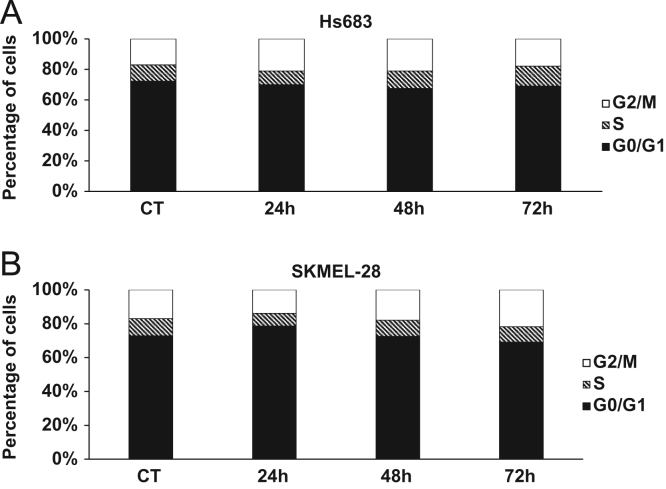
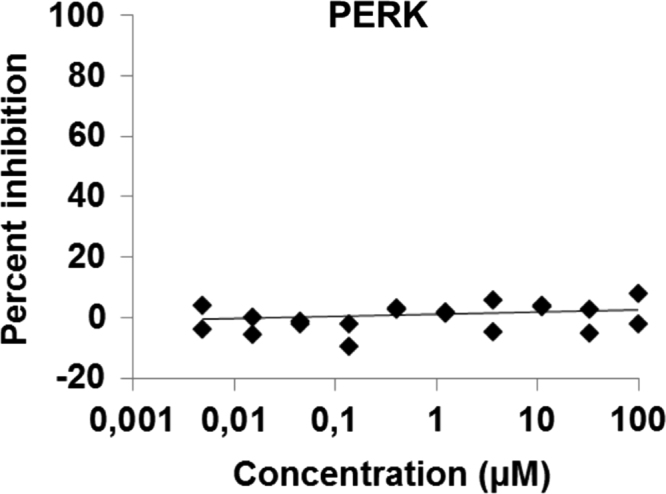
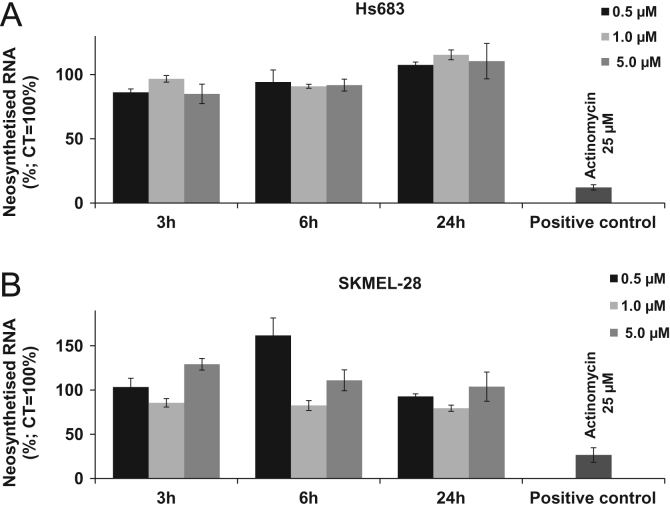
A harmine-derived beta-carboline, CM16, inhibits cancer cells growth through its effects on protein synthesis, as described in "A harmine-derived beta-carboline displays anti-cancer effects by targeting protein synthesis" (Carvalho et al., 2017)[1]. This data article provides accompanying data on CM16 cytostatic evaluation in cancer cells as well as data related to its effects on transcription and translation. After confirming the cytostatic effect of CM16, we investigated its ability to arrest the cell cycle in the glioma Hs683 and SKMEL-28 melanoma cell lines but no modification was evidenced. According to the global protein synthesis inhibition induced by CM16 [1], transcription phase, a step prior to mRNA translation, evaluated by labelled nucleotide incorporation assay was not shown to be affected under CM16 treatment in the two cell lines. By contrast, mRNA translation and particularly the initiation step were shown to be targeted by CM16 in [1]. To further decipher those effects, we established herein a list of main actors in the protein synthesis process according to literature survey for comparative analysis of cell lines displaying different sensitivity levels to CM16. Finally, one of these proteins, PERK, a kinase regulating eIF2-α phosphorylation and thereby activity, was evaluated under treatment with CM16 in a cell-free system.
一种源自哈尔明碱的β-咔啉CM16,通过其对蛋白质合成的影响来抑制癌细胞生长,如《一种源自哈尔明碱的β-咔啉通过靶向蛋白质合成发挥抗癌作用》(卡瓦略等人,2017年)[1]中所述。本数据文章提供了关于CM16在癌细胞中的细胞生长抑制评估的相关数据,以及与其对转录和翻译影响相关的数据。在确认CM16的细胞生长抑制作用后,我们研究了其使胶质瘤Hs683和SKMEL - 28黑色素瘤细胞系细胞周期停滞的能力,但未发现有改变。根据CM16诱导的整体蛋白质合成抑制[1],通过标记核苷酸掺入试验评估的mRNA翻译之前的转录阶段,在CM16处理下,这两种细胞系均未显示受到影响。相比之下,[1]中显示mRNA翻译,特别是起始步骤是CM16的作用靶点。为了进一步解读这些影响,我们通过文献调研建立了一份蛋白质合成过程中主要作用因子的列表,用于对显示出对CM16不同敏感水平的细胞系进行比较分析。最后,在无细胞体系中,对这些蛋白质之一PERK(一种调节eIF2-α磷酸化从而调节其活性的激酶)进行了CM16处理下的评估。