Zemouri Charifa, de Soet Hans, Crielaard Wim, Laheij Alexa
Department of Preventive Dentistry, Academic Centre for Dentistry Amsterdam, University of Amsterdam & Vrije Universiteit Amsterdam, Amsterdam, The Netherlands.
PLoS One. 2017 May 22;12(5):e0178007. doi: 10.1371/journal.pone.0178007. eCollection 2017.
Bio-aerosols originate from different sources and their potentially pathogenic nature may form a hazard to healthcare workers and patients. So far no extensive review on existing evidence regarding bio-aerosols is available.
This study aimed to review evidence on bio-aerosols in healthcare and the dental setting. The objectives were 1) What are the sources that generate bio-aerosols?; 2) What is the microbial load and composition of bio-aerosols and how were they measured?; and 3) What is the hazard posed by pathogenic micro-organisms transported via the aerosol route of transmission?
Systematic scoping review design. Searched in PubMed and EMBASE from inception to 09-03-2016. References were screened and selected based on abstract and full text according to eligibility criteria. Full text articles were assessed for inclusion and summarized. The results are presented in three separate objectives and summarized for an overview of evidence.
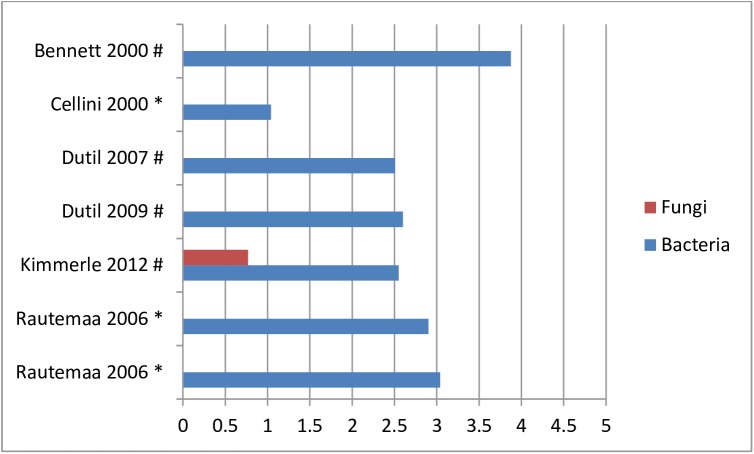
The search yielded 5,823 studies, of which 62 were included. Dental hand pieces were found to generate aerosols in the dental settings. Another 30 sources from human activities, interventions and daily cleaning performances in the hospital also generate aerosols. Fifty-five bacterial species, 45 fungi genera and ten viruses were identified in a hospital setting and 16 bacterial and 23 fungal species in the dental environment. Patients with certain risk factors had a higher chance to acquire Legionella in hospitals. Such infections can lead to irreversible septic shock and death. Only a few studies found that bio-aerosol generating procedures resulted in transmission of infectious diseases or allergic reactions.
Bio-aerosols are generated via multiple sources such as different interventions, instruments and human activity. Bio-aerosols compositions reported are heterogeneous in their microbiological composition dependent on the setting and methodology. Legionella species were found to be a bio-aerosol dependent hazard to elderly and patients with respiratory complaints. But all aerosols can be can be hazardous to both patients and healthcare workers.
生物气溶胶来源各异,其潜在致病性可能对医护人员和患者构成危害。目前尚无关于生物气溶胶现有证据的广泛综述。
本研究旨在综述医疗保健和牙科环境中生物气溶胶的证据。目标如下:1)产生生物气溶胶的来源有哪些?2)生物气溶胶的微生物负荷和组成是什么,以及如何进行测量?3)通过气溶胶传播途径传播的致病微生物会造成何种危害?
采用系统的范围综述设计。检索了从数据库建立至2016年3月9日的PubMed和EMBASE数据库。根据纳入标准,基于摘要和全文对参考文献进行筛选和选择。对全文文章进行纳入评估并总结。结果按三个独立目标呈现,并进行总结以概述相关证据。
检索共得到5823项研究,其中62项被纳入。发现牙科手机在牙科环境中会产生气溶胶。医院中另外30种来自人类活动、干预措施和日常清洁操作的来源也会产生气溶胶。在医院环境中鉴定出55种细菌、45个真菌属和10种病毒,在牙科环境中鉴定出16种细菌和23种真菌。具有某些风险因素的患者在医院感染军团菌的几率更高。此类感染可导致不可逆的感染性休克和死亡。仅有少数研究发现产生生物气溶胶的操作会导致传染病传播或过敏反应。
生物气溶胶通过多种来源产生,如不同的干预措施、器械和人类活动。所报告的生物气溶胶组成在微生物组成上因环境和方法而异。发现军团菌属是对老年人和有呼吸道疾病的患者依赖生物气溶胶的一种危害。但所有气溶胶都可能对患者和医护人员构成危害。