Li Peng, Zhou XiaoYue, Qu Ding, Guo Mengfei, Fan Chenyi, Zhou Tong, Ling Yang
a Department of Oncology , Changzhou Cancer Hospital of Soochow University , Changzhou , P.R. China.
b Affiliated Hospital of Integrated Traditional Chinese and Western Medicine, Nanjing University of Chinese Medicine , Nanjing , P.R. China.
Drug Deliv. 2017 Nov;24(1):834-845. doi: 10.1080/10717544.2017.1326540.
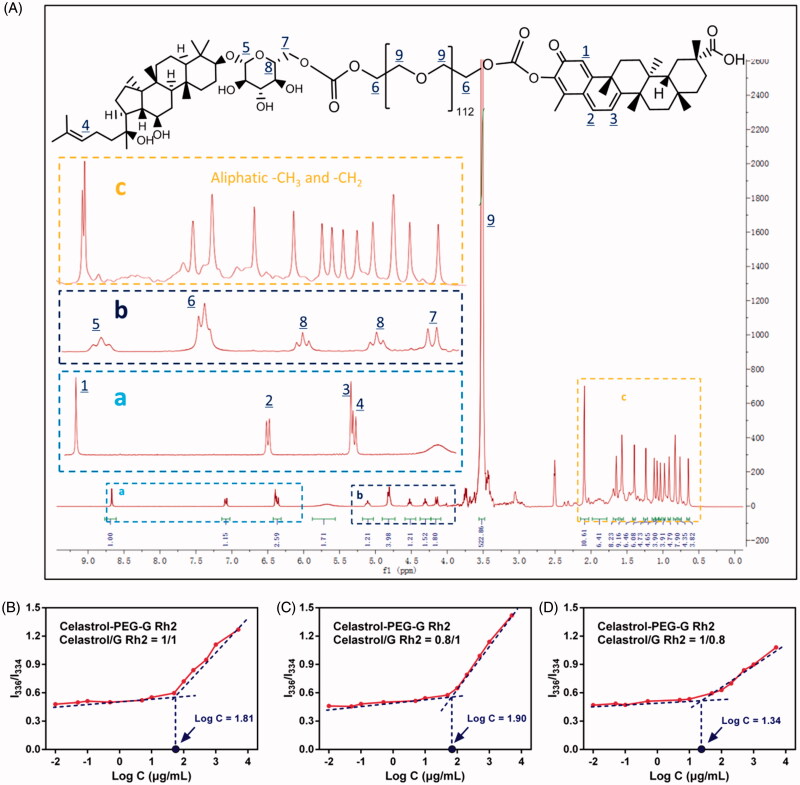
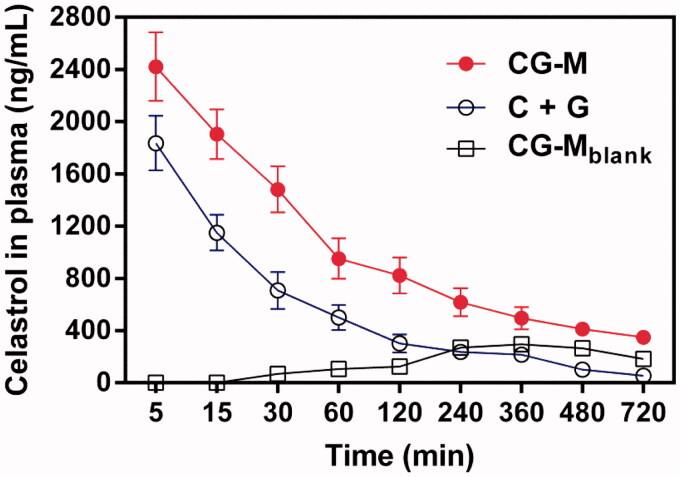
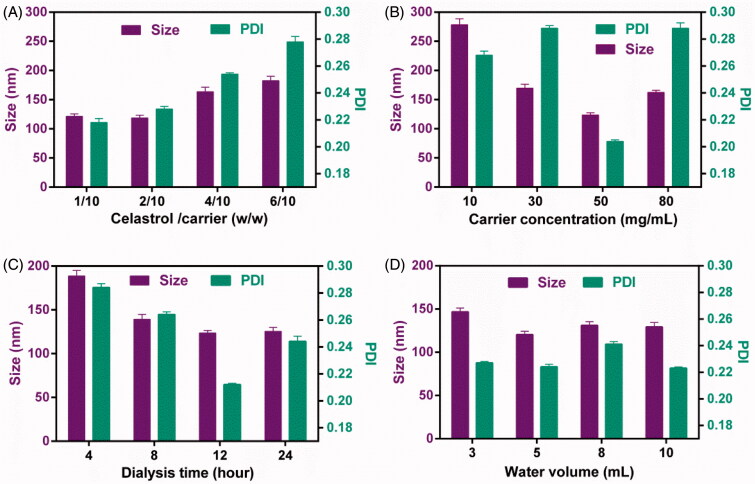
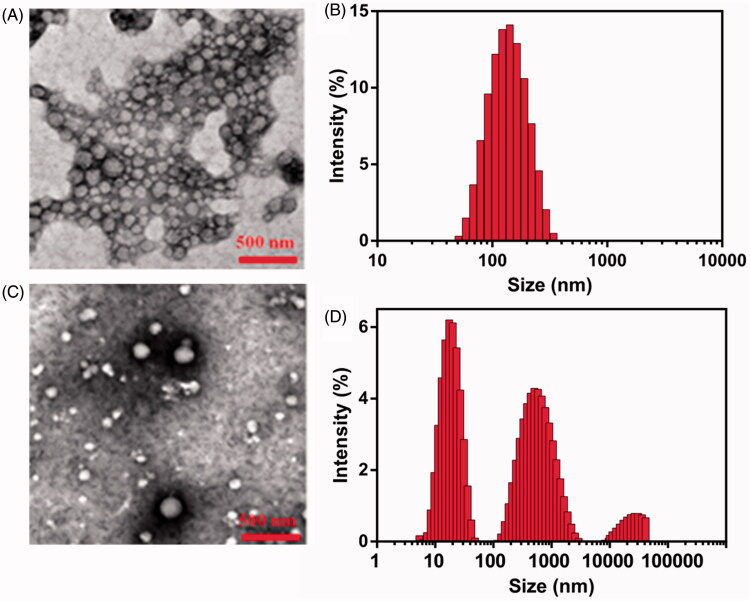
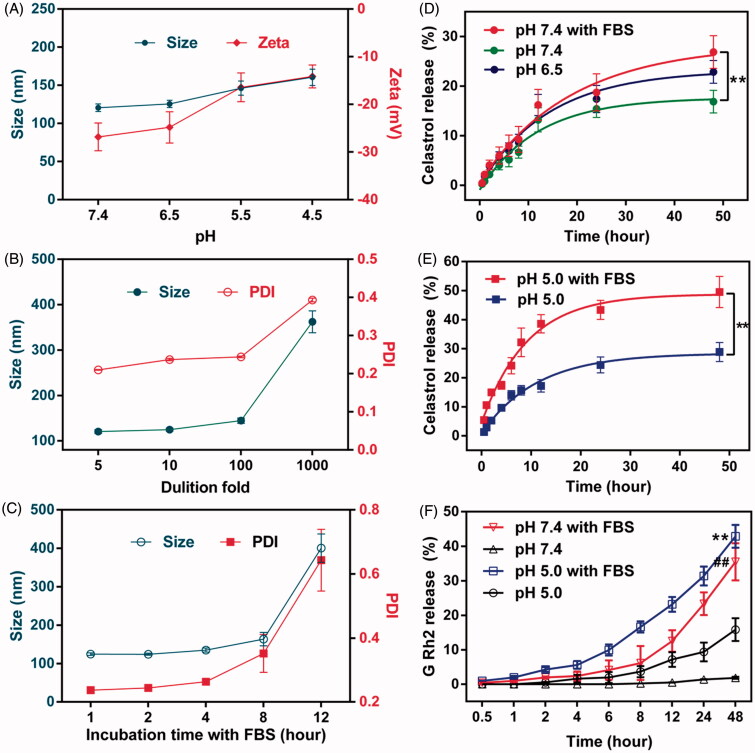
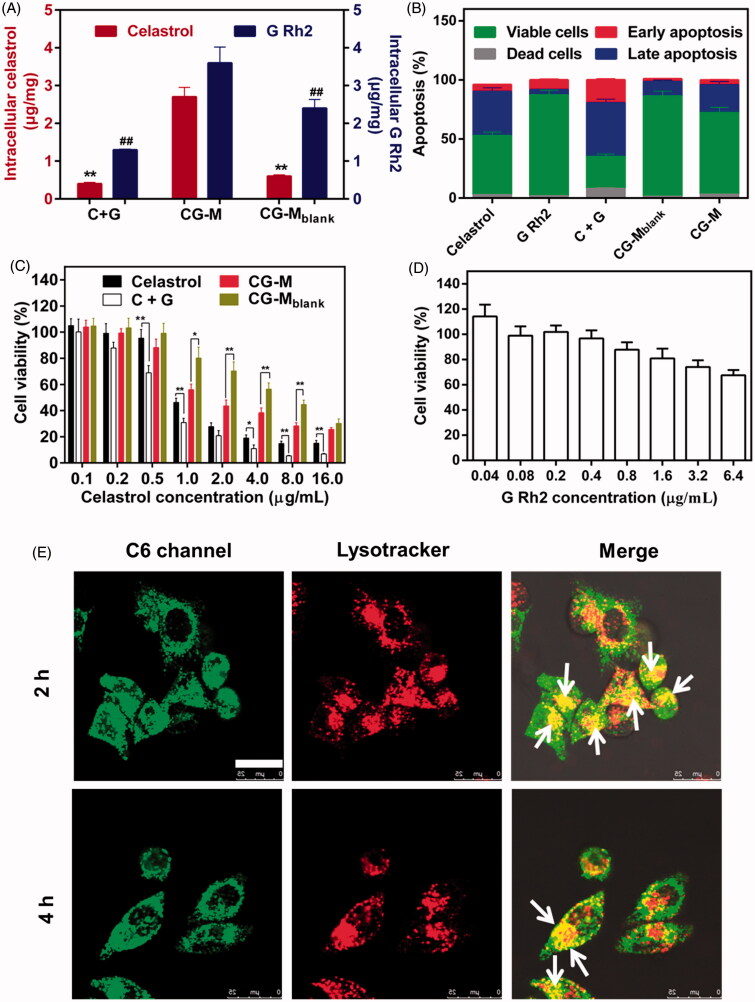
The aim of this study was to develop an amphipathic polyethylene glycol (PEG) derivative that was bi-terminally modified with celastrol and ginsenoside Rh2 (Celastrol-PEG-G Rh2). Such derivative was capable of forming novel, celastrol-loaded polymeric micelles (CG-M) for endo/lysosomal delivery and thereby synergistic treatment of lung cancer. Celastrol-PEG-G Rh2 with a yield of 55.6% was first synthesized and characterized. Its critical micellar concentration was 1 × 10M, determined by pyrene entrapment method. CG-M had a small particle size of 121.53 ± 2.35 nm, a narrow polydispersity index of 0.214 ± 0.001 and a moderately negative zeta potential of -23.14 ± 3.15 mV. Celastrol and G Rh2 were rapidly released from CG-M under acidic and enzymatic conditions, but slowly released in normal physiological environments. In cellular studies, the internalization of celastrol and G Rh2 by human non-small cell lung cancer (A549) cells treated with CG-M was 5.8-fold and 1.8-fold higher than that of non-micelle control. Combinational therapy of celastrol and G Rh2 using CG-M exhibited synergistic anticancer activities in cell apoptosis and proliferation assays via rapid drug release within endo/lysosomes. Most importantly, the celastrol in CG-M exhibited a long elimination half-life of 445.3 ± 43.5 min and an improved area under the curve of 645060.8 ± 63640.7 ng/mL/h, that were 1.03-fold and 2.44-fold greater than those of non-micelle control, respectively. These findings suggest that CG-M is a promising vector for precisely releasing anticancer drugs within the tumor cells, and thereby exerts an improved synergistic anti-lung cancer effect.
本研究的目的是开发一种两亲性聚乙二醇(PEG)衍生物,其两端用雷公藤红素和人参皂苷Rh2进行修饰(雷公藤红素-PEG-G Rh2)。这种衍生物能够形成新型的、负载雷公藤红素的聚合物胶束(CG-M)用于内体/溶酶体递送,从而协同治疗肺癌。首先合成并表征了产率为55.6%的雷公藤红素-PEG-G Rh2。通过芘包封法测定其临界胶束浓度为1×10M。CG-M粒径小,为121.53±2.35nm,多分散指数窄,为0.214±0.001,ζ电位适度为负,为-23.14±3.15mV。雷公藤红素和G Rh2在酸性和酶促条件下从CG-M中快速释放,但在正常生理环境中缓慢释放。在细胞研究中,用CG-M处理的人非小细胞肺癌(A549)细胞对雷公藤红素和G Rh2的内化分别比非胶束对照高5.8倍和1.8倍。使用CG-M的雷公藤红素和G Rh2联合治疗在细胞凋亡和增殖试验中通过内体/溶酶体内的快速药物释放表现出协同抗癌活性。最重要的是,CG-M中的雷公藤红素显示出445.3±43.5分钟的长消除半衰期和645060.8±63640.7 ng/mL/h的改善曲线下面积,分别比非胶束对照大1.03倍和2.44倍。这些发现表明,CG-M是一种有前途的载体,可在肿瘤细胞内精确释放抗癌药物,从而发挥更好的协同抗肺癌作用。