Li Yang, Fujita Mayumi, Boraschi Diana
Department of Dermatology, University of Colorado, Anschutz Medical Campus, Aurora, CO, USA.
Institute of Protein Biochemistry, National Research Council (CNR), Napoli, Italy.
Front Immunol. 2017 May 8;8:472. doi: 10.3389/fimmu.2017.00472. eCollection 2017.
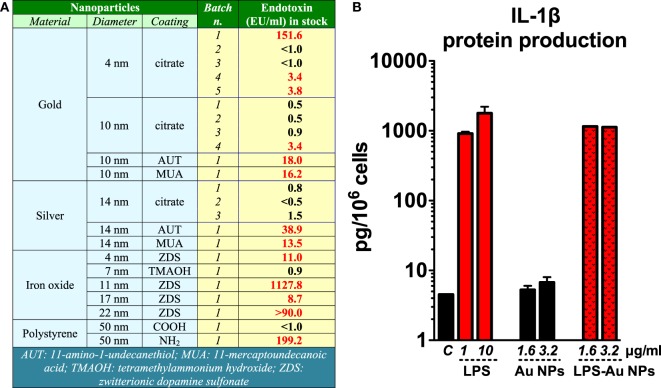
Given the presence of engineered nanomaterials in consumers' products and their application in nanomedicine, nanosafety assessment is becoming increasingly important. In particular, immunosafety aspects are being actively investigated. In nanomaterial immunosafety testing strategies, it is important to consider that nanomaterials and nanoparticles are very easy to become contaminated with endotoxin, which is a widespread contaminant coming from the Gram-negative bacterial cell membrane. Because of the potent inflammatory activity of endotoxin, contaminated nanomaterials can show inflammatory/toxic effects due to endotoxin, which may mask or misidentify the real biological effects (or lack thereof) of nanomaterials. Therefore, before running immunosafety assays, either or , the presence of endotoxin in nanomaterials must be evaluated. This calls for using appropriate assays with proper controls, because many nanomaterials interfere at various levels with the commercially available endotoxin detection methods. This also underlines the need to develop robust and bespoke strategies for endotoxin evaluation in nanomaterials.
鉴于工程纳米材料存在于消费品中及其在纳米医学中的应用,纳米安全性评估变得越来越重要。特别是,免疫安全性方面正在积极研究中。在纳米材料免疫安全性测试策略中,重要的是要考虑到纳米材料和纳米颗粒非常容易被内毒素污染,内毒素是一种来自革兰氏阴性细菌细胞膜的广泛污染物。由于内毒素具有强大的炎症活性,受污染的纳米材料可能会因内毒素而表现出炎症/毒性作用,这可能会掩盖或错误识别纳米材料的真实生物学效应(或不存在效应)。因此,在进行免疫安全性检测之前,无论是哪种检测,都必须评估纳米材料中内毒素的存在。这就需要使用适当的检测方法并设置适当的对照,因为许多纳米材料会在不同程度上干扰市售的内毒素检测方法。这也强调了开发用于评估纳米材料中内毒素的稳健且定制策略的必要性。