Offeddu Vittoria, Olotu Ally, Osier Faith, Marsh Kevin, Matuschewski Kai, Thathy Vandana
Parasitology Unit, Max Planck Institute for Infection Biology, Berlin, Germany.
Wellcome Trust Research Programme, Centre for Geographic Medicine Research-Coast, Kenya Medical Research Institute (KEMRI), Kilifi, Kenya.
Front Immunol. 2017 May 8;8:488. doi: 10.3389/fimmu.2017.00488. eCollection 2017.
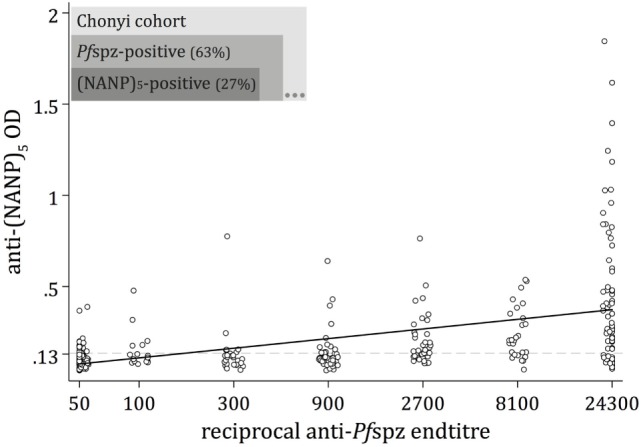
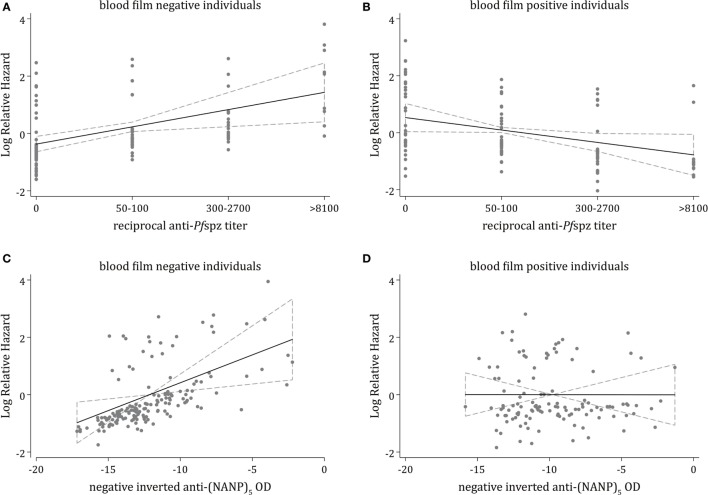
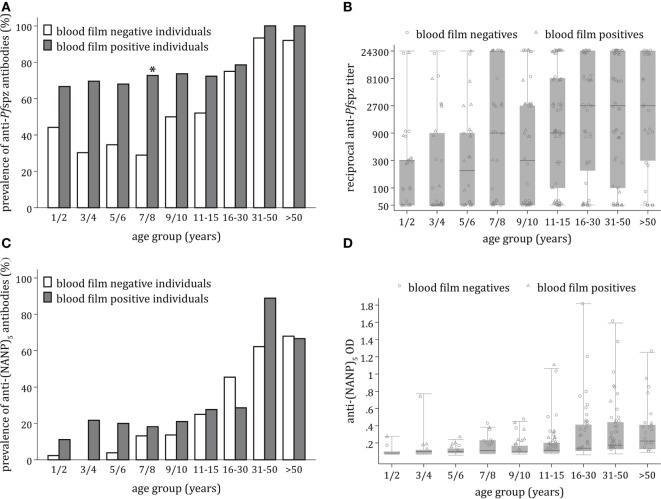
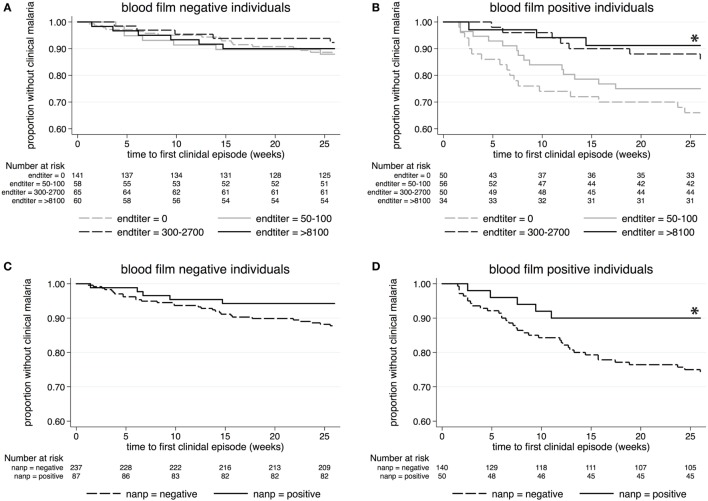
Immunoepidemiological studies typically reveal slow, age-dependent acquisition of immune responses against sporozoites. Naturally acquired immunity against preerythrocytic stages is considered inadequate to confer protection against clinical malaria. To explore previously unrecognized antisporozoite responses, we measured serum levels of naturally acquired antibodies to whole sporozoites (spz) and the immunodominant (NANP) repeats of the major sporozoite surface protein, circumsporozoite protein, in a well-characterized Kenyan cohort. Sera were sampled at the start of the malaria transmission season, and all subjects were prospectively monitored for uncomplicated clinical malaria in the ensuing 6 months. We used Kaplan-Meier analysis and multivariable regression to investigate the association of antisporozoite immunity with incidence of clinical malaria. Although naturally acquired humoral responses against spz and (NANP) were strongly correlated ( < 0.0001), 37% of spz responders did not recognize (NANP). The prevalence and magnitude of antisporozoite responses increased with age, although some high spz responders were identified among children. Survival analysis revealed a reduced risk of and increased time to first or only episode of clinical malaria among spz or (NANP) responders carrying microscopically detectable () parasitemia at the start of the transmission season ( < 0.03). Our Cox regression interaction models indicated a potentially protective interaction between high anti-spz ( = 0.002) or anti-(NANP) ( = 0.001) antibody levels and microscopically detectable parasitemia on the risk of subsequent clinical malaria. Our findings indicate that robust antisporozoite immune responses can be naturally acquired already at an early age. A potentially protective role of high levels of anti-spz antibodies against clinical episodes of uncomplicated malaria was detected, suggesting that antibody-mediated preerythrocytic immunity might indeed contribute to protection in nature.
免疫流行病学研究通常显示,针对子孢子的免疫反应是缓慢的、年龄依赖性的。针对红细胞前期阶段的自然获得性免疫被认为不足以提供针对临床疟疾的保护。为了探索以前未被认识的抗子孢子反应,我们在一个特征明确的肯尼亚队列中,测量了针对完整子孢子(spz)以及主要子孢子表面蛋白环子孢子蛋白的免疫显性(NANP)重复序列的自然获得性抗体的血清水平。在疟疾传播季节开始时采集血清,并对所有受试者在随后的6个月内进行前瞻性监测,以观察无并发症的临床疟疾情况。我们使用Kaplan-Meier分析和多变量回归来研究抗子孢子免疫与临床疟疾发病率之间的关联。尽管针对spz和(NANP)的自然获得性体液反应高度相关(<0.0001),但37%的spz反应者不识别(NANP)。抗子孢子反应的患病率和强度随年龄增加,尽管在儿童中也发现了一些高spz反应者。生存分析显示,在传播季节开始时携带显微镜下可检测到的()寄生虫血症的spz或(NANP)反应者中,首次或仅一次临床疟疾发作的风险降低,发作时间延长(<0.03)。我们的Cox回归交互模型表明,高抗spz(=0.002)或抗(NANP)(=0.001)抗体水平与显微镜下可检测到的寄生虫血症之间,在随后临床疟疾风险方面存在潜在的保护性相互作用。我们的研究结果表明,在早年就可以自然获得强大的抗子孢子免疫反应。检测到高水平的抗spz抗体对无并发症疟疾临床发作具有潜在的保护作用,这表明抗体介导的红细胞前期免疫可能确实在自然环境中有助于提供保护。