Präg Patrick, Subramanian S V
Department of Sociology and Nuffield College, University of Oxford, Oxford, UK.
Department of Social and Behavioral Sciences, Harvard Chan School of Public Health, Boston, MA, US.
Int J Public Health. 2017 Jul;62(6):709-716. doi: 10.1007/s00038-017-0981-6. Epub 2017 May 22.
The US shows a distinct health disadvantage when compared to other high-income nations. A potential lever to reduce this disadvantage is to improve the health situation of lower socioeconomic groups. Our objective is to explore how the considerable within-US variation in health inequalities compares to the health inequalities across other Western countries.
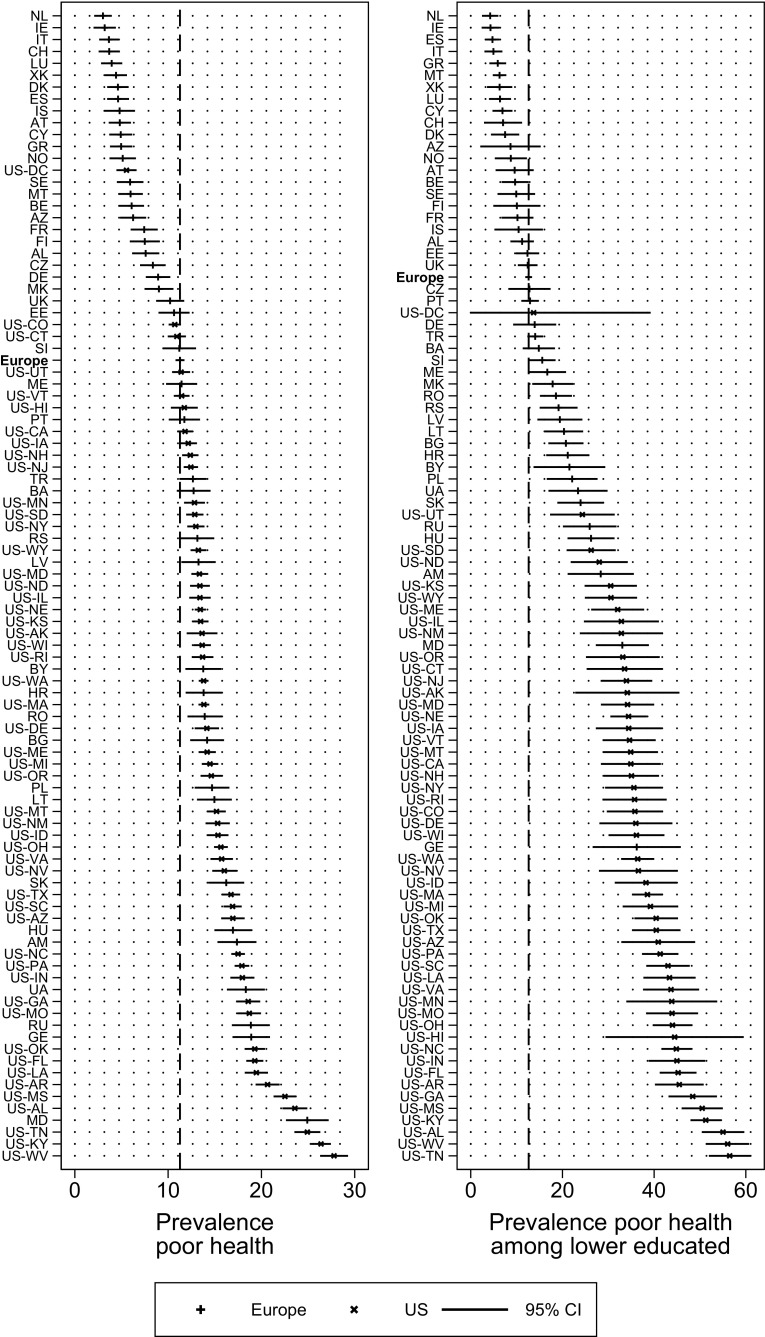
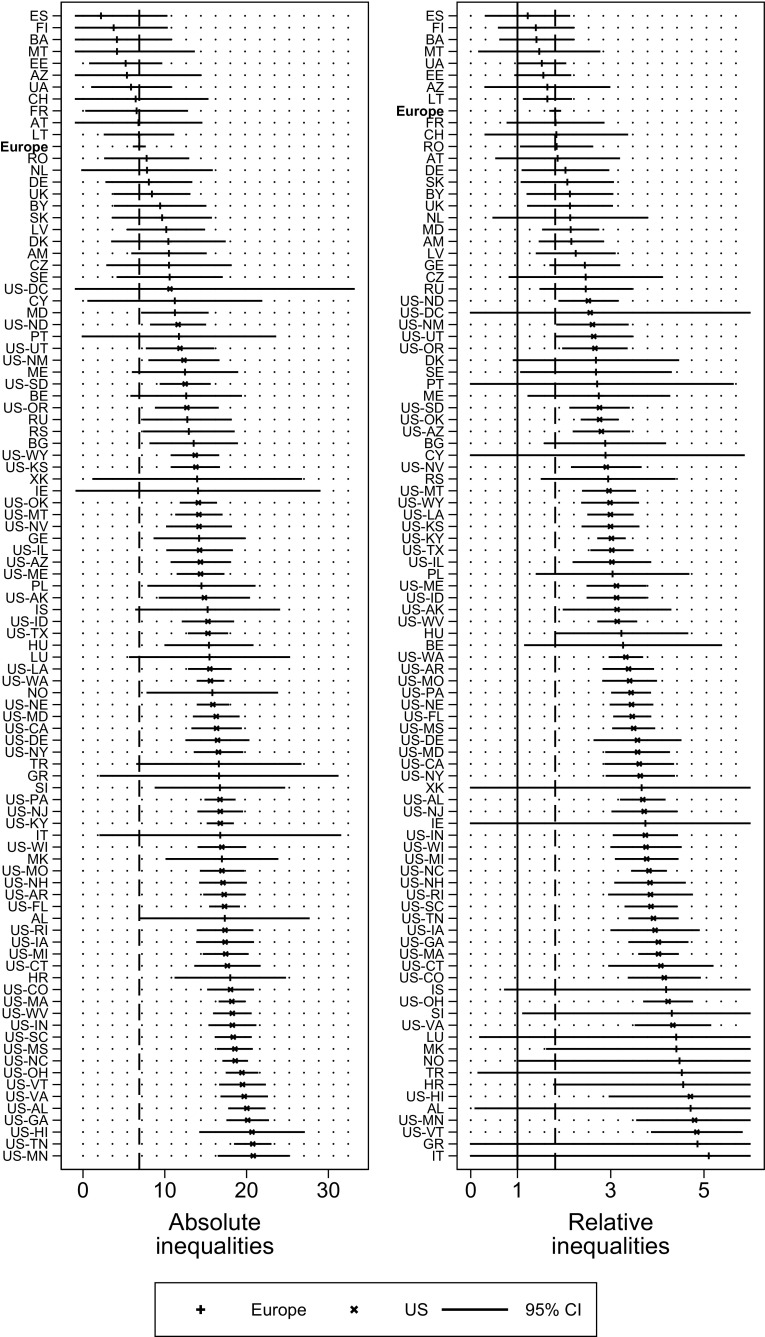
Representative survey data from 44 European countries and the US federal states were obtained from the fourth wave of the European Values Study (EVS) and the 2008 wave of the Behavioral Risk Factor Surveillance System. Using binary logistic regression, we analyze different forms of educational inequalities in self-rated health (SRH), adjusted for age and sex.
The extent of educational inequalities in SRH varies considerably over European countries and US states; with US states in general showing greater inequality, however, differences between US states and European countries are less clear than commonly assumed.
The US has considerable differences in educational inequalities in SRH across geographic locations. To understand the reasons for the US health disadvantage, comparative research has to take into account the vast variation in health inequalities within the US.
与其他高收入国家相比,美国在健康方面存在明显劣势。降低这一劣势的一个潜在手段是改善社会经济地位较低群体的健康状况。我们的目标是探究美国国内健康不平等现象的显著差异与其他西方国家的健康不平等现象相比如何。
从欧洲价值观研究(EVS)的第四轮以及行为风险因素监测系统的2008年数据中获取了44个欧洲国家和美国联邦州的代表性调查数据。使用二元逻辑回归分析,我们对自评健康(SRH)中不同形式的教育不平等进行了分析,并对年龄和性别进行了调整。
自评健康方面的教育不平等程度在欧洲国家和美国各州之间差异很大;总体而言,美国各州的不平等程度更高,然而,美国各州与欧洲国家之间的差异并不像通常认为的那么明显。
美国在自评健康方面的教育不平等在地理位置上存在很大差异。为了理解美国健康劣势的原因,比较研究必须考虑到美国国内健康不平等的巨大差异。