NorthShore Orthopaedic Institute, NorthShore University HealthSystem, 2650 Ridge Avenue Suite 2505, Evanston, IL, 60201, USA.
California Sports and Orthopaedic Institute, 2999 Regent Street Suite 225, Berkeley, CA, 94705, USA.
Knee Surg Sports Traumatol Arthrosc. 2018 Jan;26(1):306-311. doi: 10.1007/s00167-017-4563-1. Epub 2017 May 22.
Posterior elbow impingement can cause disabling pain and limited motion during activities involving elbow extension. Less understood is whether arthroscopic treatment, compared to open surgery, can result in effective management of pain, loss of range of motion, and return athletes to previous levels of activity. This study determined whether arthroscopic debridement is a safe and effective treatment for posterior elbow impingement and whether it enables athletes to return to a previous level of function.
A retrospective review of 36 consecutive patients that underwent arthroscopic debridement of the posterior elbow was performed. There were 34 male and 2 female patients, with a median age of 32 years (17-54 years). There were 7 professional athletes, 6 college athletes, and 23 high school or recreational athletes. All patients had a positive posterior impingement test for posterior pain with extension and limitations of activity. Arthroscopic debridement and additional surgical procedures were performed, and patients underwent follow-up visits at a median 51 months (range 14-81).
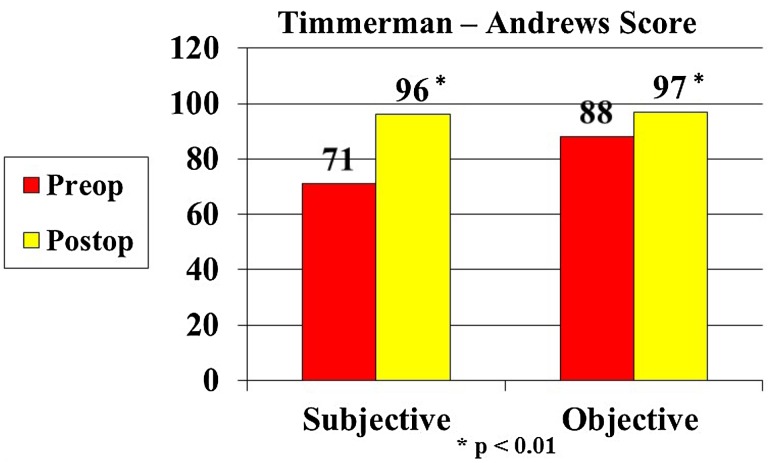
Significant improvements were seen in pain, motion, and function. No neurovascular complications were seen related to the arthroscopic debridement. The mean Andrews and Timmerman elbow score improved from 159 ± 27 to 193 ± 11 (p < 0.01). Thirty-five of thirty-six (97%) patients returned to their previous level of activity, including all professional athletes.
Arthroscopic management of posterior elbow impingement is safe and effective and can return patients, including professional athletes, to high-level athletic activity. Athletes with symptomatic posterior elbow impingement can be successfully and safely treated with arthroscopic debridement and typically will return to preinjury levels of activity.
IV.
肘后撞击症可导致活动时出现疼痛和活动度受限。但对于肘后撞击症,关节镜治疗与开放手术相比,是否能够有效管理疼痛、活动度丧失以及使运动员恢复到之前的活动水平,了解得还不够。本研究旨在确定关节镜下清创术是否是治疗肘后撞击症的一种安全有效的方法,以及它是否能使运动员恢复到之前的功能水平。
对 36 例连续接受关节镜下肘后清创术的患者进行回顾性研究。患者中男性 34 例,女性 2 例,平均年龄 32 岁(17-54 岁)。有 7 名职业运动员,6 名大学生运动员,23 名高中生或业余运动员。所有患者均有阳性的后撞击试验,表现为后向疼痛伴伸展活动受限。行关节镜下清创术及其他手术,患者平均随访 51 个月(范围 14-81)。
疼痛、活动度和功能均有显著改善。未发生与关节镜下清创术相关的神经血管并发症。Andrews 和 Timmerman 肘评分平均从 159±27 提高到 193±11(p<0.01)。36 例患者中的 35 例(97%)恢复到以前的活动水平,包括所有职业运动员。
关节镜治疗肘后撞击症安全有效,可使患者(包括职业运动员)恢复到高水平的运动活动。对于有症状的肘后撞击症患者,关节镜下清创术是一种安全有效的治疗方法,通常可使患者恢复到受伤前的活动水平。
IV。