Sabari Joshua K, Lok Benjamin H, Laird James H, Poirier John T, Rudin Charles M
Department of Medicine, Memorial Sloan Kettering Cancer Center.
Department of Radiation Oncology, Memorial Sloan Kettering Cancer Center, 300 East 66th Street, New York, New York 10065, USA.
Nat Rev Clin Oncol. 2017 Sep;14(9):549-561. doi: 10.1038/nrclinonc.2017.71. Epub 2017 May 23.
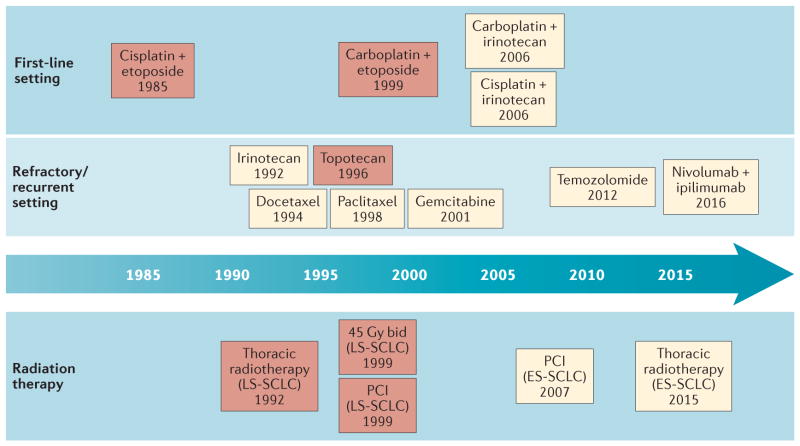
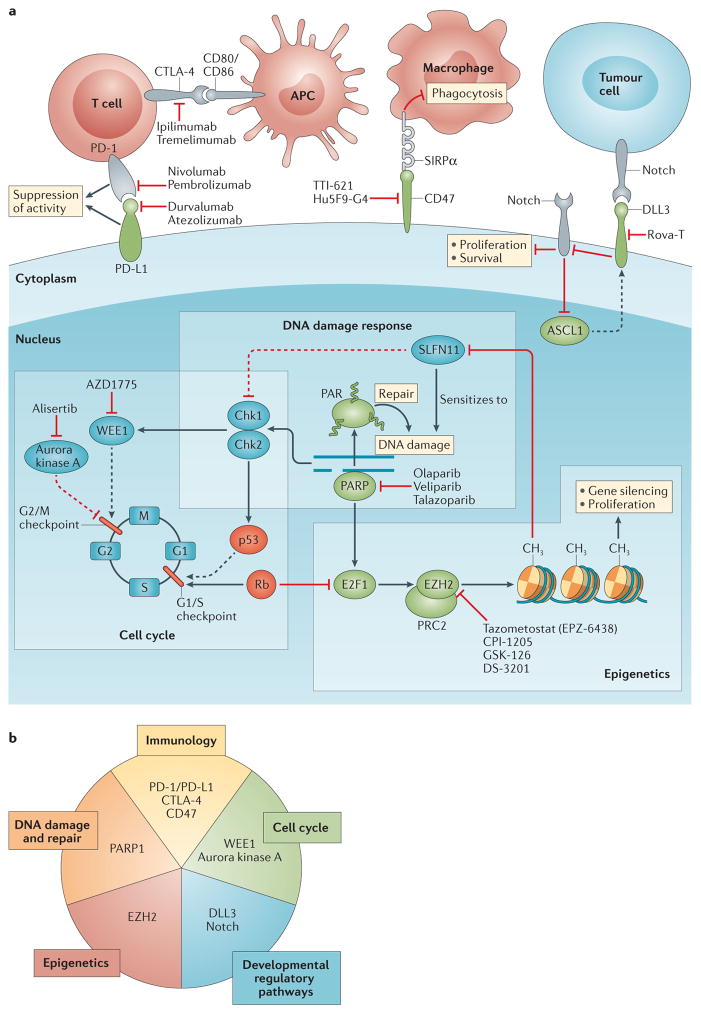
Small-cell lung cancer (SCLC) is an aggressive malignancy associated with a poor prognosis. First-line treatment has remained unchanged for decades, and a paucity of effective treatment options exists for recurrent disease. Nonetheless, advances in our understanding of SCLC biology have led to the development of novel experimental therapies. Poly [ADP-ribose] polymerase (PARP) inhibitors have shown promise in preclinical models, and are under clinical investigation in combination with cytotoxic therapies and inhibitors of cell-cycle checkpoints.Preclinical data indicate that targeting of histone-lysine N-methyltransferase EZH2, a regulator of chromatin remodelling implicated in acquired therapeutic resistance, might augment and prolong chemotherapy responses. High expression of the inhibitory Notch ligand Delta-like protein 3 (DLL3) in most SCLCs has been linked to expression of Achaete-scute homologue 1 (ASCL1; also known as ASH-1), a key transcription factor driving SCLC oncogenesis; encouraging preclinical and clinical activity has been demonstrated for an anti-DLL3-antibody-drug conjugate. The immune microenvironment of SCLC seems to be distinct from that of other solid tumours, with few tumour-infiltrating lymphocytes and low levels of the immune-checkpoint protein programmed cell death 1 ligand 1 (PD-L1). Nonetheless, immunotherapy with immune-checkpoint inhibitors holds promise for patients with this disease, independent of PD-L1 status. Herein, we review the progress made in uncovering aspects of the biology of SCLC and its microenvironment that are defining new therapeutic strategies and offering renewed hope for patients.
小细胞肺癌(SCLC)是一种侵袭性恶性肿瘤,预后较差。几十年来一线治疗方案一直未变,复发性疾病的有效治疗选择匮乏。尽管如此,我们对SCLC生物学认识的进展已促使新型实验性疗法的开发。聚[ADP-核糖]聚合酶(PARP)抑制剂在临床前模型中已显示出前景,并且正在与细胞毒性疗法及细胞周期检查点抑制剂联合进行临床研究。临床前数据表明,靶向组蛋白赖氨酸N-甲基转移酶EZH2(一种与获得性治疗耐药相关的染色质重塑调节因子)可能会增强并延长化疗反应。大多数SCLC中抑制性Notch配体Delta样蛋白3(DLL3)的高表达与achaete-scute同源物1(ASCL1,也称为ASH-1)的表达相关,ASCL1是驱动SCLC肿瘤发生的关键转录因子;一种抗DLL3抗体-药物偶联物已显示出令人鼓舞的临床前和临床活性。SCLC的免疫微环境似乎与其他实体瘤不同,肿瘤浸润淋巴细胞很少,免疫检查点蛋白程序性细胞死亡1配体1(PD-L1)水平较低。尽管如此,使用免疫检查点抑制剂进行免疫治疗对该病患者有前景,与PD-L1状态无关。在此,我们综述了在揭示SCLC及其微环境生物学方面所取得的进展,这些进展正在定义新的治疗策略并为患者带来新的希望。