Mollaoglu Gurkan, Guthrie Matthew R, Böhm Stefanie, Brägelmann Johannes, Can Ismail, Ballieu Paul M, Marx Annika, George Julie, Heinen Christine, Chalishazar Milind D, Cheng Haixia, Ireland Abbie S, Denning Kendall E, Mukhopadhyay Anandaroop, Vahrenkamp Jeffery M, Berrett Kristofer C, Mosbruger Timothy L, Wang Jun, Kohan Jessica L, Salama Mohamed E, Witt Benjamin L, Peifer Martin, Thomas Roman K, Gertz Jason, Johnson Jane E, Gazdar Adi F, Wechsler-Reya Robert J, Sos Martin L, Oliver Trudy G
Department of Oncological Sciences, University of Utah, Huntsman Cancer Institute, Salt Lake City, UT 84112, USA.
Molecular Pathology, Institute for Pathology, Medical Faculty, University of Cologne, 50937 Cologne, Germany; Department of Translational Genomics, Center of Integrated Oncology Cologne-Bonn, Medical Faculty, University of Cologne, 50931 Cologne, Germany.
Cancer Cell. 2017 Feb 13;31(2):270-285. doi: 10.1016/j.ccell.2016.12.005. Epub 2017 Jan 12.
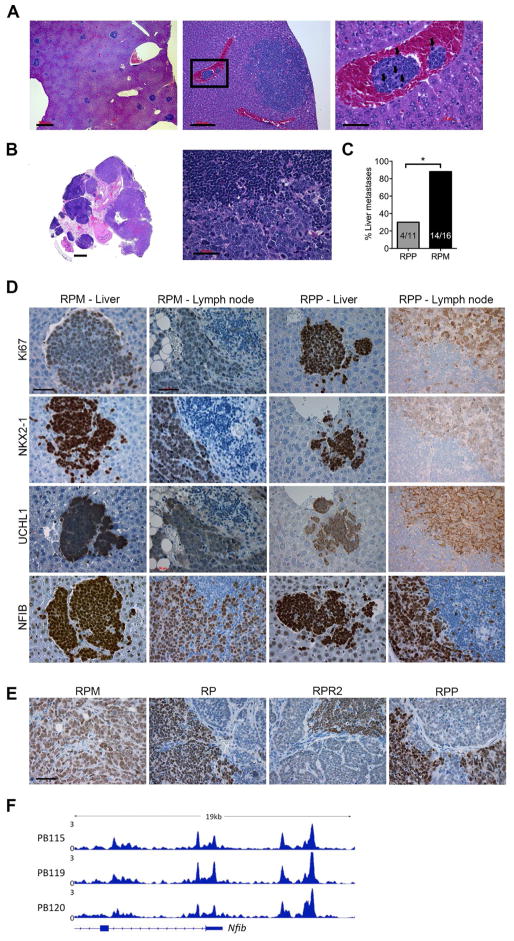
Loss of the tumor suppressors RB1 and TP53 and MYC amplification are frequent oncogenic events in small cell lung cancer (SCLC). We show that Myc expression cooperates with Rb1 and Trp53 loss in the mouse lung to promote aggressive, highly metastatic tumors, that are initially sensitive to chemotherapy followed by relapse, similar to human SCLC. Importantly, MYC drives a neuroendocrine-low "variant" subset of SCLC with high NEUROD1 expression corresponding to transcriptional profiles of human SCLC. Targeted drug screening reveals that SCLC with high MYC expression is vulnerable to Aurora kinase inhibition, which, combined with chemotherapy, strongly suppresses tumor progression and increases survival. These data identify molecular features for patient stratification and uncover a potential targeted treatment approach for MYC-driven SCLC.
肿瘤抑制因子RB1和TP53的缺失以及MYC扩增是小细胞肺癌(SCLC)中常见的致癌事件。我们发现,Myc表达与小鼠肺部Rb1和Trp53缺失协同作用,促进侵袭性、高转移性肿瘤的发生,这些肿瘤最初对化疗敏感,随后复发,类似于人类SCLC。重要的是,MYC驱动SCLC的神经内分泌低“变体”亚群,其具有高NEUROD1表达,与人类SCLC的转录谱相对应。靶向药物筛选显示,高MYC表达的SCLC对极光激酶抑制敏感,将其与化疗联合使用可强烈抑制肿瘤进展并延长生存期。这些数据确定了用于患者分层的分子特征,并揭示了一种针对MYC驱动的SCLC的潜在靶向治疗方法。