Kim Haejung, Hwang Haein, Lee Hansoo, Hong Hyo Jeong
Department of Biology, College of National Science, College of Biomedical Science, Kangwon National University, Chuncheon 24341, Korea.
Institute of Bioscience and Biotechnology, College of Biomedical Science, Kangwon National University, Chuncheon 24341, Korea.
Mol Cells. 2017 May 31;40(5):363-370. doi: 10.14348/molcells.2017.2282. Epub 2017 May 24.
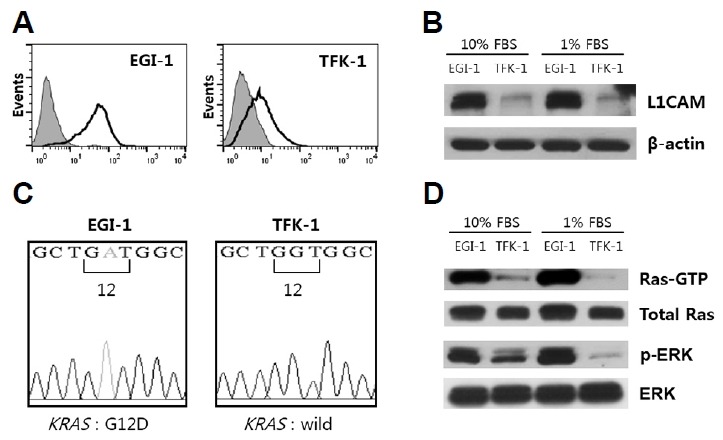
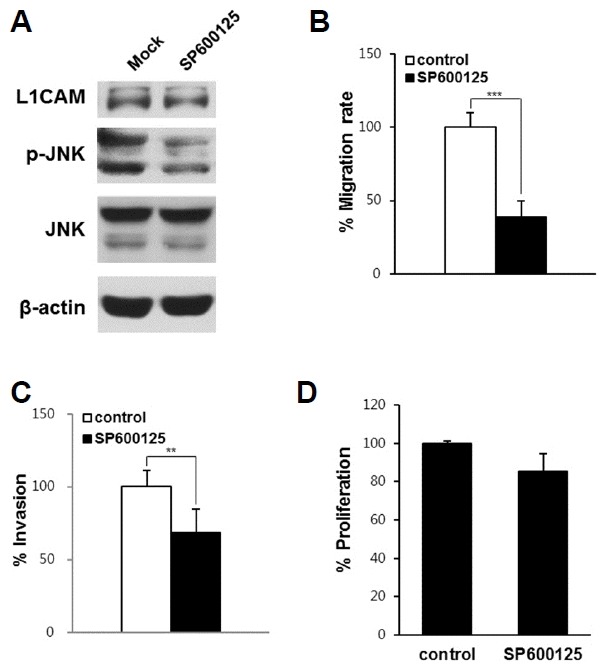
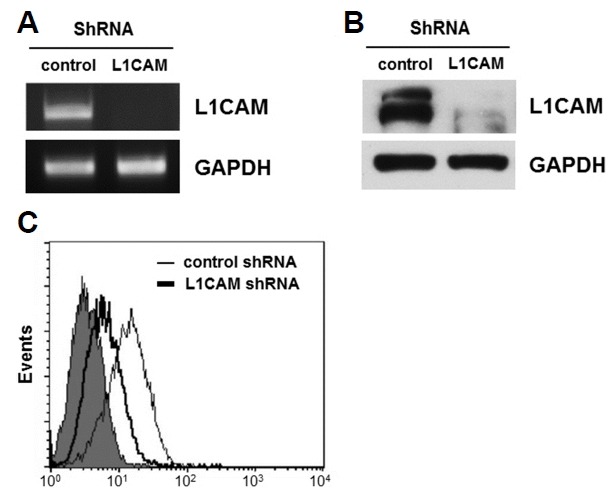
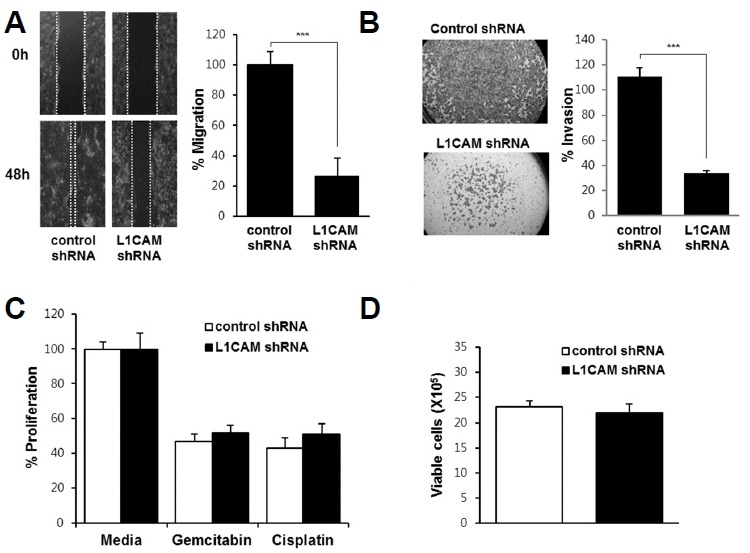
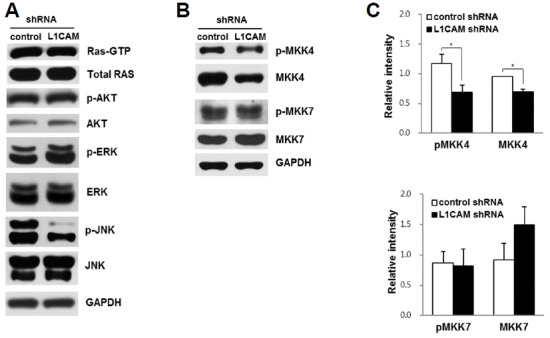
Extrahepatic cholangiocarcinoma (ECC), a malignant tumor of biliary origin, has a poor prognosis with limited treatment options. The oncogene is the most commonly mutated gene in ECC and one of the factors that predicts a poor prognosis and low survival rate. L1 cell adhesion molecule (L1CAM) is expressed in ECC cells and acts as an independent poor prognostic factor in predicting patient survival. In this study we investigate the functional significance of L1CAM in ECC cells with activating mutation. We selected an ECC cell line, EGI-1, with activating mutation, and then confirmed its expression of L1CAM by RT-PCR, western blot analysis, and flow cytometry. The suppression of L1CAM expression (using a specific lentivirus-delivered shRNA) significantly decreased the migratory and invasive properties of EGI-1 cells, without altering their proliferation or survival. Analyses of signaling effectors in L1CAM-depleted and control EGI-1 cells indicated that L1CAM suppression decreased the levels of both phosphorylated MKK4 and total MKK4, together with c-Jun N-terminal kinase (JNK) phosphorylation. Further, exposure to a JNK inhibitor (SP600125) decreased migration and invasion of EGI-1 cells. These results suggest that L1CAM promotes cellular migration and invasion via the induction of MKK4 expression, leading to JNK activation. Our study is the first to demonstrate a functional role for L1CAM in ECC carrying the activating mutation. Given that is the most commonly mutated oncogene in ECC, L1CAM may serve as an attractive therapeutic target for ECC cells with activating mutation.
肝外胆管癌(ECC)是一种起源于胆管的恶性肿瘤,预后较差,治疗选择有限。原癌基因是ECC中最常见的突变基因,也是预测预后不良和低生存率的因素之一。L1细胞粘附分子(L1CAM)在ECC细胞中表达,是预测患者生存的独立不良预后因素。在本研究中,我们研究了L1CAM在具有激活突变的ECC细胞中的功能意义。我们选择了具有激活突变的ECC细胞系EGI-1,然后通过RT-PCR、western blot分析和流式细胞术证实其L1CAM的表达。抑制L1CAM表达(使用特定的慢病毒递送shRNA)显著降低了EGI-1细胞的迁移和侵袭特性,而不改变其增殖或存活。对L1CAM缺失的EGI-1细胞和对照EGI-1细胞中的信号效应器分析表明,抑制L1CAM降低了磷酸化MKK4和总MKK4的水平,以及c-Jun氨基末端激酶(JNK)的磷酸化。此外,暴露于JNK抑制剂(SP600125)可降低EGI-1细胞的迁移和侵袭。这些结果表明,L1CAM通过诱导MKK4表达促进细胞迁移和侵袭,导致JNK激活。我们的研究首次证明了L1CAM在携带激活突变的ECC中的功能作用。鉴于原癌基因是ECC中最常见的突变癌基因,L1CAM可能是具有激活突变的ECC细胞的一个有吸引力的治疗靶点。