Jiang Quan, Tong Han-Xing, Hou Ying-Yong, Zhang Yong, Li Jing-Lei, Zhou Yu-Hong, Xu Jing, Wang Jiong-Yuan, Lu Wei-Qi
Departments of General Surgery, Zhongshan Hospital, Fudan University, Shanghai, 200032, China.
Departments of Pathology, Zhongshan Hospital, Fudan University, Shanghai, 200032, China.
Orphanet J Rare Dis. 2017 May 23;12(1):97. doi: 10.1186/s13023-017-0647-8.
Known as solid tumors of intermediate malignant potential, most inflammatory myofibroblastic tumors (IMTs) are treatable as long as the tumor is en-bloc resected. However, in some cases, the tumors have recurred and grown rapidly after successful surgery. Some of these tumors were classified as an epithelioid inflammatory myofibroblastic sarcoma (EIMS). Most previously reported EIMSs have been caused by RANBP2-ALK fusion gene. We herein report an EIMS case caused by an EML4-ALK fusion gene.
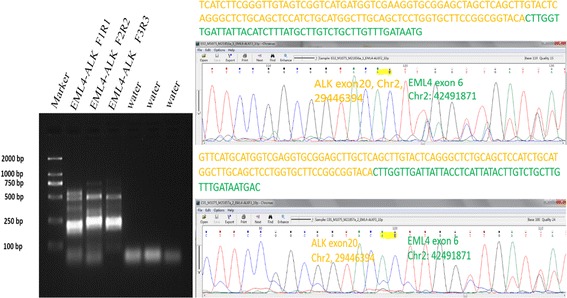
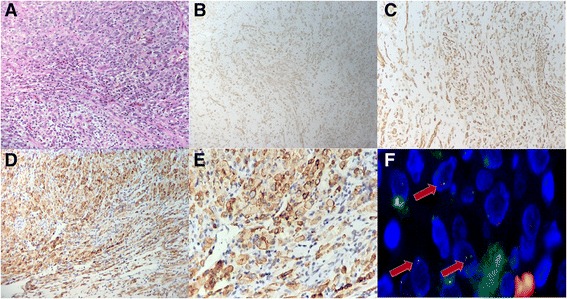
RNAseq was conducted to find out the new ALK fusion gene which could not be detected following previously reported RT-PCR methods for EIMS cases with RANBP2-ALK fusion gene. After that, RT-PCR was also conducted to further prove the newly found fusion gene. Immunohistochemistry (IHC) and fluorescence in situ hybridization (FISH) test were applied to find out the unique morphological characters compared with the previous reported EIMS cases.
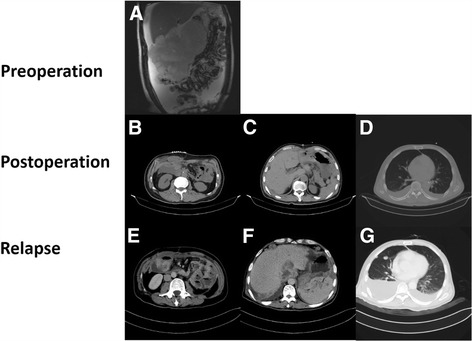
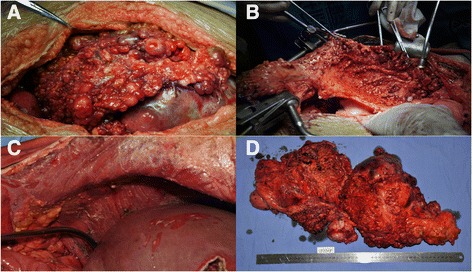
We found an EIMS case who was suffering from a rapid recurrence after cytoreducyive surgery was done to relieve the exacerbating symptoms. The patient finally died for tumor lysis syndrome after the application of crizotinib. Distinctive ALK staining under the membrane and relatively weak ALK staining in the cytoplasm could also be observed. RNAseq and RT-PCR further revealed that the tumor harbored an EML4-ALK fusion gene.
In conclusion, this is the first EIMS demonstrated to have been caused by the formation of an EML4-ALK fusion gene. This enriches the spectrum of EIMS and enlarges the horizon for the study of EIMS. The experience we shared in managing this kind of disease by discussing aspects of its success and failure could be of great value for surgeons and pathologists.
大多数炎性肌纤维母细胞瘤(IMT)被认为是具有中等恶性潜能的实体瘤,只要肿瘤能完整切除,大多可治愈。然而,在某些情况下,肿瘤在成功手术后会复发并迅速生长。其中一些肿瘤被归类为上皮样炎性肌纤维母细胞肉瘤(EIMS)。此前报道的大多数EIMS是由RANBP2-ALK融合基因引起的。我们在此报告一例由EML4-ALK融合基因引起的EIMS病例。
进行RNA测序以找出新的ALK融合基因,对于先前报道的具有RANBP2-ALK融合基因的EIMS病例,采用逆转录聚合酶链反应(RT-PCR)方法无法检测到该基因。之后,也进行RT-PCR以进一步证实新发现的融合基因。应用免疫组织化学(IHC)和荧光原位杂交(FISH)试验,以找出与先前报道的EIMS病例相比独特的形态学特征。
我们发现一例EIMS病例,在进行减瘤手术后症状加重,随后肿瘤迅速复发。患者在应用克唑替尼后最终死于肿瘤溶解综合征。还可观察到膜下明显的ALK染色以及细胞质中相对较弱的ALK染色。RNA测序和RT-PCR进一步显示该肿瘤含有EML4-ALK融合基因。
总之,这是首例被证明由EML4-ALK融合基因形成引起的EIMS。这丰富了EIMS的谱系,拓宽了EIMS的研究视野。我们通过讨论这种疾病治疗的成败所分享的经验,对外科医生和病理学家可能具有重要价值。