López Maria, Blasco Lucia, Gato Eva, Perez Astrid, Fernández-Garcia Laura, Martínez-Martinez Luis, Fernández-Cuenca Felipe, Rodríguez-Baño Jesús, Pascual Alvaro, Bou German, Tomás Maria
Department of Microbiology, Complejo Hospitalario Universitario A Coruña-INIBICLa Coruña, Spain.
Spanish Network for Research in Infectious Diseases (REIPI RD12/0015), Hospital Virgen MacarenaSeville, Spain.
Front Cell Infect Microbiol. 2017 May 9;7:143. doi: 10.3389/fcimb.2017.00143. eCollection 2017.
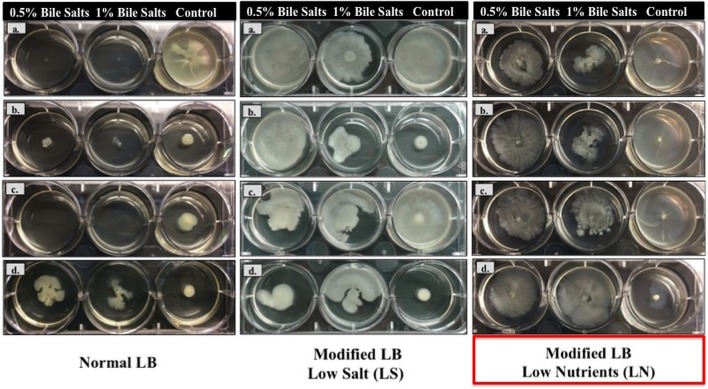
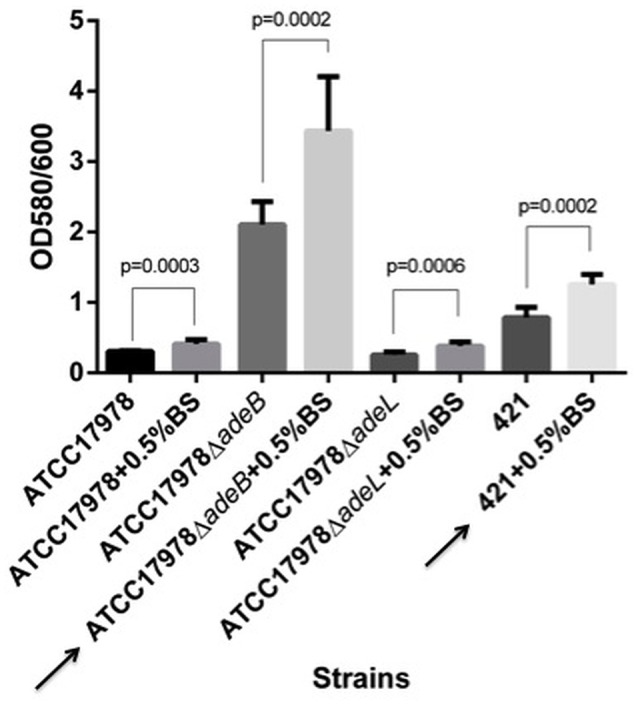
is an opportunistic nosocomial pathogen associated with multiple infections. This pathogen usually colonizes (first stage of microbial infection) host tissues that are in contact with the external environment. As one of the sites of entry in human hosts is the gastrointestinal tract, the pathogen must be capable of tolerating bile salts. However, studies analyzing the molecular characteristics involved in the response to bile salts in clinical strains of are scarce. Microbiological and transcriptional studies (arrays and RT-PCR) in the response to bile salts were carried out in isogenic ( Δ ATCC 17978 and Δ ATCC 17978) and clinical strains from clone ST79/PFGE-HUI-1 which is characterized by lacking the AdeABC efflux pump and by overexpression the AdeFGH efflux pump. In presence of bile salts, in addition to the glutamate/aspartate transporter were found overexpressed in Δ ATCC 17978, the virulence factors (surface motility, biofilm, and Type VI Secretion System) which are associated with activation of the Quorum Sensing system. Overexpression of these factors was confirmed in clinical strains of clone ST79/PFGE-HUI-1. This the first study about the adaptive response to bile salts investigating the molecular and microbiological characteristics in response to bile salts of an isogenic model of ATCC 17978 and clinical isolates of (clinical strains of ST79/PFGE-HUI-1) lacking the main RND efflux pump (AdeABC). Clinical isolates of lacking the AdeABC efflux pump (clone ST79/PFGE-HUI-1) displayed a new clinical profile (increased invasiveness) possibly associated with the response to stress conditions (such as the presence of bile salts).
是一种与多种感染相关的机会性医院病原体。这种病原体通常定殖(微生物感染的第一阶段)于与外部环境接触的宿主组织。由于人类宿主的进入部位之一是胃肠道,该病原体必须能够耐受胆盐。然而,分析临床菌株中胆盐反应所涉及分子特征的研究很少。对缺乏主要RND外排泵(AdeABC)的同基因菌株(ΔATCC 17978和ΔATCC 17978)以及来自克隆ST79/PFGE-HUI-1的临床菌株进行了胆盐反应的微生物学和转录研究(阵列和RT-PCR),该克隆的特征是缺乏AdeABC外排泵且AdeFGH外排泵过表达。在存在胆盐的情况下,除了在ΔATCC 17978中发现谷氨酸/天冬氨酸转运蛋白过表达外,还发现了与群体感应系统激活相关的毒力因子(表面运动性、生物膜和VI型分泌系统)。这些因子的过表达在克隆ST79/PFGE-HUI-1的临床菌株中得到证实。这是第一项关于对胆盐适应性反应的研究,调查了ATCC 17978同基因模型和缺乏主要RND外排泵(AdeABC)的临床分离株(ST79/PFGE-HUI-1临床菌株)对胆盐反应的分子和微生物学特征。缺乏AdeABC外排泵的临床分离株(克隆ST79/PFGE-HUI-1)表现出一种新的临床特征(侵袭性增加),可能与对应激条件(如存在胆盐)的反应有关。