Zhong Weijie, Xu Xin, Zhu Zhigang, Du Qinghua, Du Hong, Yang Li, Ling Yanying, Xiong Huabao, Li Qingshan
Department of Hematology & Oncology, Guangzhou First People's Hospital, Guangzhou Medical University, Guangzhou, China.
Immunology Institute, Mount Sinai School of Medicine, New York, NY, USA.
Oncotarget. 2017 Jul 25;8(30):49757-49772. doi: 10.18632/oncotarget.17693.
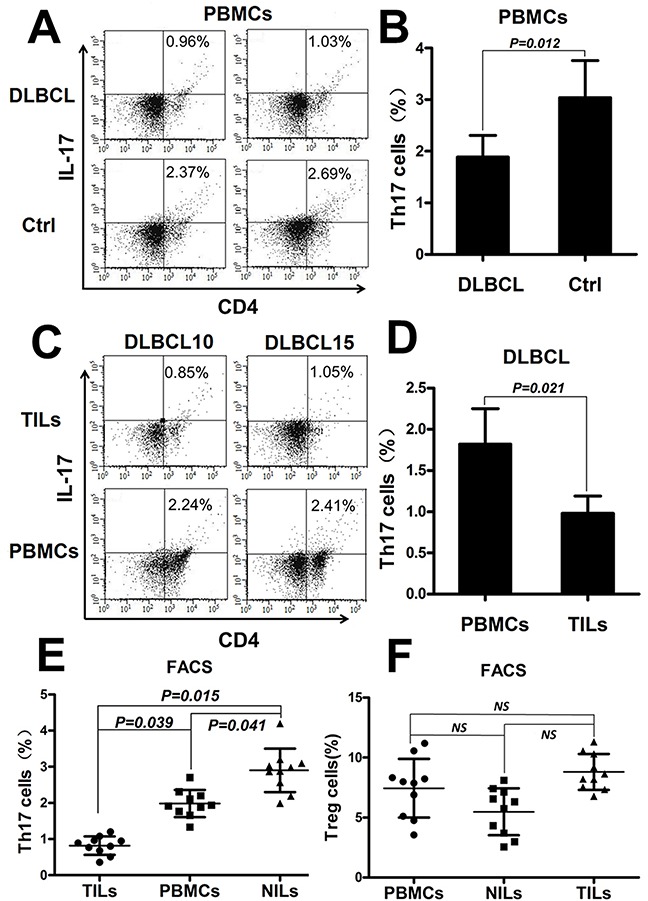
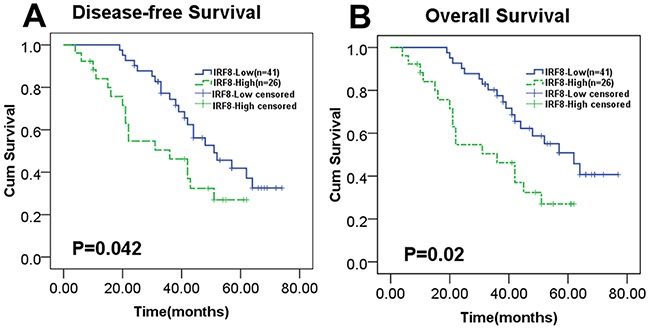
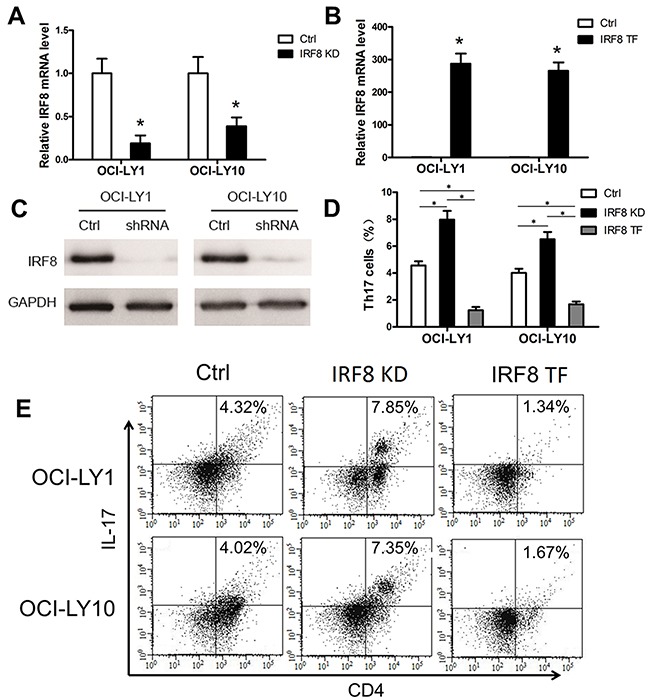
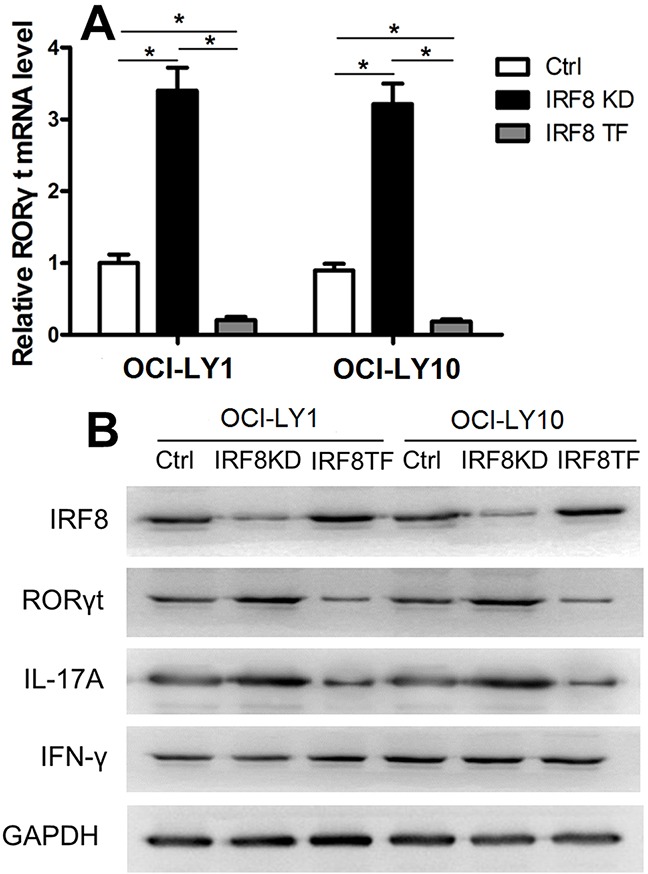
The immunological pathogenesis of diffuse large B cell lymphoma (DLBCL) remains elusive. Searching for new prognostic markers of DLBCL is a crucial focal point for clinical scientists. The aim of the present study was to examine the prognostic value of interferon regulatory factor 8 (IRF8) expression and its effect on the development of Th17 cells in the tumor microenvironment of DLBCL patients. Flow cytometry, immunohistochemistry, and quantitative real-time PCR were used to detect the distribution of Th17 cells and related cytokines and IRF8 in tumor tissues from DLBCL patients. Two DLBCL cell lines (OCI-LY10 and OCI-LY1) with IRF8 knockdown or overexpression and two human B lymphoblast cell lines were co-cultured with peripheral blood mononuclear cells (PBMCs) in vitro to determine the effect of IRF8 on the generation of Th17 cells. Quantitative real-time PCR and Western blotting were used to investigate the involvement of retinoic acid receptor-related orphan receptor gamma t (RORγt) in the effect of IRF8 on Th17 cell generation. The survival of 67 DLBCL patients was estimated using the Kaplan-Meier method and log-rank analysis. The percentage of Th17 cells was lower in DLBCL tumor tissues than in PBMCs and corresponding adjacent benign tissues. Relative expression of interleukin (IL)-17A was lower, whereas that of interferon (IFN)-γ was higher in tumor tissues than in benign tissues. Co-culture with DLBCL cell lines inhibited the generation of Th17 cells in vitro. IRF8 upregulation was detected in DLBCL tumor tissues, and it was associated with decreased DLBCL patient survival. Investigation of the underlying mechanism suggested that IRF8 upregulation in DLBCL, through an unknown mechanism, inhibited Th17 cell generation by suppressing RORγt in neighboring CD4+ T cells. Tumor cells may express soluble or membrane-bound factors that inhibit the expression of RORγt in T cells within the tumor microenvironment. Our findings suggest that IRF8 expression could be a prognostic factor for DLBCL.
弥漫性大B细胞淋巴瘤(DLBCL)的免疫发病机制仍不清楚。寻找DLBCL新的预后标志物是临床科学家的一个关键焦点。本研究的目的是检测干扰素调节因子8(IRF8)表达的预后价值及其对DLBCL患者肿瘤微环境中Th17细胞发育的影响。采用流式细胞术、免疫组织化学和定量实时PCR检测DLBCL患者肿瘤组织中Th17细胞、相关细胞因子及IRF8的分布。将两种IRF8敲低或过表达的DLBCL细胞系(OCI-LY10和OCI-LY1)以及两个人类B淋巴母细胞系与外周血单个核细胞(PBMC)在体外共培养,以确定IRF8对Th17细胞生成的影响。采用定量实时PCR和蛋白质印迹法研究维甲酸受体相关孤儿受体γt(RORγt)在IRF8对Th17细胞生成影响中的作用。采用Kaplan-Meier法和对数秩检验分析评估67例DLBCL患者的生存率。DLBCL肿瘤组织中Th17细胞的百分比低于PBMC和相应的相邻良性组织。肿瘤组织中白细胞介素(IL)-17A的相对表达较低,而干扰素(IFN)-γ的相对表达高于良性组织。与DLBCL细胞系共培养可在体外抑制Th17细胞的生成。在DLBCL肿瘤组织中检测到IRF8上调,且其与DLBCL患者生存率降低有关。对潜在机制的研究表明,DLBCL中IRF8上调通过未知机制抑制邻近CD4+T细胞中的RORγt,从而抑制Th17细胞生成。肿瘤细胞可能表达可溶性或膜结合因子,抑制肿瘤微环境中T细胞中RORγt的表达。我们的研究结果表明,IRF8表达可能是DLBCL的一个预后因素。