Vreede Andrew P, Bockenstedt Paula L, Knight Jason S
aDivision of Rheumatology bDivision of Hematology, Department of Internal Medicine, University of Michigan Medical School, Ann Arbor, Michigan, USA.
Curr Opin Rheumatol. 2017 Sep;29(5):458-466. doi: 10.1097/BOR.0000000000000410.
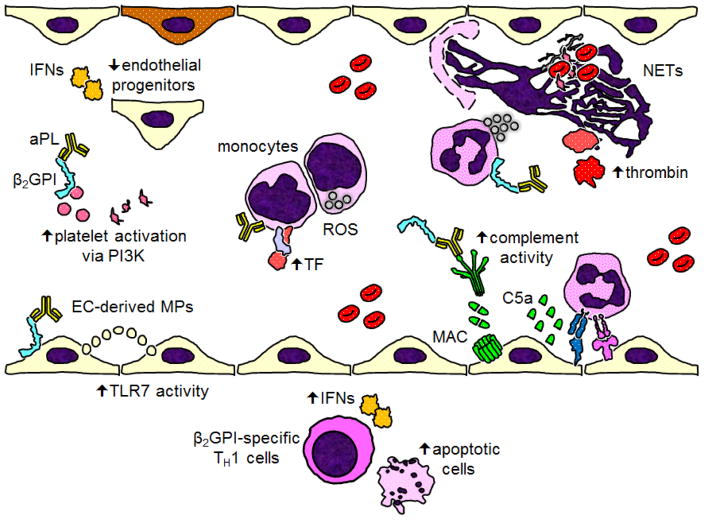
Antiphospholipid syndrome (APS) is a leading acquired cause of thrombosis and pregnancy loss. Upon diagnosis (which is unlikely to be made until at least one morbid event has occurred), anticoagulant medications are typically prescribed in an attempt to prevent future events. This approach is not uniformly effective and does not prevent associated autoimmune and inflammatory complications. The goal of this review is to update clinicians and scientists on mechanistic and clinically relevant studies from the past 18 months, which have especially focused on inflammatory aspects of APS pathophysiology.
How antiphospholipid antibodies leverage receptors and signaling pathways to activate cells is being increasingly defined. Although established mediators of disease pathogenesis (like endothelial cells and the complement system) continue to receive intensive study, emerging concepts (such as the role of neutrophils) are also receiving increasing attention. In-vivo animal studies and small clinical trials are demonstrating how repurposed medications (hydroxychloroquine, statins, and rivaroxaban) may have clinical benefit in APS, with these concepts importantly supported by mechanistic data.
As anticoagulant medications are not uniformly effective and do not comprehensively target the underlying pathophysiology of APS, there is a continued need to reveal the inflammatory aspects of APS, which may be modulated by novel and repurposed therapies.
抗磷脂综合征(APS)是导致血栓形成和妊娠丢失的主要后天性病因。一旦确诊(通常至少在发生一次不良事件后才能确诊),通常会开具抗凝药物以预防未来事件。这种方法并非始终有效,也无法预防相关的自身免疫和炎症并发症。本综述的目的是向临床医生和科学家介绍过去18个月中有关机制和临床相关研究的最新情况,这些研究特别关注APS病理生理学的炎症方面。
抗磷脂抗体如何利用受体和信号通路激活细胞正日益明确。尽管疾病发病机制的既定介质(如内皮细胞和补体系统)仍在接受深入研究,但新出现的概念(如中性粒细胞的作用)也受到越来越多的关注。体内动物研究和小型临床试验正在证明,重新利用的药物(羟氯喹、他汀类药物和利伐沙班)可能对APS具有临床益处,这些概念得到了机制数据的重要支持。
由于抗凝药物并非始终有效,且不能全面针对APS的潜在病理生理学,因此持续需要揭示APS的炎症方面,这可能会通过新的和重新利用的疗法进行调节。