Department of Endocrinology and Diabetes, The First Affiliated Hospital, Xiamen University, Xiamen, China.
School of Medicine, Xiamen University, Xiamen, China.
Sci Rep. 2017 May 24;7(1):2383. doi: 10.1038/s41598-017-02631-1.
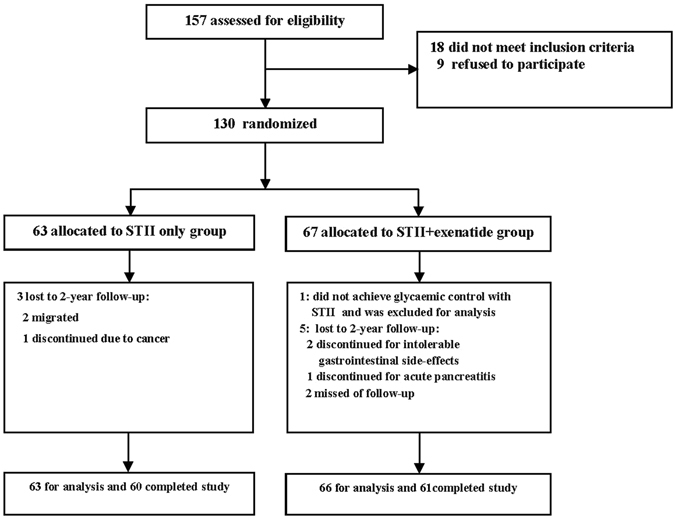
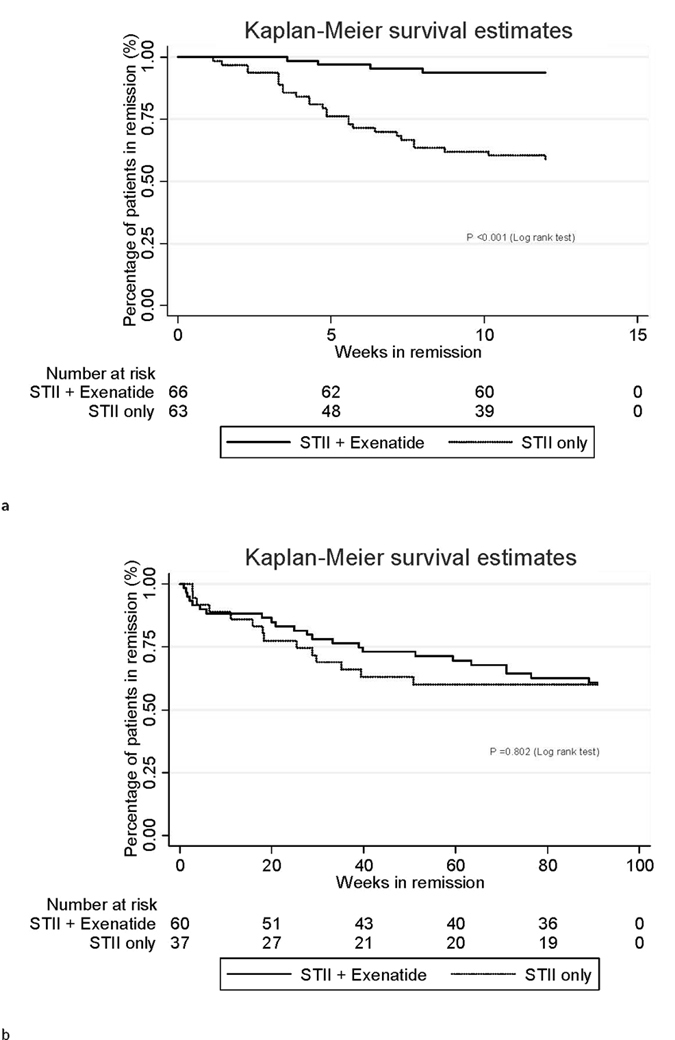
Early short-term intensive insulin (STII) therapy can induce drug-free glycemic remission for up to 1 year in half of newly diagnosed type 2 diabetic mellitus (T2DM) patients. Whether exenatide following STII therapy will induce higher long-term glycaemic remission is currently unknown. To assess the effect of STII+ exenatide therapy, compared with STII only, on maintenance of glycaemic remission in newly diagnosed T2DM patients. In this randomized, parallel-group, open-label, controlled trial, 129 patients (66 in STII+ exenatide group and 63 in STII only group) firstly completed 3-week STII therapy, then STII+ exenatide group was treated with exenatide for 12 weeks further. The cumulative probabilities of 1-year and 2-year glycaemic remission in STII+ exenatide group were 68.2 ± 5.7% and 53.0 ± 6.1%, which were significantly higher than STII only group (36.5 ± 6.1% and 31.8 ± 5.9%) (p-values < 0.001). Patients in STII+ exenatide group, compared with STII only group, showed significantly decreased levels of waist (82.2 (81.0, 83.5) cm v.s. 84.2 (82.7, 85.7) cm, p = 0.048) and HbA1c (5.83 (5.60, 6.06)% v.s. 6.49 (6.20, 6.77)%, p < 0.001) after 12-week exenatide treatment, but these differences disappeared after 1-year and 2-year follow-up. As conclusions, Improved effect of sequential exenatide after STII therapy on maintenance of glycaemic remission only occurred during exenatide treatment and lost upon treatment cessation.
新诊断的 2 型糖尿病患者中,早期短期强化胰岛素(STII)治疗可使一半患者达到长达 1 年的无药物血糖缓解。目前尚不清楚艾塞那肽治疗 STII 后是否会诱导更高的长期血糖缓解。评估 STII+艾塞那肽治疗与仅 STII 治疗相比,对新诊断的 2 型糖尿病患者维持血糖缓解的效果。在这项随机、平行组、开放标签、对照试验中,129 名患者(STII+艾塞那肽组 66 名,仅 STII 组 63 名)首先完成了 3 周的 STII 治疗,然后 STII+艾塞那肽组进一步接受了 12 周的艾塞那肽治疗。STII+艾塞那肽组的 1 年和 2 年血糖缓解累积概率分别为 68.2±5.7%和 53.0±6.1%,显著高于仅 STII 组(36.5±6.1%和 31.8±5.9%)(p 值均<0.001)。与仅 STII 组相比,STII+艾塞那肽组患者的腰围(82.2(81.0,83.5)cm 比 84.2(82.7,85.7)cm,p=0.048)和 HbA1c(5.83(5.60,6.06)%比 6.49(6.20,6.77)%,p<0.001)水平在 12 周艾塞那肽治疗后显著降低,但在 1 年和 2 年随访后这些差异消失。总之,STII 后序贯艾塞那肽治疗对血糖缓解的维持效果仅在艾塞那肽治疗期间发生,停药后即消失。