Gudipaty Lalitha, Rosenfeld Nora K, Fuller Carissa S, Gallop Robert, Schutta Mark H, Rickels Michael R
Division of Endocrinology, Diabetes, and Metabolism, Department of Medicine, Perelman School of Medicine at the University of Pennsylvania, Philadelphia, PA.
Department of Mathematics, West Chester University of Pennsylvania, West Chester, PA.
Diabetes Care. 2014 Sep;37(9):2451-8. doi: 10.2337/dc14-0398. Epub 2014 Jun 26.
Agents that augment GLP-1 effects enhance glucose-dependent β-cell insulin production and secretion and thus are hoped to prevent progressive impairment in insulin secretion characteristic of type 2 diabetes (T2D). The purpose of this study was to evaluate GLP-1 effects on β-cell secretory capacity, an in vivo measure of functional β-cell mass, early in the course of T2D.
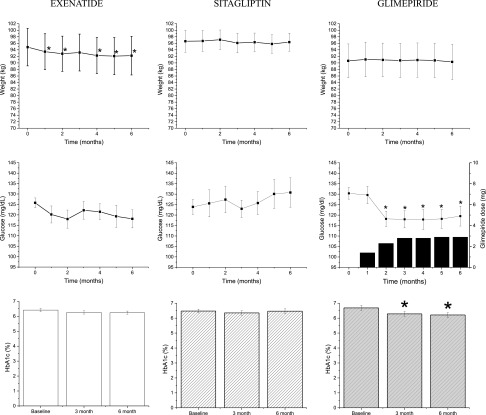
We conducted a randomized controlled trial in 40 subjects with early T2D who received the GLP-1 analog exenatide (n = 14), the dipeptidyl peptidase IV inhibitor sitagliptin (n = 12), or the sulfonylurea glimepiride (n = 14) as an active comparator insulin secretagogue for 6 months. Acute insulin responses to arginine (AIRarg) were measured at baseline and after 6 months of treatment with 5 days of drug washout under fasting, 230 mg/dL (glucose potentiation of arginine-induced insulin release [AIRpot]), and 340 mg/dL (maximum arginine-induced insulin release [AIRmax]) hyperglycemic clamp conditions, in which AIRmax provides the β-cell secretory capacity.
The change in AIRpot was significantly greater with glimepiride versus exenatide treatment (P < 0.05), and a similar trend was notable for the change in AIRmax (P = 0.1). Within each group, the primary outcome measure, AIRmax, was unchanged after 6 months of treatment with exenatide or sitagliptin compared with baseline but was increased with glimepiride (P < 0.05). α-Cell glucagon secretion (AGRmin) was also increased with glimepiride treatment (P < 0.05), and the change in AGRmin trended higher with glimepiride than with exenatide (P = 0.06).
After 6 months of treatment, exenatide or sitagliptin had no significant effect on functional β-cell mass as measured by β-cell secretory capacity, whereas glimepiride appeared to enhance β- and α-cell secretion.
增强胰高血糖素样肽-1(GLP-1)作用的药物可增强葡萄糖依赖性β细胞胰岛素的产生和分泌,因此有望预防2型糖尿病(T2D)特征性的胰岛素分泌进行性损害。本研究的目的是在T2D病程早期评估GLP-1对β细胞分泌能力(功能性β细胞量的一项体内测量指标)的影响。
我们对40例早期T2D患者进行了一项随机对照试验,这些患者接受GLP-1类似物艾塞那肽(n = 14)、二肽基肽酶IV抑制剂西他列汀(n = 12)或磺脲类药物格列美脲(n = 14)作为活性对照胰岛素促分泌剂,治疗6个月。在基线时以及在禁食、230 mg/dL(精氨酸诱导胰岛素释放的葡萄糖增强作用 [AIRpot])和340 mg/dL(最大精氨酸诱导胰岛素释放 [AIRmax])高血糖钳夹条件下进行5天药物洗脱的6个月治疗后,测量对精氨酸的急性胰岛素反应(AIRarg),其中AIRmax可反映β细胞分泌能力。
与艾塞那肽治疗相比,格列美脲治疗后AIRpot的变化显著更大(P < 0.05),AIRmax的变化也有类似趋势(P = 0.1)。在每组中,主要结局指标AIRmax在接受艾塞那肽或西他列汀治疗6个月后与基线相比无变化,但格列美脲治疗后升高(P < 0.05)。格列美脲治疗后α细胞胰高血糖素分泌(AGRmin)也增加(P < 0.05),AGRmin的变化格列美脲组比艾塞那肽组更高(P = 0.06)。
治疗6个月后,通过β细胞分泌能力测量,艾塞那肽或西他列汀对功能性β细胞量无显著影响,而格列美脲似乎增强了β细胞和α细胞的分泌。