Baus Cristina, Bas Jesús, Calabria Marco, Costa Albert
Center for Brain and Cognition, Universitat Pompeu FabraBarcelona, Spain.
Institució Catalana de Recerca i Estudis AvançatsBarcelona, Spain.
Front Psychol. 2017 May 9;8:709. doi: 10.3389/fpsyg.2017.00709. eCollection 2017.
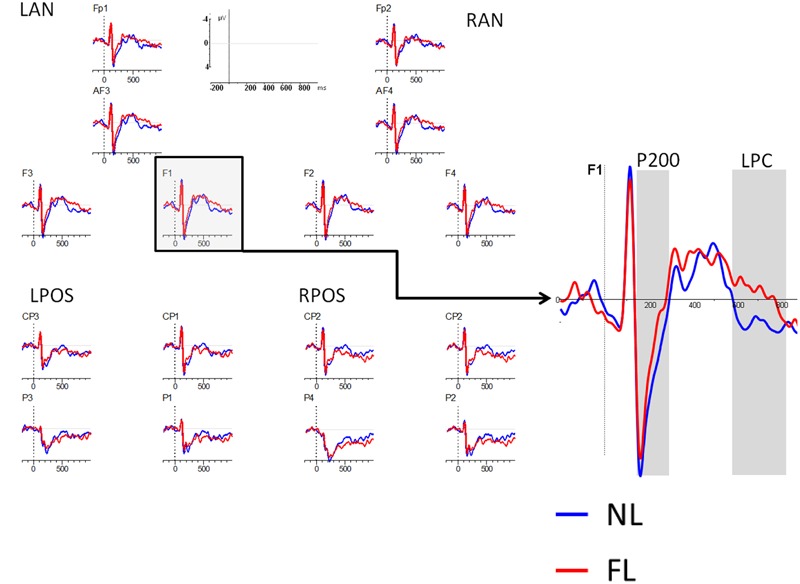
Here we investigated how the language in which a person addresses us, native or foreign, influences subsequent face recognition. In an old/new paradigm, we explored the behavioral and electrophysiological activity associated with face recognition memory. Participants were first presented with faces accompanied by voices speaking either in their native (NL) or foreign language (FL). Faces were then presented in isolation and participants decided whether the face was presented before (old) or not (new). The results revealed that participants were more accurate at remembering faces previously paired with their native as opposed to their FL. At the event-related potential (ERP) level, we obtained evidence that faces in the NL were differently encoded from those in the FL condition, potentially due to differences in processing demands. During recognition, the frontal old/new effect was present (with a difference in latency) regardless of the language with which a face was associated, while the parietal old/new effect appeared only for faces associated with the native language. These results suggest that the language of our social interactions has an impact on the memory processes underlying the recognition of individuals.
在此,我们研究了一个人称呼我们时使用的语言,无论是母语还是外语,如何影响后续的人脸识别。在一个旧/新范式中,我们探索了与人脸识别记忆相关的行为和电生理活动。参与者首先看到的是伴随着用母语(NL)或外语(FL)说话的声音的面孔。然后面孔单独呈现,参与者判断该面孔之前是否出现过(旧面孔)或未出现过(新面孔)。结果显示,与外语相比,参与者在记住之前与母语配对的面孔方面更准确。在事件相关电位(ERP)水平上,我们获得的证据表明,母语条件下的面孔与外语条件下的面孔编码方式不同,这可能是由于处理需求的差异。在识别过程中,无论面孔与哪种语言相关联,额叶旧/新效应都会出现(潜伏期存在差异),而顶叶旧/新效应仅在与母语相关联的面孔中出现。这些结果表明,我们社交互动中的语言会对个体识别所基于的记忆过程产生影响。