Gallazzi Enrico, Drago Lorenzo, Baldini Andrea, Stockley Ian, George David A, Scarponi Sara, Romanò Carlo L
Department of Reconstructive Surgery of Osteo-articular Infections, I.R.C.C.S. Galeazzi Orthopaedic Institute, Milano, Italy.
Laboratory of Clinical Chemistry and Microbiology, I.R.C.C.S. Galeazzi Orthopaedic Institute, Milan, Italy.
J Bone Jt Infect. 2017 Feb 4;2(2):107-113. doi: 10.7150/jbji.18308. eCollection 2017.
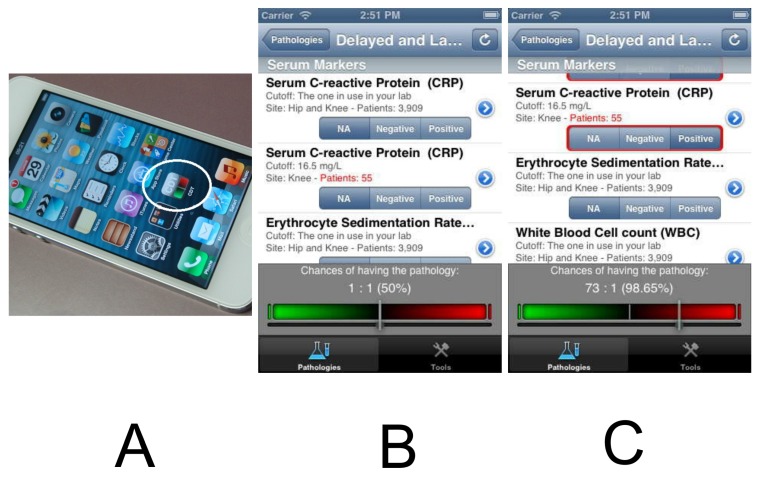
: Differentiating between septic and aseptic joint prosthesis may be challenging, since no single test is able to confirm or rule out infection. The choice and interpretation of the panel of tests performed in any case often relies on empirical evaluation and poorly validated scores. The "Combined Diagnostic Tool (CDT)" App, a smartphone application for iOS, was developed to allow to automatically calculate the probability of having a of periprosthetic joint infection, on the basis of the relative sensitivity and specificity of the positive and negative diagnostic tests performed in any given patient. : The aim of the present study was to apply the CDT software to investigate the ability of the tests routinely performed in three high-volume European centers to diagnose a periprosthetic infection. : This three-center retrospective study included 120 consecutive patients undergoing total hip or knee revision, and included 65 infected patients (Group A) and 55 patients without infection (Group B). The following parameters were evaluated: number and type of positive and negative diagnostic tests performed pre-, intra- and post-operatively and resultant probability calculated by the CDT App of having a peri-prosthetic joint infection, based on pre-, intra- and post-operative combined tests. : Serological tests were the most common performed, with an average 2.7 tests per patient for Group A and 2.2 for Group B, followed by joint aspiration (0.9 and 0.8 tests per patient, respectively) and imaging techniques (0.5 and 0.2 test per patient). Mean CDT App calculated probability of having an infection based on pre-operative tests was 79.4% for patients in Group A and 35.7 in Group B. Twenty-nine patients in Group A had > 10% chance of not having an infection, and 29 of Group B had > 10% chance of having an infection. : This is the first retrospective study focused on investigating the number and type of tests commonly performed prior to joint revision surgery and aimed at evaluating their combined ability to diagnose a peri-prosthetic infection. CDT App allowed us to demonstrate that, on average, the routine combination of commonly used tests is unable to diagnose pre-operatively a peri-prosthetic infection with a probability higher than 90%.
区分感染性和无菌性关节假体可能具有挑战性,因为没有单一的检测方法能够确诊或排除感染。在任何情况下,所进行的一系列检测的选择和解读往往依赖于经验评估和验证不佳的评分。“联合诊断工具(CDT)”应用程序是一款适用于iOS的智能手机应用程序,旨在根据在任何给定患者中进行的阳性和阴性诊断检测的相对敏感性和特异性,自动计算发生假体周围关节感染的概率。本研究的目的是应用CDT软件来研究在欧洲三个大型中心常规进行的检测诊断假体周围感染的能力。这项三中心回顾性研究纳入了120例连续接受全髋关节或膝关节翻修手术的患者,其中包括65例感染患者(A组)和55例未感染患者(B组)。评估了以下参数:术前、术中和术后进行的阳性和阴性诊断检测的数量和类型,以及根据术前、术中和术后联合检测结果由CDT应用程序计算的发生假体周围关节感染的概率。血清学检测是最常进行的检测,A组患者平均每人进行2.7次检测,B组为2.2次,其次是关节穿刺(分别为每人0.9次和0.8次检测)和成像技术(每人0.5次和0.2次检测)。根据术前检测结果,CDT应用程序计算的A组患者感染概率平均为79.4%,B组为35.7%。A组中有29例患者无感染机会>10%,B组中有29例患者感染机会>10%。这是第一项回顾性研究,重点是调查关节翻修手术前通常进行的检测的数量和类型,并旨在评估它们联合诊断假体周围感染的能力。CDT应用程序使我们能够证明,平均而言,常用检测的常规组合在术前无法以高于90%的概率诊断假体周围感染。