Lee Kyoung Hwa, Lee Ji Un, Ku Nam Su, Jeong Su Jin, Han Sang Hoon, Choi Jun Yong, Song Young Goo, Kim June Myung
Department of Internal Medicine, Yonsei University College of Medicine, Seoul, Korea.
Division of Infectious Diseases, Department of Internal Medicine, Hongik Hospital, Seoul, Korea.
Yonsei Med J. 2017 Jul;58(4):770-777. doi: 10.3349/ymj.2017.58.4.770.
Tenofovir disoproxil fumarate (TDF) is commonly prescribed as a fixed-dose, co-formulated antiretroviral drug for HIV-1 infection. The major concern of long-term TDF use is renal dysfunction. However, little is known about the long-term patterns of changes in renal function in HIV-infected Koreans receiving TDF.
We prospectively followed 50 HIV-infected Koreans, performing laboratory tests every 3 months during the first year and every 6 months for the next 2 years. Urine N-acetyl-β-D-glucosaminidase (NAG) and plasma cystatin-C were measured using samples collected in the first year. Data on renal function were retrospectively collected on HIV-infected patients receiving first-line TDF (n=40) and in antiretroviral therapy (ART)-naïve patients (n=24) for 3 years. Renal function was evaluated as estimated glomerular filtration rate (eGFR) from serum creatinine [Modification of Diet in Renal Disease (MDRD)] and cystatin-C.
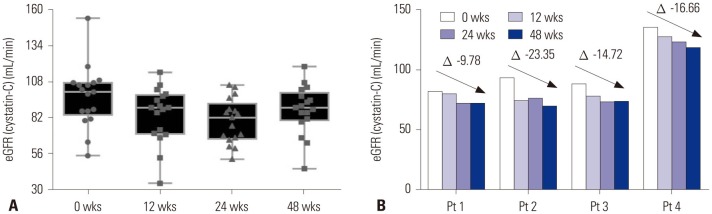
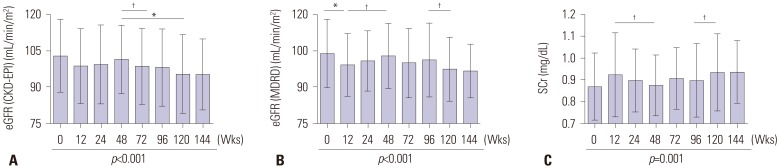
The eGFR (cystatin-C) showed significant changes from 0 to 48 wks (p=0.002), with the lowest levels at 24 wks (84.3±18.8 mL/min vs. 90.3±22.5 mL/min, p=0.021 by post hoc test). Urine NAG levels did not differ at 0, 12, 24, and 48 wks, although eGFR (MDRD) significantly decreased from 0 (98.7±18.9 mL/min/1.73 m²) to 144 wks (89.0±14.7 mL/min/1.73 m²) (p=0.010). The first-line TDF group had significantly lower eGFR (MDRD) than the ART-naïve group at 144 wks (89.7 mL/min/1.73 m² vs. 98.4 mL/min/1.73 m², p=0.036). Thirteen (26%) participants experienced a decrease in renal impairment of 10 mL/min/1.73 m² in eGFR (MDRD) at 144 wks.
These data suggest that clinically meaningful renal injury can develop in HIV-infected Koreans receiving long-term TDF.
富马酸替诺福韦二吡呋酯(TDF)通常作为一种固定剂量的复方抗逆转录病毒药物用于治疗HIV-1感染。长期使用TDF的主要担忧是肾功能障碍。然而,对于接受TDF治疗的韩国HIV感染者肾功能变化的长期模式知之甚少。
我们对50名韩国HIV感染者进行了前瞻性随访,在第一年每3个月进行一次实验室检查,在接下来的2年中每6个月进行一次。使用第一年采集的样本测量尿N-乙酰-β-D-氨基葡萄糖苷酶(NAG)和血浆胱抑素C。回顾性收集接受一线TDF治疗的HIV感染者(n = 40)和未接受抗逆转录病毒治疗(ART)的患者(n = 24)3年的肾功能数据。根据血清肌酐[肾脏病饮食改良(MDRD)]和胱抑素C评估肾功能,计算估计肾小球滤过率(eGFR)。
eGFR(胱抑素C)在0至48周有显著变化(p = 0.002),在24周时最低(84.3±18.8 mL/min对比90.3±22.5 mL/min,事后检验p = 0.021)。尿NAG水平在0、12、24和48周时无差异,尽管eGFR(MDRD)从0周(98.7±18.9 mL/min/1.73 m²)显著降至144周(89.0±14.7 mL/min/1.73 m²)(p = 0.010)。在144周时,一线TDF组的eGFR(MDRD)显著低于未接受ART治疗的组(89.7 mL/min/1.73 m²对比98.4 mL/min/1.73 m²,p = 0.036)。13名(26%)参与者在144周时eGFR(MDRD)出现了每1.73 m²下降10 mL/min的肾功能损害。
这些数据表明,接受长期TDF治疗的韩国HIV感染者可能会出现具有临床意义的肾损伤。