Zhang Wei, Bailey-Elkin Ben A, Knaap Robert C M, Khare Baldeep, Dalebout Tim J, Johnson Garrett G, van Kasteren Puck B, McLeish Nigel J, Gu Jun, He Wenguang, Kikkert Marjolein, Mark Brian L, Sidhu Sachdev S
Donnelly Centre for Cellular and Biomolecular Research, Banting and Best Department of Medical Research, and Department of Molecular Genetics, University of Toronto, Toronto, Ontario, Canada.
Department of Microbiology, University of Manitoba, Winnipeg, Manitoba, Canada.
PLoS Pathog. 2017 May 18;13(5):e1006372. doi: 10.1371/journal.ppat.1006372. eCollection 2017 May.
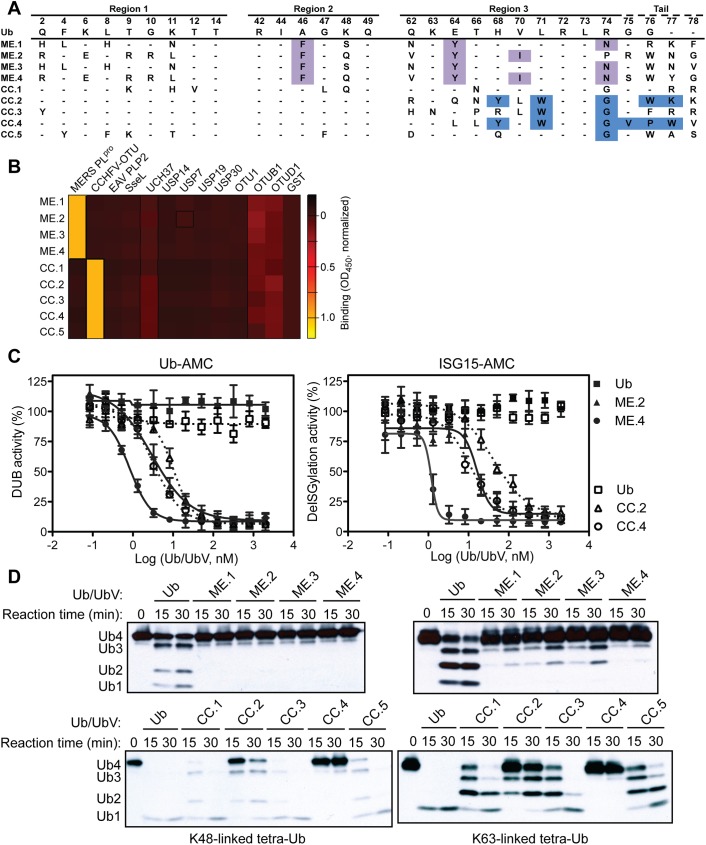
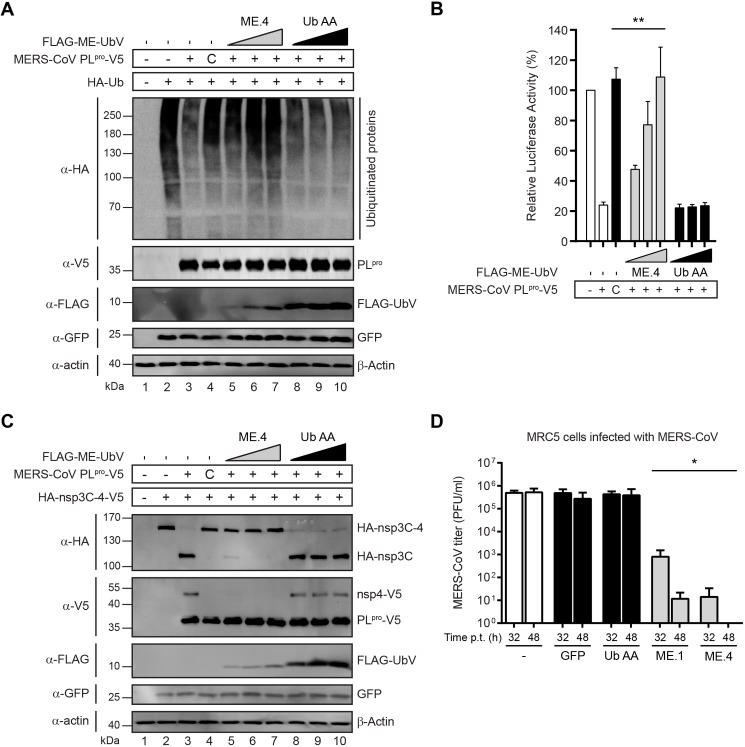
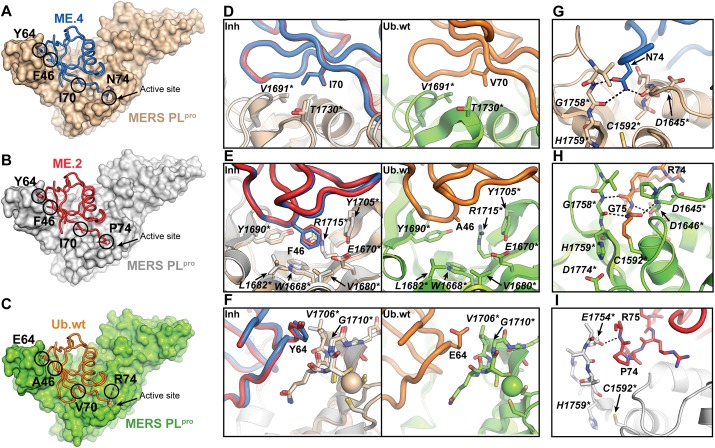
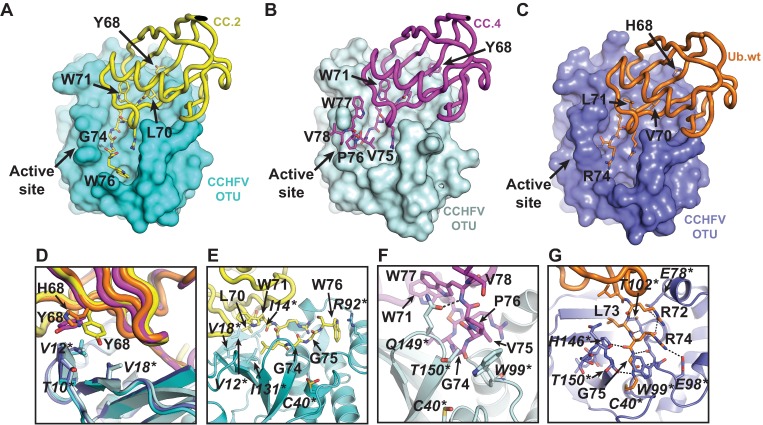
The recent Middle East respiratory syndrome coronavirus (MERS-CoV), Ebola and Zika virus outbreaks exemplify the continued threat of (re-)emerging viruses to human health, and our inability to rapidly develop effective therapeutic countermeasures. Many viruses, including MERS-CoV and the Crimean-Congo hemorrhagic fever virus (CCHFV) encode deubiquitinating (DUB) enzymes that are critical for viral replication and pathogenicity. They bind and remove ubiquitin (Ub) and interferon stimulated gene 15 (ISG15) from cellular proteins to suppress host antiviral innate immune responses. A variety of viral DUBs (vDUBs), including the MERS-CoV papain-like protease, are responsible for cleaving the viral replicase polyproteins during replication, and are thereby critical components of the viral replication cycle. Together, this makes vDUBs highly attractive antiviral drug targets. However, structural similarity between the catalytic cores of vDUBs and human DUBs complicates the development of selective small molecule vDUB inhibitors. We have thus developed an alternative strategy to target the vDUB activity through a rational protein design approach. Here, we report the use of phage-displayed ubiquitin variant (UbV) libraries to rapidly identify potent and highly selective protein-based inhibitors targeting the DUB domains of MERS-CoV and CCHFV. UbVs bound the vDUBs with high affinity and specificity to inhibit deubiquitination, deISGylation and in the case of MERS-CoV also viral replicative polyprotein processing. Co-crystallization studies further revealed critical molecular interactions between UbVs and MERS-CoV or CCHFV vDUBs, accounting for the observed binding specificity and high affinity. Finally, expression of UbVs during MERS-CoV infection reduced infectious progeny titers by more than four orders of magnitude, demonstrating the remarkable potency of UbVs as antiviral agents. Our results thereby establish a strategy to produce protein-based inhibitors that could protect against a diverse range of viruses by providing UbVs via mRNA or protein delivery technologies or through transgenic techniques.
近期中东呼吸综合征冠状病毒(MERS-CoV)、埃博拉病毒和寨卡病毒的爆发,体现了新出现的(或再次出现的)病毒对人类健康持续构成的威胁,以及我们在迅速开发有效治疗对策方面的无能。许多病毒,包括MERS-CoV和克里米亚-刚果出血热病毒(CCHFV),都编码去泛素化(DUB)酶,这些酶对病毒复制和致病性至关重要。它们结合并从细胞蛋白中去除泛素(Ub)和干扰素刺激基因15(ISG15),以抑制宿主抗病毒先天免疫反应。多种病毒DUB(vDUB),包括MERS-CoV木瓜样蛋白酶,在复制过程中负责切割病毒复制酶多聚蛋白,因此是病毒复制周期的关键组成部分。综上所述,这使得vDUB成为极具吸引力的抗病毒药物靶点。然而,vDUB的催化核心与人DUB之间的结构相似性,使选择性小分子vDUB抑制剂的开发变得复杂。因此,我们通过合理的蛋白质设计方法,开发了一种针对vDUB活性的替代策略。在此,我们报告了利用噬菌体展示泛素变体(UbV)文库,快速鉴定针对MERS-CoV和CCHFV的DUB结构域的强效且高度选择性的基于蛋白质的抑制剂。UbV以高亲和力和特异性结合vDUB,以抑制去泛素化、去ISGylation,对于MERS-CoV而言,还能抑制病毒复制性多聚蛋白的加工。共结晶研究进一步揭示了UbV与MERS-CoV或CCHFV vDUB之间的关键分子相互作用,解释了观察到的结合特异性和高亲和力。最后,在MERS-CoV感染期间表达UbV可使感染后代滴度降低超过四个数量级,证明了UbV作为抗病毒剂的显著效力。我们的结果从而确立了一种生产基于蛋白质的抑制剂的策略,该抑制剂可通过mRNA或蛋白质递送技术或通过转基因技术提供UbV,从而预防多种病毒。