Korkmaz Filiz T, Kerr David E
Cellular, Molecular and Biomedical Sciences Program, University of Vermont, 89 Beaumont Avenue, C141C Given, Burlington, VT, 05405, USA.
Department of Animal and Veterinary Sciences, University of Vermont, 570 Main Street, 213 Terrill Hall, Burlington, VT, 05405, USA.
BMC Genomics. 2017 May 25;18(1):405. doi: 10.1186/s12864-017-3796-1.
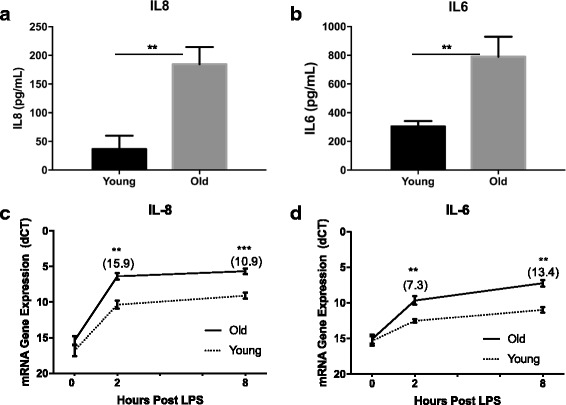
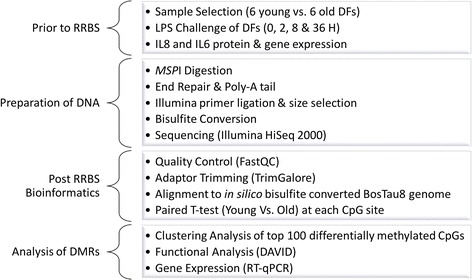
Differences in DNA methylation are known to contribute to the development of immune-related disorders in humans but relatively little is known about how methylation regulates immune function in cattle. Utilizing whole-transcriptome analyses of bovine dermal fibroblasts, we have previously identified an age and breed-dependent up-regulation of genes within the toll-like receptor 4 (TLR4) pathway that correlates with enhanced fibroblast production of IL-8 in response to lipopolysaccharide (LPS). Age-dependent differences in IL-8 production are abolished by treatment with 5-aza-2-deoxycytidine and Trichostatin A (AZA-TSA), suggesting epigenetic regulation of the innate response to LPS. In the current study, we performed reduced representation bisulfite sequencing (RRBS) on fibroblast cultures isolated from the same animals at 5- and 16-months of age to identify genes that exhibit variable methylation with age. To validate the role of methylation in gene expression, six innate response genes that were hyper-methylated in young animals were assessed by RT-qPCR in fibroblasts from animals at different ages and from different breeds.
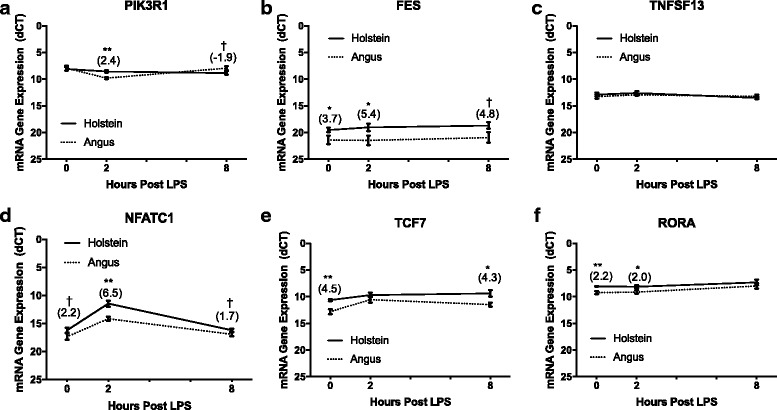
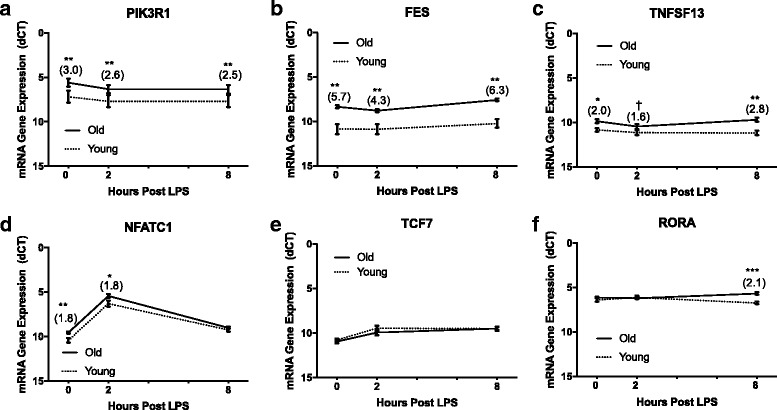
We identified 14,094 differentially methylated CpGs (DMCs) that differed between fibroblast cultures at 5- versus 16-months of age. Of the 5065 DMCs that fell within gene regions, 1117 were located within promoters, 1057 were within gene exons and 2891 were within gene introns and 67% were more methylated in young cultures. Transcription factor enrichment of the promoter regions hyper-methylated in young cultures revealed significant regulation by the key pro-inflammatory regulator, NF-κB. Additionally, five out of six chosen genes (PIK3R1, FES, NFATC1, TNFSF13 and RORA) that were more methylated in young cultures showed a significant reduction in expression post-LPS treatment in comparison with older cultures. Two of these genes, FES and NFATC1, were similarly down-regulated in Angus cultures that also exhibit a low LPS response phenotype.
Our study has identified immune-related loci regulated by DNA methylation in cattle that may contribute to differential cellular response to LPS, two of which exhibit an identical expression profile in both low-responding age and breed phenotypes. Methylation biomarkers of differential immunity may prove useful in developing selection strategies for replacement cows that are less susceptible to severe infections, such as coliform mastitis.
已知DNA甲基化差异会导致人类免疫相关疾病的发生,但关于甲基化如何调节牛的免疫功能,人们了解相对较少。利用牛皮肤成纤维细胞的全转录组分析,我们之前已经确定了Toll样受体4(TLR4)通路中基因的年龄和品种依赖性上调,这与成纤维细胞在响应脂多糖(LPS)时IL-8的产生增加相关。用5-氮杂-2'-脱氧胞苷和曲古抑菌素A(AZA-TSA)处理可消除IL-8产生的年龄依赖性差异,这表明LPS先天反应存在表观遗传调控。在本研究中,我们对从5月龄和16月龄同一动物分离的成纤维细胞培养物进行了简化代表性亚硫酸氢盐测序(RRBS),以鉴定随年龄呈现可变甲基化的基因。为了验证甲基化在基因表达中的作用,通过RT-qPCR对来自不同年龄和不同品种动物的成纤维细胞中6个在幼年动物中高甲基化的先天反应基因进行了评估。
我们鉴定出14,094个差异甲基化CpG(DMC),它们在5月龄和成纤维细胞培养物与16月龄的成纤维细胞培养物之间存在差异。在位于基因区域的5065个DMC中,1117个位于启动子内,1057个位于基因外显子内,2891个位于基因内含子内,并且67%在幼年培养物中甲基化程度更高。幼年培养物中高甲基化启动子区域的转录因子富集显示关键促炎调节因子NF-κB有显著调控作用。此外,在幼年培养物中甲基化程度更高的六个选定基因中的五个(PIK3R1、FES、NFATC1、TNFSF13和RORA)与老年培养物相比,在LPS处理后表达显著降低。其中两个基因,FES和NFATC1,在同样表现出低LPS反应表型的安格斯培养物中也有类似的下调。
我们的研究已经确定了牛中受DNA甲基化调控的免疫相关基因座,这些基因座可能导致细胞对LPS的不同反应,其中两个在低反应年龄和品种表型中表现出相同的表达谱。差异免疫的甲基化生物标志物可能有助于制定针对不易感染严重感染(如大肠杆菌性乳腺炎)的后备奶牛的选择策略。