Ballou Sarah, Kaptchuk Ted J, Hirsch William, Nee Judy, Iturrino Johanna, Hall Kathryn T, Kelley John M, Cheng Vivian, Kirsch Irving, Jacobson Eric, Conboy Lisa, Lembo Anthony, Davis Roger B
Department of Medicine, Division of Gastroenterology, Beth Israel Deaconess Medical Center, 330 Brookline Avenue, Boston, MA, 02215, USA.
Program in Placebo Studies, Beth Israel Deaconess Medical Center/Harvard Medical School, 330 Brookline Avenue, Boston, MA, 02215, USA.
Trials. 2017 May 25;18(1):234. doi: 10.1186/s13063-017-1964-x.
Placebo medications, by definition, are composed of inactive ingredients that have no physiological effect on symptoms. Nonetheless, administration of placebo in randomized controlled trials (RCTs) and in clinical settings has been demonstrated to have significant impact on many physical and psychological complaints. Until recently, conventional wisdom has suggested that patients must believe that placebo pills actually contain (or, at least, might possibly contain) active medication in order to elicit a response to placebo. However, several recent RCTs, including patients with irritable bowel syndrome (IBS), chronic low back pain, and episodic migraine, have demonstrated that individuals receiving open-label placebo (OLP) can still experience symptomatic improvement and benefit from honestly described placebo treatment.
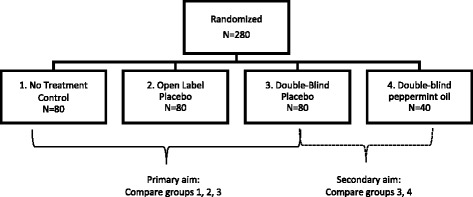
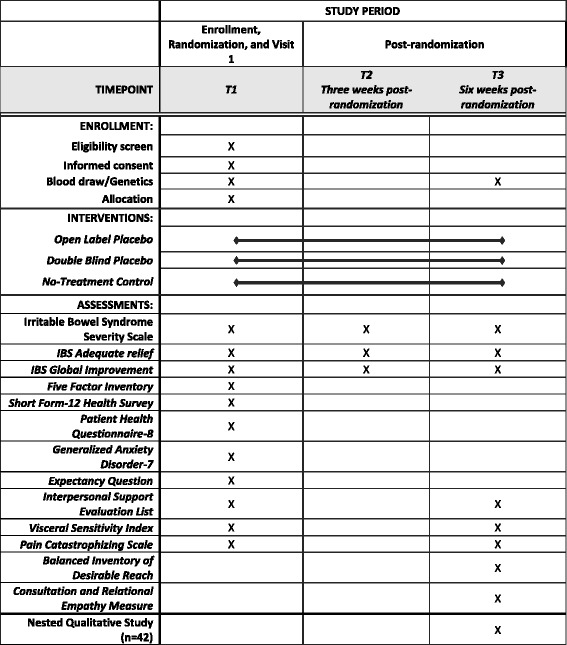
This paper describes an innovative multidisciplinary trial design (n = 280) that attempts to replicate and expand upon an earlier IBS OLP study. The current study will compare OLP to double-blind placebo (DBP) administration which is made possible by including a nested, double-blind RCT comparing DBP and peppermint oil. The study also examines possible genetic and psychological predictors of OLP and seeks to better understand participants' experiences with OLP and DBP through a series of extensive interviews with a randomly selected subgroup.
OLP treatment is a novel strategy for ethically harnessing placebo effects. It has potential to re-frame theories of placebo and to influence how physicians can optimize watch-and-wait strategies for common, subjective symptoms. The current study aims to dramatically expand what we know about OLP by comparing, for the first time, OLP and DBP administration. Adopting a unique, multidisciplinary approach, the study also explores genetic, psychological and experiential dimensions of OLP. The paper ends with an extensive discussion of the "culture" of the trial as well as potential mechanisms of OLP and ethical implications.
ClinicalTrials.gov, identifier: NCT02802241 . Registered on 14 June 2016.
根据定义,安慰剂药物由对症状没有生理作用的非活性成分组成。尽管如此,在随机对照试验(RCT)和临床环境中给予安慰剂已被证明对许多身体和心理不适有显著影响。直到最近,传统观点认为患者必须相信安慰剂药丸实际上含有(或者至少可能含有)活性药物才能对安慰剂产生反应。然而,最近的几项随机对照试验,包括患有肠易激综合征(IBS)、慢性下背痛和发作性偏头痛的患者,已经证明接受开放标签安慰剂(OLP)的个体仍然可以经历症状改善,并从如实描述的安慰剂治疗中受益。
本文描述了一种创新的多学科试验设计(n = 280),该设计试图复制并扩展早期的一项IBS开放标签安慰剂研究。当前的研究将开放标签安慰剂与双盲安慰剂(DBP)给药进行比较,这通过纳入一项比较双盲安慰剂和薄荷油的嵌套双盲随机对照试验得以实现。该研究还考察开放标签安慰剂的可能的遗传和心理预测因素,并通过对一个随机选择的亚组进行一系列广泛访谈,力求更好地了解参与者对开放标签安慰剂和双盲安慰剂的体验。
开放标签安慰剂治疗是一种在伦理上利用安慰剂效应的新策略。它有可能重新构建安慰剂理论,并影响医生如何优化针对常见主观症状的观察等待策略。当前的研究旨在通过首次比较开放标签安慰剂和双盲安慰剂给药,极大地扩展我们对开放标签安慰剂的认识。该研究采用独特的多学科方法,还探索了开放标签安慰剂的遗传、心理和体验维度。本文最后对试验的“文化”以及开放标签安慰剂的潜在机制和伦理意义进行了广泛讨论。
ClinicalTrials.gov,标识符:NCT02802241。于2016年6月14日注册。