Gude Wouter T, Roos-Blom Marie-José, van der Veer Sabine N, de Jonge Evert, Peek Niels, Dongelmans Dave A, de Keizer Nicolette F
Department of Medical Informatics, Academic Medical Center, Amsterdam Public Health research institute, University of Amsterdam, Amsterdam, The Netherlands.
National Intensive Care Evaluation (NICE) foundation, Amsterdam, The Netherlands.
Implement Sci. 2017 May 25;12(1):68. doi: 10.1186/s13012-017-0594-8.
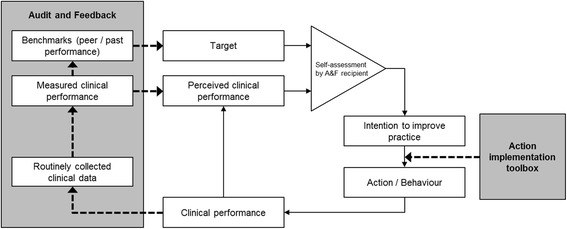
Audit and feedback is often used as a strategy to improve quality of care, however, its effects are variable and often marginal. In order to learn how to design and deliver effective feedback, we need to understand their mechanisms of action. This theory-informed study will investigate how electronic audit and feedback affects improvement intentions (i.e. information-intention gap), and whether an action implementation toolbox with suggested actions and materials helps translating those intentions into action (i.e. intention-behaviour gap). The study will be executed in Dutch intensive care units (ICUs) and will be focused on pain management.
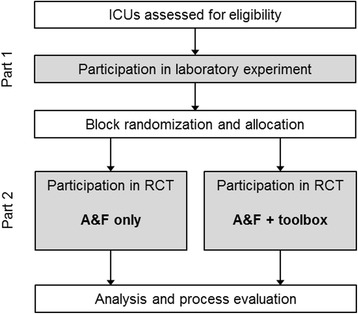
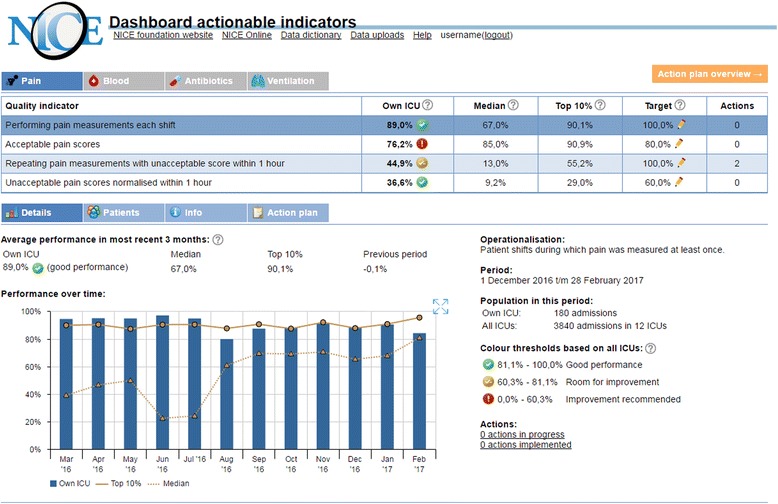
We will conduct a laboratory experiment with individual ICU professionals to assess the impact of feedback on their intentions to improve practice. Next, we will conduct a cluster randomised controlled trial with ICUs allocated to feedback without or feedback with action implementation toolbox group. Participants will not be told explicitly what aspect of the intervention is randomised; they will only be aware that there are two variations of providing feedback. ICUs are eligible for participation if they submit indicator data to the Dutch National Intensive Care Evaluation (NICE) quality registry and agree to allocate a quality improvement team that spends 4 h per month on the intervention. All participating ICUs will receive access to an online quality dashboard that provides two functionalities: gaining insight into clinical performance on pain management indicators and developing action plans. ICUs with access to the toolbox can develop their action plans guided by a list of potential barriers in the care process, associated suggested actions, and supporting materials to facilitate implementation of the actions. The primary outcome measure for the laboratory experiment is the proportion of improvement intentions set by participants that are consistent with recommendations based on peer comparisons; for the randomised trial it is the proportion of patient shifts during which pain has been adequately managed. We will also conduct a process evaluation to understand how the intervention is implemented and used in clinical practice, and how implementation and use affect the intervention's impact.
The results of this study will inform care providers and managers in ICU and other clinical settings how to use indicator-based performance feedback in conjunction with an action implementation toolbox to improve quality of care. Within the ICU context, this study will produce concrete and directly applicable knowledge with respect to what is or is not effective for improving pain management, and under which circumstances. The results will further guide future research that aims to understand the mechanisms behind audit and feedback and contribute to identifying the active ingredients of successful interventions.
ClinicalTrials.gov NCT02922101 . Registered 26 September 2016.
审核与反馈常被用作提高医疗质量的策略,然而,其效果参差不齐且往往有限。为了了解如何设计和提供有效的反馈,我们需要明白其作用机制。这项基于理论的研究将调查电子审核与反馈如何影响改进意愿(即信息 - 意愿差距),以及一个包含建议行动和材料的行动实施工具箱是否有助于将这些意愿转化为行动(即意愿 - 行为差距)。该研究将在荷兰的重症监护病房(ICU)开展,重点关注疼痛管理。
我们将对个体ICU专业人员进行实验室实验,以评估反馈对他们改进实践意愿的影响。接下来,我们将对ICU进行整群随机对照试验,将其分为无行动实施工具箱的反馈组和有行动实施工具箱的反馈组。参与者不会被明确告知干预措施的哪个方面是随机的;他们只会知道有两种提供反馈的方式。如果ICU向荷兰国家重症监护评估(NICE)质量登记处提交指标数据,并同意分配一个每月花4小时进行干预的质量改进团队,那么该ICU就有资格参与。所有参与的ICU都将能够访问一个在线质量仪表板,该仪表板提供两项功能:深入了解疼痛管理指标的临床绩效以及制定行动计划。有权使用工具箱的ICU可以根据护理过程中的潜在障碍列表、相关建议行动以及支持行动实施的材料来制定他们的行动计划。实验室实验的主要结局指标是参与者设定的与基于同行比较的建议一致的改进意愿比例;对于随机试验,主要结局指标是疼痛得到充分管理的患者轮班比例。我们还将进行过程评估,以了解干预措施在临床实践中是如何实施和使用的,以及实施和使用方式如何影响干预效果。
本研究的结果将告知ICU及其他临床环境中的护理提供者和管理人员如何结合行动实施工具箱使用基于指标的绩效反馈来提高医疗质量。在ICU环境中,本研究将产生关于哪些方法对改善疼痛管理有效或无效以及在何种情况下有效或无效的具体且直接适用的知识。研究结果将进一步指导未来旨在理解审核与反馈背后机制的研究,并有助于确定成功干预措施的关键要素。
ClinicalTrials.gov NCT02922101。于2016年9月26日注册。