Vors Cécile, Drai Jocelyne, Pineau Gaëlle, Laville Martine, Vidal Hubert, Laugerette Fabienne, Michalski Marie-Caroline
Univ-Lyon, CarMeN laboratory, INRA U1397, Inserm U1060, Université Claude Bernard Lyon 1, INSA Lyon, Charles Mérieux Medical School, FR-69600, Oullins, France.
Centre de Recherche en Nutrition Humaine Rhône-Alpes (CRNH-RA) and Centre Européen pour la Nutrition et la Santé (CENS), Pierre-Bénite, France.
Lipids Health Dis. 2017 May 25;16(1):97. doi: 10.1186/s12944-017-0486-6.
Postprandial hyperlipemia is recognized as a major cardio-metabolic risk factor, recently linked to the co-absorption of pro-inflammatory lipopolysaccharides with dietary lipids. This causes endotoxemia that is involved in the pathophysiology of obesity and insulin resistance, but to date the impact of food formulation is unknown. We tested a novel concept that endotoxin absorption can be modulated by fat emulsified structure in the meal, and potentially differently in obese vs. lean men.
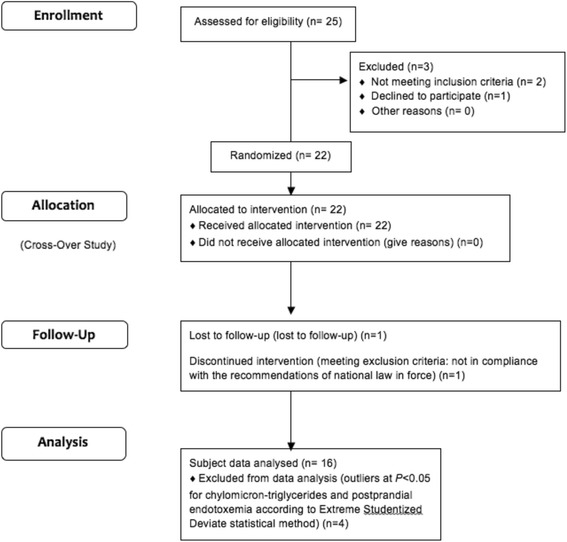
In a randomized controlled crossover study, eight normal-weight and eight obese age-matched healthy men ingested two isocaloric, isolipidic breakfasts of identical composition including 40 g of milk fat that was emulsified or unemulsified. Plasma- and chylomicron-endotoxemia and chylomicron-triglycerides were measured during 8 h after breakfast ingestion.
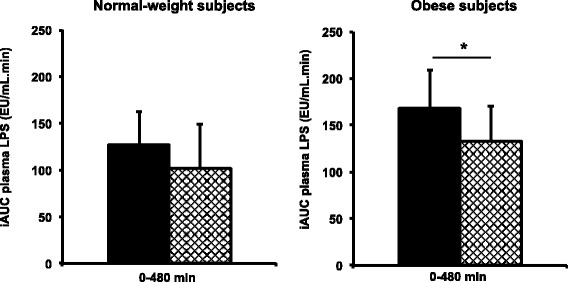
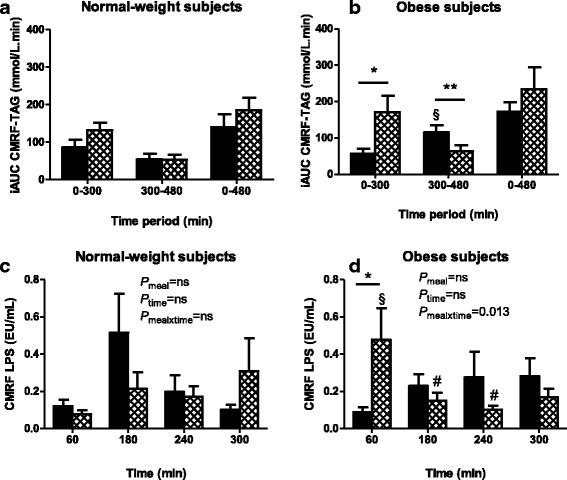
After emulsion consumption, parallel to an enhanced chylomicronemia, obese subjects presented an early and sharp increase in chylomicron-endotoxemia at 60 min (P = 0.02), which was higher than (i) after spread fat in obese subjects (P < 0.05) and (ii) after both spread and emulsified fat in normal-weight subjects (P < 0.05). However in obese subjects, the iAUC of plasma endotoxemia over 8 h was lower after emulsion than after spread fat (P < 0.05) whereas in NW subjects such reduction of plasma LPS-iAUC was not observed (P = 0.67).
This study provides initial evidence that optimizing fat structure in the meal can be part of a dietary strategy to lower the metabolic impact of postprandial endotoxemia in obese men.
Registered at ClinicalTrials.gov # NCT01249378 on July 13, 2010.
餐后高脂血症被认为是主要的心血管代谢危险因素,最近发现其与促炎性脂多糖和膳食脂质的共同吸收有关。这会导致内毒素血症,而内毒素血症参与肥胖症和胰岛素抵抗的病理生理过程,但迄今为止,食物配方的影响尚不清楚。我们测试了一个新的概念,即膳食中脂肪的乳化结构可以调节内毒素的吸收,而且肥胖男性和瘦男性的调节方式可能有所不同。
在一项随机对照交叉研究中,8名体重正常和8名年龄匹配的肥胖健康男性摄入了两种等热量、等脂质且成分相同的早餐,其中包含40克乳化或未乳化的乳脂肪。在摄入早餐后的8小时内,测量血浆和乳糜微粒内毒素血症以及乳糜微粒甘油三酯。
食用乳化脂肪后,与乳糜微粒血症增强同时出现的是,肥胖受试者在60分钟时乳糜微粒内毒素血症出现早期急剧升高(P = 0.02),高于(i)肥胖受试者食用分散脂肪后(P < 0.05)以及(ii)体重正常受试者食用分散脂肪和乳化脂肪后(P < 0.05)。然而,在肥胖受试者中,乳化脂肪后8小时血浆内毒素血症的iAUC低于分散脂肪后(P < 0.05),而在体重正常受试者中未观察到血浆LPS-iAUC的这种降低(P = 0.67)。
本研究提供了初步证据,表明优化膳食中的脂肪结构可以作为一种饮食策略的一部分,以降低餐后内毒素血症对肥胖男性的代谢影响。
于2010年7月13日在ClinicalTrials.gov上注册,注册号为#NCT01249378。