Chen Yung-Fu, Lin Hsuan-Hung, Lin Chih-Sheng, Turbat Battsetseg, Wang Kuo-An, Chung Wei-Sheng
Department of Healthcare Administration.
Department of Dental Technology and Materials Science, Central Taiwan University of Science and Technology, Taichung.
Int J Chron Obstruct Pulmon Dis. 2017 May 10;12:1375-1383. doi: 10.2147/COPD.S126102. eCollection 2017.
Bronchiectasis is characterized by permanent dilatation of the bronchial tree caused by recurrent airway infection and inflammation. The association of atherosclerosis and inflammation is well established. However, studies on the relationship between bronchiectasis and stroke are scant.
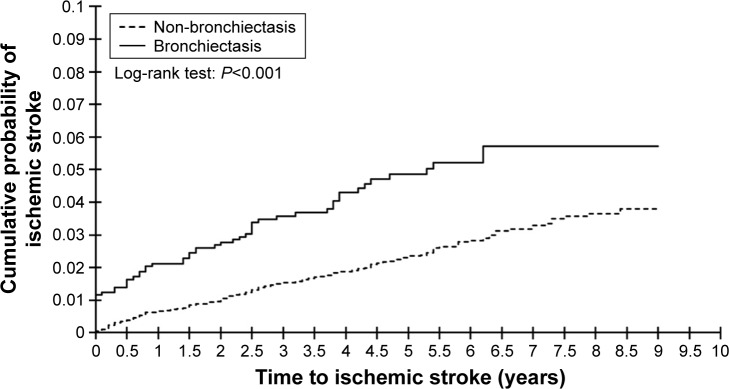
We conducted a population-based cohort study to investigate the incidence and risk of ischemic stroke in patients with bronchiectasis.
Data of 1,295 patients newly diagnosed as bronchiectasis between 2000 and 2008 were retrieved from the Taiwan National Health Insurance Research Database. A total of 6,475 controls without bronchiectasis at a ratio of 5:1 were randomly selected from the general population based on frequency-matched age and sex to the patients. All participants were followed up to the date of ischemic stroke development, censoring, or the end of 2010. The Cox proportional hazard model was used to identify the risk of ischemic stroke in patients with bronchiectasis compared with those without bronchiectasis.
The patients with bronchiectasis exhibited a higher incidence rate of ischemic stroke (9.18 vs 4.66 per 1,000 person-years) than the patients without bronchiectasis, with an adjusted hazard ratio of 1.74 (95% confidence interval =1.28-2.35). The patients with bronchiectasis and any comorbidities exhibited a 2.66-fold adjusted hazard ratio of ischemic stroke compared with those with neither bronchiectasis nor comorbidity (95% confidence interval =1.85-3.84). The patients with bronchiectasis carried a dose response of ischemic stroke according to the number of emergency visits and hospitalizations per year.
This study indicated that bronchiectasis is an independent risk factor of ischemic stroke.
支气管扩张症的特征是由于反复的气道感染和炎症导致支气管树永久性扩张。动脉粥样硬化与炎症之间的关联已得到充分证实。然而,关于支气管扩张症与中风之间关系的研究却很少。
我们进行了一项基于人群的队列研究,以调查支气管扩张症患者缺血性中风的发病率和风险。
从台湾国民健康保险研究数据库中检索了2000年至2008年间新诊断为支气管扩张症的1295例患者的数据。根据年龄和性别与患者频率匹配的原则,从普通人群中随机选取了6475例无支气管扩张症的对照,比例为5:1。所有参与者均随访至缺血性中风发生、审查或2010年底。使用Cox比例风险模型确定支气管扩张症患者与无支气管扩张症患者相比缺血性中风的风险。
支气管扩张症患者缺血性中风的发病率(每1,000人年9.18例 vs 4.66例)高于无支气管扩张症的患者,调整后的风险比为1.74(95%置信区间 = 1.28 - 2.35)。与既无支气管扩张症又无合并症的患者相比,有支气管扩张症且有任何合并症的患者缺血性中风的调整后风险比为2.66倍(95%置信区间 = 1.85 - 3.84)。支气管扩张症患者根据每年的急诊就诊次数和住院次数呈现缺血性中风的剂量反应。
本研究表明支气管扩张症是缺血性中风的独立危险因素。