Luo Han, Yang Hongliu, Wei Tao, Gong Yanping, Su Anping, Ma Yu, Zou Xiuhe, Lei Jianyong, Zhao Wanjun, Zhu Jingqiang
Thyroid & Breast Surgery.
Nephrology.
Ther Clin Risk Manag. 2017 May 15;13:635-641. doi: 10.2147/TCRM.S129910. eCollection 2017.
The optimal approach to detect and treat symptomatic hypocalcemia (SxH) after thyroidectomy is still uncertain. In our retrospective study, we sought to set a standardized postoperative management protocol on the basis of relative change of parathyroid hormone (PTH) and absolute value of postoperative day 1 (POD1) PTH.
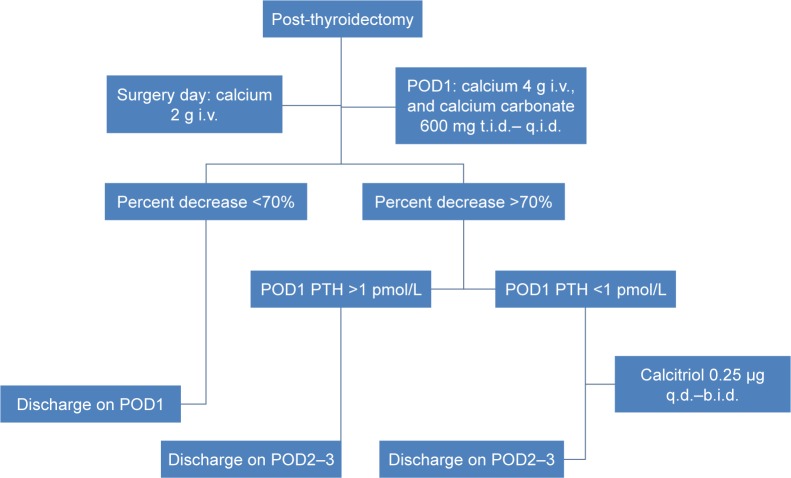
Patients who underwent thyroidectomy were identified retrospectively in our prospective database. Blood was collected 1 day before surgery and on POD1. Extra calcium and calcitriol supplement was prescribed when necessary. Meanwhile, postoperative signs of SxH were treated and recorded in detail. Patients were followed up for 1 month after surgery and then 3 months thereafter.
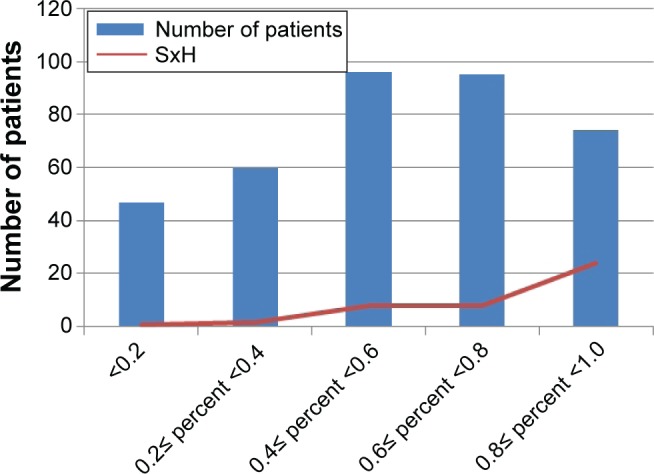
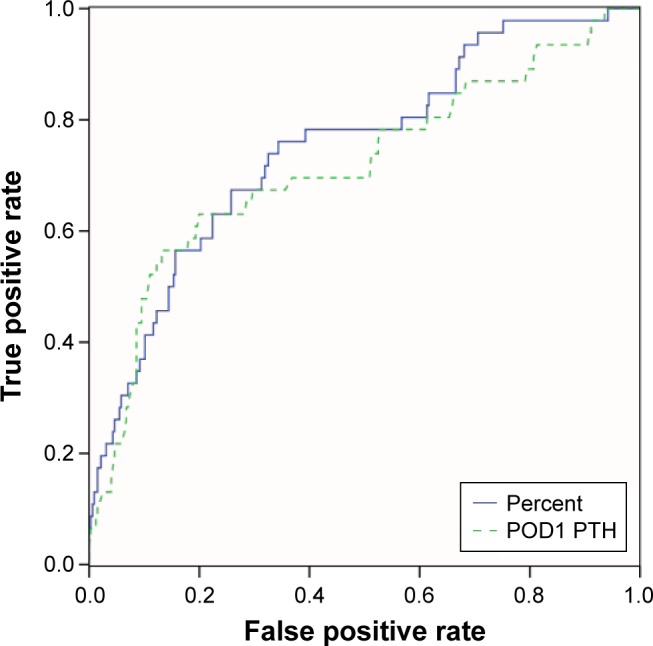
A total of 744 patients were included in the final analysis. Transient SxH occurred in 86 (11.6%) patients, and persistent SxH occurred in 4 (0.54%) patients in more than half year after surgery. Relative decrease of PTH reached its maximal discriminative effect at 70% (area under the curve [AUC] =0.754), with a sensitivity of 72.1% and a specificity of 75%. In Group 1 (≤70%), 24 (4.67%) patients were interpreted as having SxH, whereas in Group 2, 62 (27.0%) patients had SxH (>70%), <0.001. Days of symptom relief in Group 1-1 (1, 2) were significantly shorter than those in Group 2-2 (1, 10), =0.023. In Group 2, 112 (80%) patients with POD1 PTH <1 pmol/L were treated with calcitriol, whereas only 8 (8.89%) patients with POD1 PTH ≥1 pmol/L were treated with calcitriol (<0.001). According to relief of SxH and recovery of parathyroid function, treating with and without calcitriol showed no difference in patients with POD1 PTH <1 and ≥1 pmol/L.
Relative decrease of PTH >70% is a significant risk factor for SxH in post-thyroidectomy. The decreasing percent of PTH ≤70% ensures discharge on POD1, but longer hospitalization was advocated for patients with decreasing percent of PTH >70%, who needed extra calcitriol supplement when POD1 PTH <1 pmol/L.
甲状腺切除术后检测和治疗症状性低钙血症(SxH)的最佳方法仍不明确。在我们的回顾性研究中,我们试图根据甲状旁腺激素(PTH)的相对变化和术后第1天(POD1)PTH的绝对值制定标准化的术后管理方案。
在我们的前瞻性数据库中对接受甲状腺切除术的患者进行回顾性识别。在手术前1天和POD1采集血液。必要时开具额外的钙剂和骨化三醇补充剂。同时,对SxH的术后体征进行治疗并详细记录。患者术后随访1个月,之后再随访3个月。
最终分析共纳入744例患者。86例(11.6%)患者发生短暂性SxH,4例(0.54%)患者在术后半年以上发生持续性SxH。PTH相对下降70%时达到最大鉴别效果(曲线下面积[AUC]=0.754),敏感性为72.1%,特异性为75%。在第1组(≤70%),24例(4.67%)患者被判定为有SxH,而在第2组,62例(27.0%)患者有SxH(>70%),P<0.001。第1-1组(1,2)症状缓解天数明显短于第2-2组(1,10),P=0.023。在第2组中,112例(80%)POD1 PTH<1 pmol/L的患者接受了骨化三醇治疗,而只有8例(8.89%)POD1 PTH≥1 pmol/L的患者接受了骨化三醇治疗(P<0.001)。根据SxH的缓解情况和甲状旁腺功能的恢复情况,POD1 PTH<1和≥1 pmol/L的患者接受或不接受骨化三醇治疗无差异。
PTH相对下降>70%是甲状腺切除术后发生SxH的重要危险因素。PTH下降百分比≤70%可确保患者在POD1出院,但对于PTH下降百分比>70%的患者,建议延长住院时间,当POD1 PTH<1 pmol/L时需要额外补充骨化三醇。