Ermoian Ralph P, Breneman John, Walterhouse David O, Chi Yueh-Yun, Meza Jane, Anderson James, Hawkins Douglas S, Hayes-Jordan Andrea A, Parham David M, Yock Torunn I, Donaldson Sarah S, Wolden Suzanne L
Department of Radiation Oncology, University of Washington, Washington.
Department of Radiation Oncology, University of Cincinnati, Ohio.
Pediatr Blood Cancer. 2017 Sep;64(9). doi: 10.1002/pbc.26540. Epub 2017 May 26.
Recent Children's Oncology Group (COG) trials tested the efficacy of reduced therapy in an effort to lessen late effects compared to the Intergroup Rhabdomyosarcoma Study (IRS) IV regimen with associated hematologic and hepatic toxicity, and infertility. Here, we analyze the efficacy of 45 Gray (Gy) local radiotherapy (RT) in patients with Group III orbital embryonal rhabdomyosarcoma (ERMS) enrolled on the COG low-risk study ARST0331.
Sixty-two patients with Group III orbital ERMS were treated on ARST0331 with four cycles of vincristine (VCR), dactinomycin (DACT), and cyclophosphamide (CPM; VAC, total cumulative CPM dose 4.8 g/m ) followed by four cycles of VCR and DACT over 22 weeks. Forty-five Gray of radiation was administered in 25 fractions beginning at week 13 of therapy.
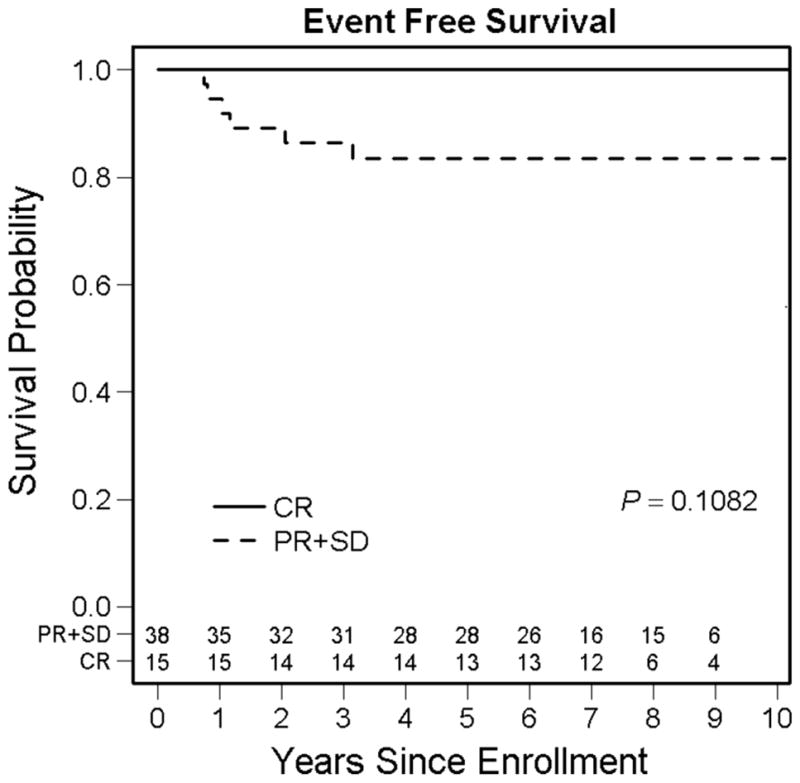
Fifty-three patients were evaluable for this response analysis; seven had missing week 12 response evaluation data and two had progressive disease prior to starting RT. Median follow-up was 7.8 years. None of the 15 patients with radiographic complete response (CR) compared to 6 of the 38 patients with <CR after 12 weeks of VAC chemotherapy had local recurrences (P = 0.11). There was no difference in overall survival by response at week 12 (P = 0.52).
For patients with Group III orbital ERMS achieving a CR following VAC chemotherapy that includes modest dose CPM, 45 Gy may be sufficient for durable failure-free survival. However, for those with <CR treated with the ARST0331 systemic therapy, a different local therapy approach may be needed to achieve the control rate of IRS-IV without its toxicity.
近期儿童肿瘤研究组(COG)开展了多项试验,旨在测试减少治疗强度的疗效,以期与横纹肌肉瘤协作组(IRS)IV方案相比,减轻迟发效应,后者存在相关血液学和肝脏毒性以及不育问题。在此,我们分析了参加COG低危研究ARST0331的III组眼眶胚胎性横纹肌肉瘤(ERMS)患者接受45格雷(Gy)局部放疗(RT)的疗效。
62例III组眼眶ERMS患者参加了ARST0331研究,接受四个周期的长春新碱(VCR)、放线菌素D(DACT)和环磷酰胺(CPM;VAC方案,CPM总累积剂量4.8 g/m²)治疗,随后在22周内接受四个周期的VCR和DACT治疗。从治疗第13周开始,分25次给予45 Gy的放疗。
53例患者可纳入该反应分析;7例患者缺少第12周反应评估数据,2例患者在开始放疗前病情进展。中位随访时间为7.8年。15例影像学完全缓解(CR)的患者中无一例出现局部复发,而38例VAC化疗12周后未达到CR的患者中有6例出现局部复发(P = 0.11)。第12周时的反应情况对总生存无差异(P = 0.52)。
对于接受含适度剂量CPM的VAC化疗后达到CR的III组眼眶ERMS患者,45 Gy的放疗剂量可能足以实现持久的无病生存。然而,对于接受ARST0331全身治疗后未达到CR的患者,可能需要采用不同的局部治疗方法,以达到IRS-IV方案的控制率且无其毒性。