Ruan Yan, He Jianrong, Wu Wei, He Ping, Tian Yanping, Xiao Lan, Liu Gaoke, Wang Jiali, Cheng Yuda, Zhang Shuo, Yang Yi, Xiong Jiaxiang, Zhao Ke, Wan Ying, Huang He, Zhang Junlei, Jian Rui
Laboratory of Stem Cell and Developmental Biology, Department of Histology and Embryology, Third Military Medical University, Chongqing 400038, China.
Biomedical Analysis Center, Third Military Medical University, Chongqing 400038, China.
Oncotarget. 2017 Jul 18;8(29):47607-47618. doi: 10.18632/oncotarget.17744.
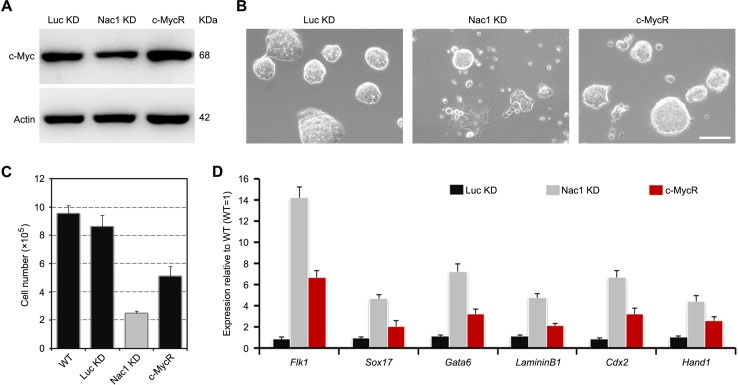
The pluripotency transcriptional network in embryonic stem cells (ESCs) is composed of distinct functional units including the core and Myc units. It is hoped that dissection of the cellular functions and interconnections of network factors will aid our understanding of ESC and cancer biology. Proteomic and genomic approaches have identified Nac1 as a member of the core pluripotency network. However, previous studies have predominantly focused on the role of Nac1 in psychomotor stimulant response and cancer pathogenesis. In this study, we report that Nac1 is a self-renewal promoting factor, but is not required for maintaining pluripotency of ESCs. Loss of function of Nac1 in ESCs results in a reduced proliferation rate and an enhanced differentiation propensity. Nac1 overexpression promotes ESC proliferation and delays ESC differentiation in the absence of leukemia inhibitory factor (LIF). Furthermore, we demonstrated that Nac1 directly binds to the c-Myc promoter and regulates c-Myc transcription. The study also revealed that the function of Nac1 in promoting ESC self-renewal appears to be partially mediated by c-Myc. These findings establish a functional link between the core and c-Myc-centered networks and provide new insights into mechanisms of stemness regulation in ESCs and cancer.
胚胎干细胞(ESC)中的多能性转录网络由不同的功能单元组成,包括核心单元和Myc单元。人们希望剖析网络因子的细胞功能及其相互联系,将有助于我们理解ESC生物学和癌症生物学。蛋白质组学和基因组学方法已将Nac1鉴定为核心多能性网络的成员之一。然而,先前的研究主要集中在Nac1在精神运动兴奋剂反应和癌症发病机制中的作用。在本研究中,我们报告Nac1是一种促进自我更新的因子,但不是维持ESC多能性所必需的。ESC中Nac1功能的丧失导致增殖速率降低和分化倾向增强。在没有白血病抑制因子(LIF)的情况下,Nac1的过表达促进ESC增殖并延迟ESC分化。此外,我们证明Nac1直接结合c-Myc启动子并调节c-Myc转录。该研究还表明,Nac1在促进ESC自我更新中的功能似乎部分由c-Myc介导。这些发现建立了核心网络与以c-Myc为中心的网络之间的功能联系,并为ESC和癌症中干性调节机制提供了新的见解。