Kool Bridget, Wise Michelle R, Peiris-John Roshini, Sadler Lynn, Mahony Faith, Wells Susan
Section of Epidemiology and Biostatistics, School of Population Health, University of Auckland, Auckland, New Zealand.
Department of Obstetrics and Gynaecology, University of Auckland, Auckland, New Zealand.
BMC Med Educ. 2017 May 26;17(1):91. doi: 10.1186/s12909-017-0927-y.
Teaching clinical audit skills to nascent health professionals is one strategy to improve frontline care. The undergraduate medical curriculum at the University of Auckland provides improvement science theory and skills in Year 5 teaching, and the opportunity to put this into practice during an Obstetrics and Gynaecology (O&G) clinical attachment in Year 6. In 2015, a revised medical school curriculum at the university resulted in a planned reduction of the O&G attachment from five weeks to four, necessitating revision of the Year 6 Quality Improvement (QI) project. The aim of this study was to evaluate if the revised programme provided an important experiential learning opportunity for medical students without imposing an unsustainable burden on clinical services.
Based on a CIPP (Context/Input/Process/Product) evaluation model, the study was conducted in several stages to get a sense of the context as the new programme was being planned (Context evaluation), the feasibility of an alternative approach to meet the educational need (Input evaluation), the implementation of the revised programme (Process evaluation) and finally, the programme outcomes (Product evaluation). We used multiple data sources (supervisors, students, academic administrators, and hospital staff) and data collection methods (questionnaires, focus groups, individual interviews, consultative workshops, student reports and oral presentations).
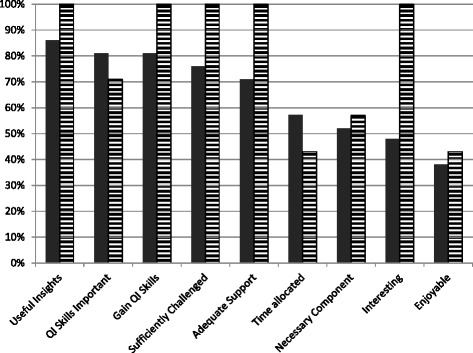
The context evaluation revealed the Year 6 QI programme to be valuable and contributed to O&G service improvements, however, the following concerns were identified: time to complete the project, timely topic selection and access to data, recognition of student achievement, and staff workload. The evaluation of the revised QI project indicated improvement in student perceptions of their QI knowledge and skills, and most areas previously identified as challenging, despite the concurrent reduction in the duration of the O&G attachment.
Applying the CIPP model for evaluation to our revised QI programme enabled streamlining of procedures to achieve greater efficiency without compromising the quality of the learning experience, or increasing pressure on staff. A four week clinical rotation is adequate for medical educators to consider opportunities for including QI projects as part of student experiential learning.
向初出茅庐的卫生专业人员传授临床审计技能是改善一线医疗服务的一种策略。奥克兰大学的本科医学课程在五年级教学中提供改进科学理论和技能,并在六年级的妇产科临床实习期间提供将其付诸实践的机会。2015年,该大学修订后的医学院课程计划将妇产科实习时间从五周减至四周,因此有必要对六年级的质量改进(QI)项目进行修订。本研究的目的是评估修订后的项目是否为医学生提供了重要的体验式学习机会,同时又不会给临床服务带来不可持续的负担。
基于CIPP(背景/输入/过程/产品)评估模型,该研究分几个阶段进行,以了解新计划规划过程中的背景情况(背景评估)、满足教育需求的替代方法的可行性(输入评估)、修订后计划的实施情况(过程评估),最后是计划成果(产品评估)。我们使用了多种数据来源(导师、学生、学术管理人员和医院工作人员)和数据收集方法(问卷调查、焦点小组、个人访谈、咨询研讨会、学生报告和口头陈述)。
背景评估显示六年级的QI项目很有价值,并有助于改善妇产科服务,然而,也发现了以下问题:完成项目的时间、及时选择主题和获取数据、认可学生成绩以及工作人员的工作量。对修订后的QI项目的评估表明,尽管妇产科实习时间同时减少,但学生对其QI知识和技能的认知有所提高,并且之前确定的大多数具有挑战性的领域也有所改善。
将CIPP评估模型应用于我们修订后的QI项目,能够简化程序以提高效率,同时不影响学习体验的质量,也不会增加工作人员的压力。为期四周的临床轮转足以让医学教育工作者考虑将QI项目作为学生体验式学习的一部分。