Shah Kevin P, Goyal Shreya, Ramachandran Vignesh, Kohn Jaden R, Go Jonathan A, Wiley Zachary, Moturu Anoosha, Namireddy Meera K, Kumar Anjali, Jacobs Ryan C, Stampfl Matthew, Shah Jesal R, Fu Justin, Lin Weijie V, Ho Brandon, Wey Grace, Lin Sophie Y, Caruso Andrew C, Gay Lindsey Jordan, Stewart Diana E, Andrabi Sara
Office of Undergraduate Medical Education, Baylor College of Medicine, Houston, TX, USA.
Department of Medicine, Section of General Internal Medicine, Baylor College of Medicine, Houston, TX, USA.
BMC Med Educ. 2020 Apr 23;20(1):126. doi: 10.1186/s12909-020-1982-3.
While the Association of American Medical Colleges encourages medical schools to incorporate quality improvement and patient safety (QI/PS) into their curriculum, medical students continue to have limited QI/PS exposure. To prepare medical students for careers that involve QI/PS, the Institute for Healthcare Improvement chapter at an allopathic medical school and school of allied health professions initiated self-directed learning by offering student-led workshops to equip learners with skills to improve the quality and safety of healthcare processes.
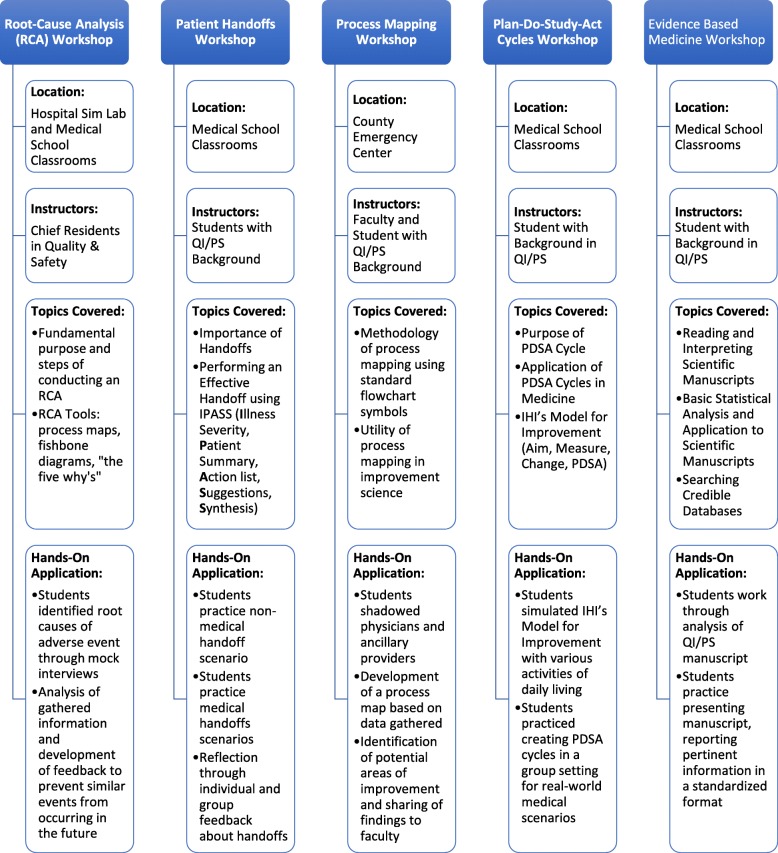
In this prospective cohort study, workshops were hosted for medical students between 2015 and 2018 on five QI/PS topics: Process Mapping, Root-Cause Analysis (RCA), Plan-Do-Study-Act (PDSA) Cycles, Evidence Based Medicine (EBM), and Patient Handoffs. Each workshop included a hands-on component to engage learners in practical applications of QI/PS skills in their careers. Change in knowledge, attitudes, and behaviors was assessed via pre- and post-surveys using 5-point Likert scales, and analyzed using either the McNemar test or non-parametric Wilcoxon signed-rank test. Surveys also gathered qualitative feedback regarding strengths, future areas for improvement, and reasons for attending the workshops.
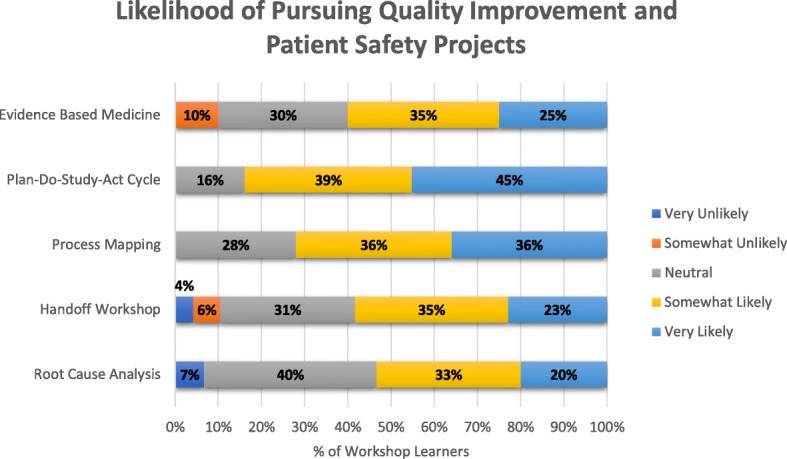
Data was collected from 88.5% of learners (n = 185/209); 19.5% of learners reported prior formal instruction in these topics. Statistically significant improvements in learners' confidence were observed for each workshop. Additionally, after attending workshops, learners felt comfortable teaching the learned QI/PS skill to colleagues (mean pre/post difference 1.96, p < 0.0001, n = 139) and were more likely to pursue QI/PS projects in their careers (mean pre/post difference 0.45, p < 0.0001, n = 139). Lastly, learners demonstrated a statistically significant increase in knowledge in four out of five skills workshop topics.
Few medical students have formal instruction in QI/PS tools. This pilot study highlights advantages of incorporating an innovative, student-directed modified 'flipped classroom' methodology, with a focus on active experiential learning and minimal didactic instruction.
尽管美国医学院协会鼓励医学院校将质量改进和患者安全(QI/PS)纳入课程,但医学生对QI/PS的接触仍然有限。为了让医学生为涉及QI/PS的职业做好准备,一所全科医学院和联合健康职业学院的医疗改进研究所分会通过举办学生主导的研讨会来开展自主学习,以使学习者具备提高医疗保健流程质量和安全性的技能。
在这项前瞻性队列研究中,2015年至2018年期间为医学生举办了关于五个QI/PS主题的研讨会:流程映射、根本原因分析(RCA)、计划-执行-研究-行动(PDSA)循环、循证医学(EBM)和患者交接。每个研讨会都包括一个实践环节,让学习者在其职业中实际应用QI/PS技能。通过使用5点李克特量表的前后调查来评估知识、态度和行为的变化,并使用麦克尼马尔检验或非参数威尔科克森符号秩检验进行分析。调查还收集了关于优势、未来改进领域以及参加研讨会原因的定性反馈。
从88.5%的学习者(n = 185/209)那里收集了数据;19.5%的学习者报告此前曾接受过这些主题的正规教学。每个研讨会都观察到学习者的信心有统计学上的显著提高。此外,参加研讨会后,学习者感到能够自如地向同事传授所学的QI/PS技能(前后平均差异1.96,p < 0.0001,n = 139),并且更有可能在其职业中开展QI/PS项目(前后平均差异0.45,p < 0.0001,n = 139)。最后,学习者在五个技能研讨会主题中的四个主题上的知识有统计学上的显著增加。
很少有医学生接受过QI/PS工具的正规教学。这项试点研究突出了采用创新的、以学生为导向的改良“翻转课堂”方法的优势,该方法侧重于主动体验式学习且减少讲授式教学。