Sortsø Camilla, Lauridsen Jørgen, Emneus Martha, Green Anders, Jensen Peter Bjødstrup
Centre of Health Economics Research (COHERE), Department of Business and Economics, University of Southern Denmark, Campusvej 55, DK-5s30, Odense M, Denmark.
Institute of Applied Economics and Health Research (ApEHR), Copenhagen, Denmark.
Health Econ Rev. 2017 Dec;7(1):21. doi: 10.1186/s13561-017-0155-5. Epub 2017 May 26.
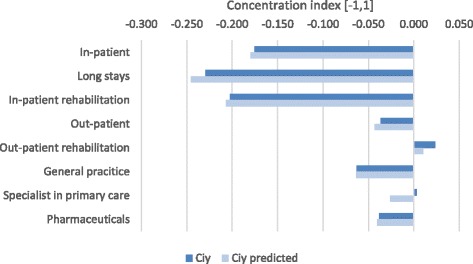
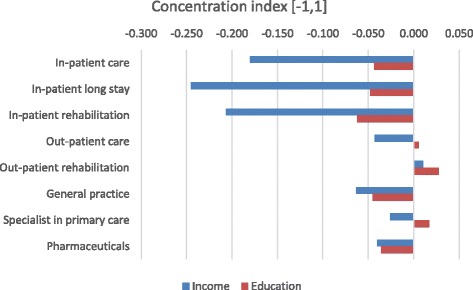
Understanding socioeconomic inequalities in health care is critical for achieving health equity. The aim of this paper is threefold: 1) to quantify inequality in diabetes health care service utilization; 2) to understand determinants of these inequalities in relation to socio-demographic and clinical morbidity factors; and 3) to compare the empirical outcome of using income level and educational level as proxies for Socio Economic Status (SES).Data on the entire Danish population of diabetes patients in 2011 (N = 318,729) were applied. Patients' unique personal identification number enabled individual patient data from several national registers to be linked. A concentration index approach with decomposition into contributing factors was applied. Differences in diabetes patients' health care utilization patterns suggest that use of services differ among patients of lower and higher SES, despite the Danish universal health care system. Especially, out-patient services, rehabilitation and specialists in primary care show different utilization patterns according to SES. Comparison of the empirical outcome from using educational level and income level as proxy for patients' SES indicate important differences in inequality estimates. While income, alike other measures of labor market attachment, to a certain extent is explained by morbidity and thus endogenous, education is more decisive for patients' ability to take advantage of the more specialized services provided in a universal health care system.
了解医疗保健中的社会经济不平等对于实现健康公平至关重要。本文的目的有三个:1)量化糖尿病医疗服务利用方面的不平等;2)了解这些不平等与社会人口和临床发病因素相关的决定因素;3)比较使用收入水平和教育水平作为社会经济地位(SES)代理指标的实证结果。使用了2011年丹麦全体糖尿病患者的数据(N = 318,729)。患者唯一的个人识别号码使得能够将来自几个国家登记处的个体患者数据相链接。采用了一种将集中指数分解为影响因素的方法。糖尿病患者医疗服务利用模式的差异表明,尽管丹麦实行全民医疗保健系统,但社会经济地位较低和较高的患者在服务使用上存在差异。特别是,门诊服务、康复服务和初级保健中的专科服务根据社会经济地位呈现出不同的利用模式。将教育水平和收入水平作为患者社会经济地位代理指标的实证结果比较表明,不平等估计存在重要差异。虽然收入与劳动力市场依附的其他衡量指标一样,在一定程度上由发病率解释,因此是内生的,但教育对于患者利用全民医疗保健系统提供的更专业服务的能力更为关键。