Mosquera Paola A, Waenerlund Anna-Karin, Goicolea Isabel, Gustafsson Per E
Department of Public Health and Clinical Medicine, Unit of Epidemiology and Global Health, Umeå University, Umeå, SE-901 87, Sweden.
Int J Equity Health. 2017 Jan 18;16(1):20. doi: 10.1186/s12939-017-0520-3.
Despite the goal of the Swedish health system to offer health care according to the principle of horizontal equity, little is known about the equality in access to health care use among young people. To explore this issue, the present study aimed i) to assess horizontal inequity in health care utilization among young people in Northern Sweden; and ii) to explore the contribution of different factors to explain the observed inequalities.
Participants (N = 3016 youths aged 16-25 years) came from the "Health on Equal terms" survey conducted in 2014 in the four northernmost counties in Sweden. Concentration indices (C) and horizontal inequity indices (HI) were calculated to measure inequalities in the utilization of two health care services (general practitioners (GP) and youth clinics). The HI was calculated based on health care utilization and variables representing socioeconomic status (household income), health care needs factors and non-need factors affecting health care use. A decomposition analysis was carried out to explain the income-related inequalities.
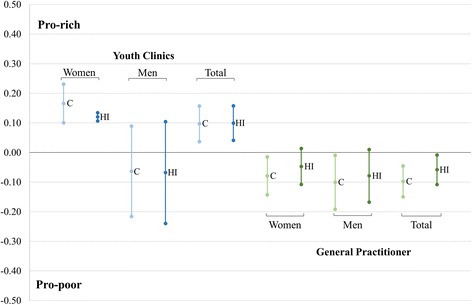
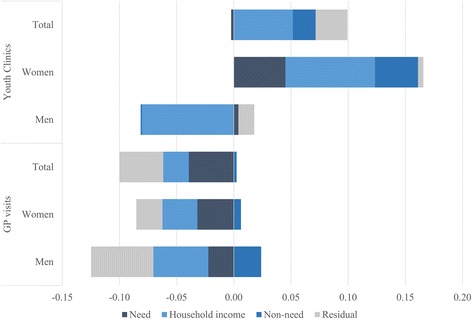
Results showed a significant positive income-related inequality for youth clinic utilization in women (C = 0.166) and total sample (C = 0.097), indicating that services were concentrated among the better-off. In contrast, general practitioner visits showed inequality pointing toward a higher utilization among less affluent individuals; significant in women (C = -0.079), men (C = -0.101) and pooled sample (C = -0.097). After taking health care needs into consideration, the utilization of youth clinics remained significantly pro-rich in women (HI = 0.121) and total sample (HI = 0.099); and consistently pro-poor for the GP visits in the pooled sample (HI = -0.058). The decomposition analyses suggest that socioeconomic inequalities explain a considerable portion of the pro-rich utilization of youth clinics services among young women. The corresponding analyses for GP visits showed that need factors and socioeconomic conditions accounted for the pro-poor concentration of GP visits.
The distribution of GP visits among young people in Northern Sweden slightly favored the low-income group, and thus seems to meet the premises of horizontal equity. In contrast, the findings suggest substantial pro-rich horizontal inequity in the utilization of youth clinics among young women, which are largely rooted in socioeconomic inequalities.
尽管瑞典医疗体系的目标是按照水平公平原则提供医疗服务,但对于年轻人在获得医疗服务使用方面的平等情况却知之甚少。为探讨这一问题,本研究旨在:i)评估瑞典北部年轻人在医疗服务利用方面的水平不公平性;ii)探究不同因素对所观察到的不平等现象的解释作用。
参与者(N = 3016名年龄在16 - 25岁的年轻人)来自2014年在瑞典最北部四个县进行的“平等健康”调查。计算集中指数(C)和水平不公平指数(HI),以衡量两种医疗服务(全科医生(GP)和青少年诊所)利用方面的不平等情况。HI是基于医疗服务利用情况以及代表社会经济地位(家庭收入)、医疗需求因素和影响医疗服务使用的非需求因素的变量计算得出的。进行了分解分析以解释与收入相关的不平等现象。
结果显示,在女性(C = 0.166)和总样本(C = 0.097)中,青少年诊所利用存在显著的与收入相关的正向不平等,表明服务集中在较富裕人群中。相比之下,全科医生就诊显示出不平等,指向较不富裕个体的利用率更高;在女性(C = -0.079)、男性(C = -0.101)和合并样本(C = -0.097)中均显著。在考虑医疗需求后,青少年诊所在女性(HI = 0.121)和总样本(HI = 0.099)中的利用仍然显著有利于富裕人群;而在合并样本中,全科医生就诊一直有利于贫困人群(HI = -0.058)。分解分析表明,社会经济不平等解释了年轻女性中青少年诊所服务利用有利于富裕人群的相当一部分情况。全科医生就诊的相应分析表明,需求因素和社会经济状况导致了全科医生就诊有利于贫困人群的集中情况。
瑞典北部年轻人中全科医生就诊的分布略微有利于低收入群体,因此似乎符合水平公平的前提。相比之下,研究结果表明年轻女性在青少年诊所利用方面存在大量有利于富裕人群的水平不公平现象,这在很大程度上源于社会经济不平等。