Oxford Centre for fMRI of the Brain, Nuffield Department of Clinical Neurosciences, University of Oxford, Oxford OX3 9DU, UK; Cardiff University Brain Research Imaging Centre, School of Psychology, Cardiff University, Cardiff CF24 4HQ, UK; University College, Oxford OX1 4BH, UK.
Oxford Centre for fMRI of the Brain, Nuffield Department of Clinical Neurosciences, University of Oxford, Oxford OX3 9DU, UK.
Curr Biol. 2017 Jun 5;27(11):1685-1691.e3. doi: 10.1016/j.cub.2017.04.055. Epub 2017 May 25.
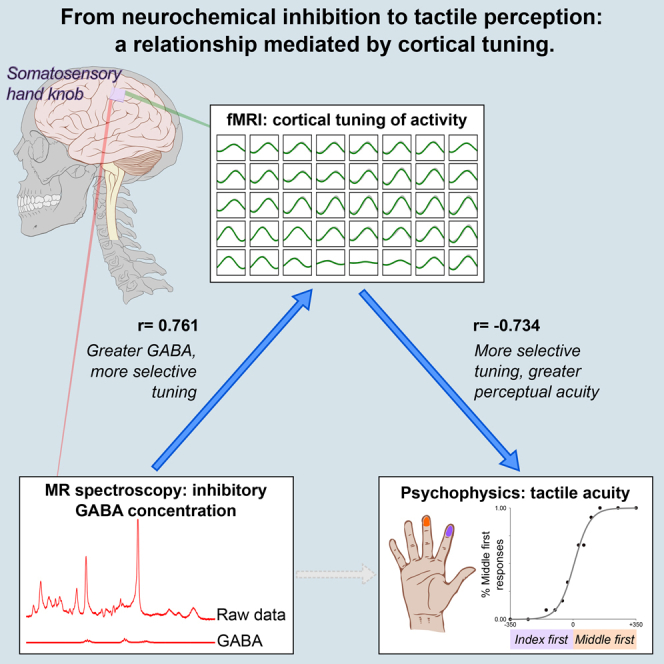
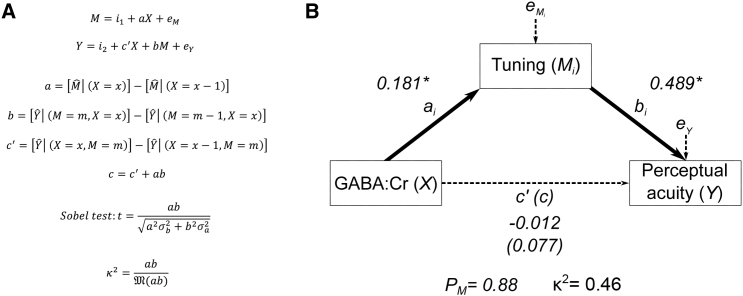
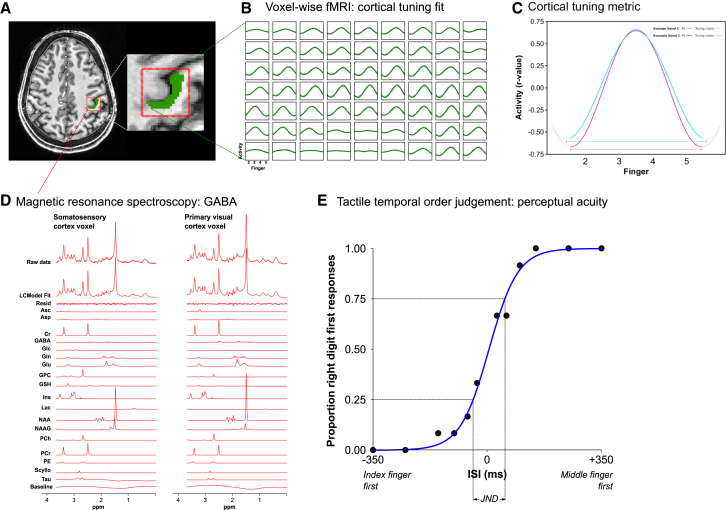
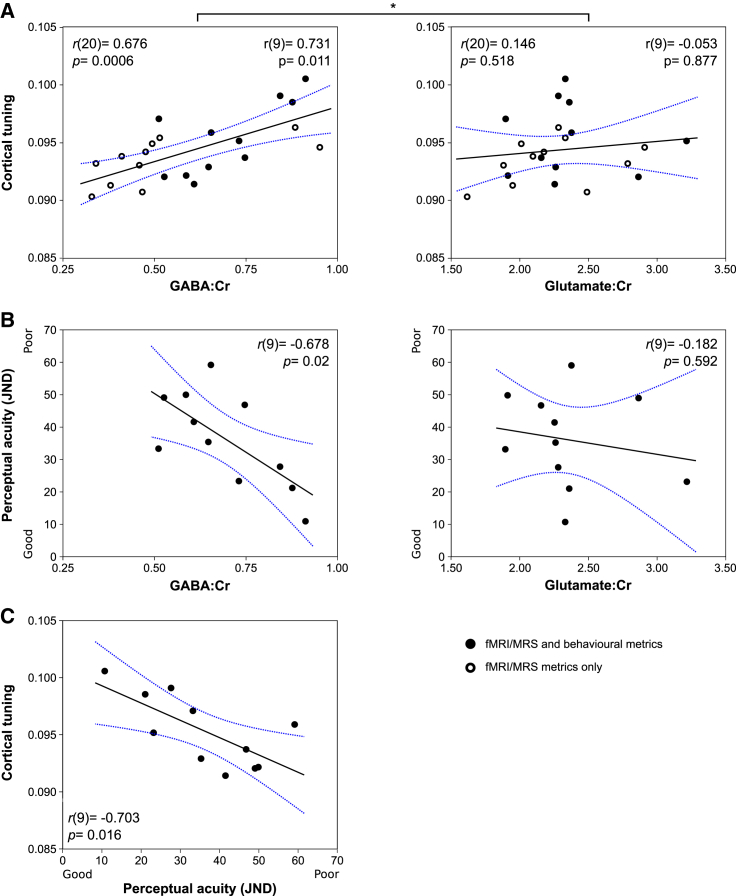
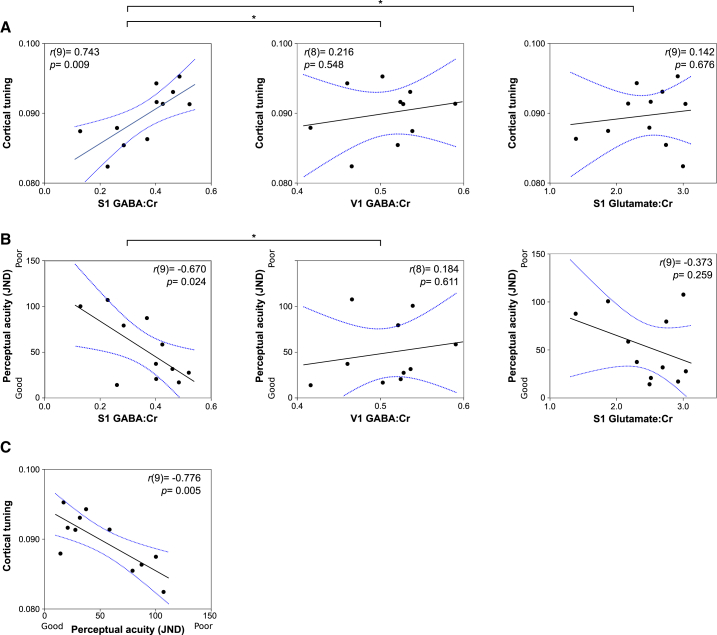
Understanding both the organization of the human cortex and its relation to the performance of distinct functions is fundamental in neuroscience. The primary sensory cortices display topographic organization, whereby receptive fields follow a characteristic pattern, from tonotopy to retinotopy to somatotopy [1]. GABAergic signaling is vital to the maintenance of cortical receptive fields [2]; however, it is unclear how this fine-grain inhibition relates to measurable patterns of perception [3, 4]. Based on perceptual changes following perturbation of the GABAergic system, it is conceivable that the resting level of cortical GABAergic tone directly relates to the spatial specificity of activation in response to a given input [5-7]. The specificity of cortical activation can be considered in terms of cortical tuning: greater cortical tuning yields more localized recruitment of cortical territory in response to a given input. We applied a combination of fMRI, MR spectroscopy, and psychophysics to substantiate the link between the cortical neurochemical milieu, the tuning of cortical activity, and variability in perceptual acuity, using human somatosensory cortex as a model. We provide data that explain human perceptual acuity in terms of both the underlying cellular and metabolic processes. Specifically, higher concentrations of sensorimotor GABA are associated with more selective cortical tuning, which in turn is associated with enhanced perception. These results show anatomical and neurochemical specificity and are replicated in an independent cohort. The mechanistic link from neurochemistry to perception provides a vital step in understanding population variability in sensory behavior, informing metabolic therapeutic interventions to restore perceptual abilities clinically.
理解人类大脑皮层的组织及其与不同功能表现的关系是神经科学的基础。初级感觉皮层表现出拓扑组织,其感受野呈现出特征性的模式,从音高拓扑到视网膜拓扑到体感拓扑[1]。GABA 能信号对于维持皮层感受野至关重要[2];然而,目前尚不清楚这种精细的抑制作用与可测量的感知模式有何关系[3,4]。基于 GABA 能系统扰动后感知的变化,可以想象皮层 GABA 能紧张度的静息水平直接关系到对给定输入的激活的空间特异性[5-7]。皮层激活的特异性可以用皮层调谐来考虑:更大的皮层调谐会导致对给定输入的皮层区域的更局部招募。我们应用 fMRI、磁共振波谱和心理物理学的组合,使用人类体感皮层作为模型,证实了皮层神经化学环境、皮层活动的调谐与感知敏锐度变化之间的联系。我们提供的数据从细胞和代谢过程两方面解释了人类感知敏锐度。具体来说,感觉运动 GABA 的浓度越高,皮层调谐的选择性越强,而感知的增强。这些结果显示了解剖学和神经化学的特异性,并在一个独立的队列中得到了复制。从神经化学到感知的机制联系为理解感觉行为的群体变异性提供了重要的一步,为临床上恢复感知能力的代谢治疗干预提供了信息。