Watson Estelle D, Micklesfield Lisa K, van Poppel Mireille N M, Norris Shane A, Sattler Matteo C, Dietz Pavel
Centre for Exercise Science and Sports Medicine, School of Therapeutic Sciences, Faculty of Health Sciences, University of Witwatersrand, Johannesburg, South Africa.
MRC/Wits Developmental Pathways for Health Research Unit, Department of Paediatrics, School of Clinical Medicine, Faculty of Health Sciences, University of Witwatersrand, Johannesburg, South Africa.
PLoS One. 2017 May 26;12(5):e0177996. doi: 10.1371/journal.pone.0177996. eCollection 2017.
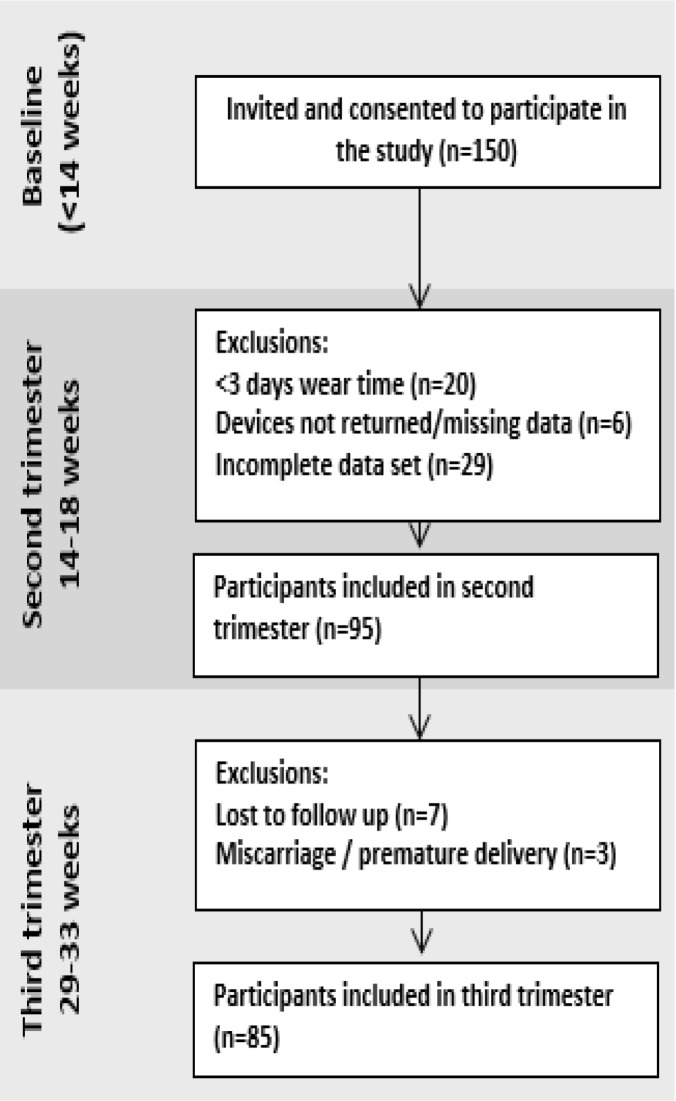
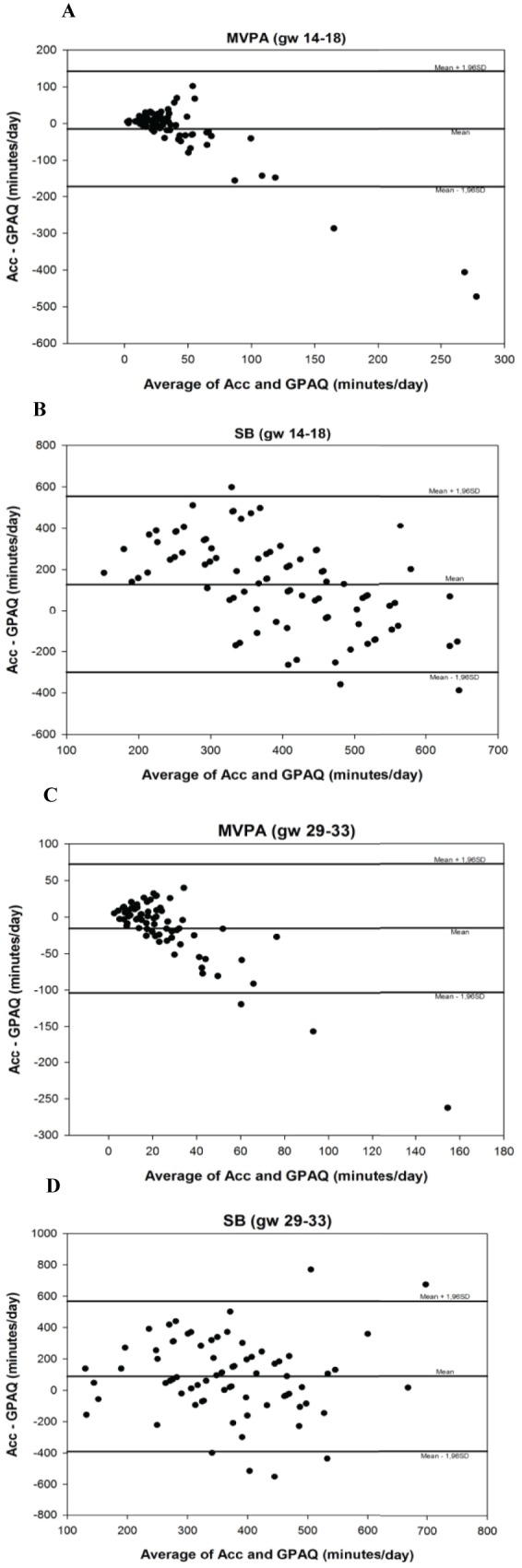
The physiological and biomechanical changes that occur during pregnancy make accurate measurement of physical activity (PA) a challenge during this unique period. The Global Physical Activity Questionnaire (GPAQ) has been used extensively in low-to-middle income countries, but has never been validated in a pregnant population. In this longitudinal study, 95 pregnant women (mean age: 29.5±5.7 years; BMI: 26.9±5.0 kg/m2) completed the GPAQ and were asked to wear an accelerometer for 7 days at two time points during pregnancy (14-18 and 29-33 weeks gestation). There was a significant difference between accelerometry and GPAQ when measuring moderate-to-vigorous physical activity (MVPA) at 29-33 weeks gestation (16.6 vs 21.4 min/day; p = 0.02) as well as sedentary behaviour (SB) at both 14-18 weeks (457.0 vs 300 min/day; p < 0.01) and 29-33 weeks gestation (431.5 vs 300 min/day; p < 0.01). There was poor agreement between the GPAQ and accelerometry for both PA and SB at both time points (ICC: -0.05-0.08). Bland Altman plots indicated that the GPAQ overestimates PA by 14.8 min/day at 14-18 weeks and by 15.8 min/day at 29-33 weeks gestation. It underestimates SB by 127.5 min/day at 14-18 weeks and by 89.2 min/day at 29-33 weeks gestation. When compared to accelerometry, the GPAQ shows poor agreement and appears to overestimate PA and underestimate SB during pregnancy.
孕期发生的生理和生物力学变化使得在这一特殊时期准确测量身体活动(PA)成为一项挑战。全球身体活动问卷(GPAQ)在低收入和中等收入国家得到了广泛应用,但从未在孕妇群体中进行过验证。在这项纵向研究中,95名孕妇(平均年龄:29.5±5.7岁;BMI:26.9±5.0kg/m²)完成了GPAQ,并被要求在孕期的两个时间点(妊娠14 - 18周和29 - 33周)佩戴加速度计7天。在妊娠29 - 33周时,测量中度至剧烈身体活动(MVPA)时,加速度计测量结果与GPAQ之间存在显著差异(分别为16.6分钟/天和21.4分钟/天;p = 0.02),在妊娠14 - 18周以及29 - 33周时测量久坐行为(SB)时也存在显著差异(分别为457.0分钟/天和300分钟/天;p < 0.01以及431.5分钟/天和300分钟/天;p < 0.01)。在两个时间点,GPAQ与加速度计在PA和SB方面的一致性都很差(ICC:-0.05 - 0.08)。Bland Altman图表明,GPAQ在妊娠14 - 18周时高估PA 14.8分钟/天,在妊娠29 - 33周时高估15.8分钟/天。它在妊娠14 - 18周时低估SB 127.5分钟/天,在妊娠29 - 33周时低估89.2分钟/天。与加速度计相比,GPAQ显示出较差的一致性,并且在孕期似乎高估了PA而低估了SB。