Yoon Ikjune, Kim Hyeok, Noh Dong Kun
Department of Smart Systems Software, Soongsil University, Seoul 06978, Korea.
Department of Software Convergence, Soongsil University, Seoul 06978, Korea.
Sensors (Basel). 2017 May 27;17(6):1226. doi: 10.3390/s17061226.
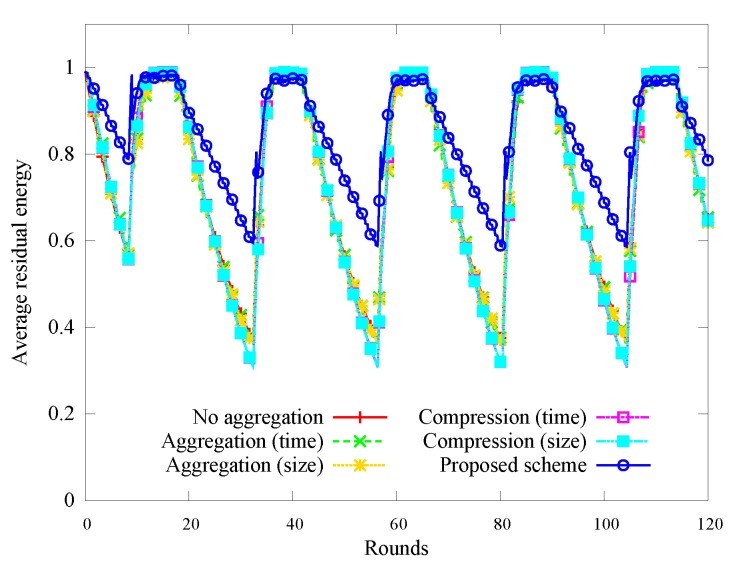
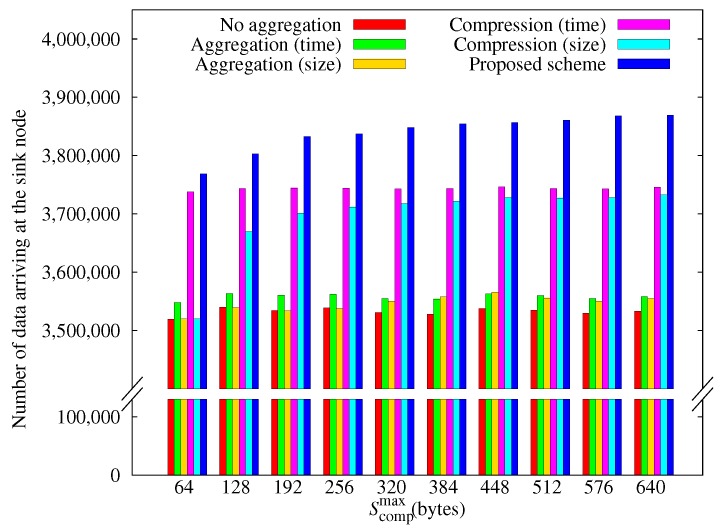
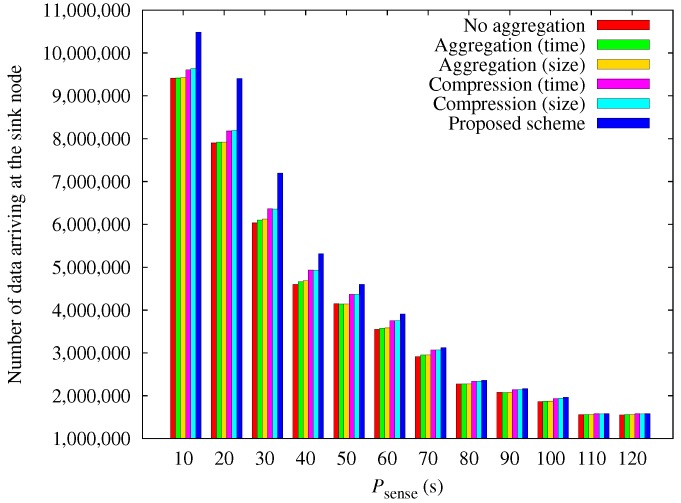
A node in a solar-powered wireless sensor network (WSN) collects energy when the sun shines and stores it in a battery or capacitor for use when no solar power is available, in particular at night. In our scheme, each tiny node in a WSN periodically determines its energy budget, which takes into account its residual energy, and its likely acquisition and consumption. If it expects to acquire more energy than it can store, the data which has it has sensed is aggregated with data from other nodes, compressed, and transmitted. Otherwise, the node continues to sense data, but turns off its wireless communication to reduce energy consumption. We compared several schemes by simulation. Our scheme reduced the number of nodes forced to black out due to lack of energy so that more data arrives at the sink node.
太阳能无线传感器网络(WSN)中的节点在有阳光时收集能量,并将其存储在电池或电容器中,以便在没有太阳能时使用,特别是在夜间。在我们的方案中,WSN中的每个微小节点会定期确定其能量预算,该预算会考虑其剩余能量以及可能的能量获取和消耗情况。如果预计获取的能量超过其存储能力,则将其感知到的数据与来自其他节点的数据进行聚合、压缩并传输。否则,该节点继续感知数据,但关闭其无线通信以降低能耗。我们通过仿真比较了几种方案。我们的方案减少了因能量不足而被迫断电的节点数量,从而使更多数据到达汇聚节点。