Antolín Diego, Medrano Nicolás, Calvo Belén, Martínez Pedro A
Group of Electronic Design (GDE), Aragón Institute for Engineering Research (I3A), Departamento de Ingeniería Electrónica y Comunicaciones, Universidad de Zaragoza, C/ Pedro Cerbuna 12, Zaragoza 50009, Spain.
Sensors (Basel). 2017 Aug 4;17(8):1794. doi: 10.3390/s17081794.
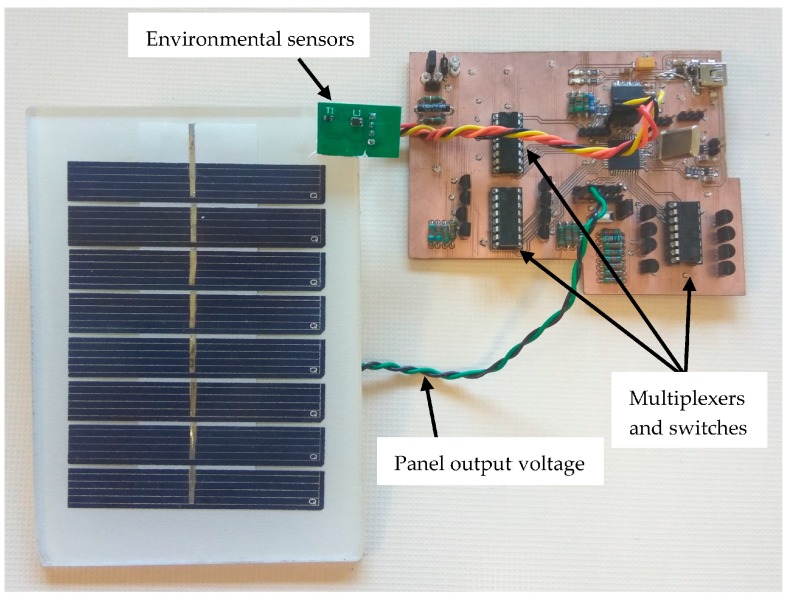
This paper presents a low-cost high-efficiency solar energy harvesting system to power outdoor wireless sensor nodes. It is based on a Voltage Open Circuit (VOC) algorithm that estimates the open-circuit voltage by means of a multilayer perceptron neural network model trained using local experimental characterization data, which are acquired through a novel low cost characterization system incorporated into the deployed node. Both units-characterization and modelling-are controlled by the same low-cost microcontroller, providing a complete solution which can be understood as a virtual pilot cell, with identical characteristics to those of the specific small solar cell installed on the sensor node, that besides allows an easy adaptation to changes in the actual environmental conditions, panel aging, etc. Experimental comparison to a classical pilot panel based VOC algorithm show better efficiency under the same tested conditions.
本文提出了一种低成本、高效率的太阳能采集系统,用于为户外无线传感器节点供电。它基于一种开路电压(VOC)算法,该算法通过使用多层感知器神经网络模型来估计开路电压,该模型是使用本地实验表征数据进行训练的,这些数据是通过集成到已部署节点中的新型低成本表征系统获取的。表征和建模这两个单元均由同一个低成本微控制器控制,提供了一个完整的解决方案,该方案可被理解为一个虚拟的标准光伏电池,其特性与安装在传感器节点上的特定小型太阳能电池相同,此外还能轻松适应实际环境条件的变化、面板老化等情况。与基于经典标准光伏电池板的VOC算法进行的实验比较表明,在相同测试条件下,该系统具有更高的效率。