Experimental Therapeutics and Pathophysiology Branch, Intramural Research Program, National Institute of Mental Health, National Institutes of Health, Bethesda, MD, USA.
Clinical Neuroendocrinology Branch, National Institute of Mental Health, National Institutes of Health, Bethesda, MD, USA.
Mol Psychiatry. 2018 Jul;23(7):1626-1631. doi: 10.1038/mp.2017.109. Epub 2017 May 30.
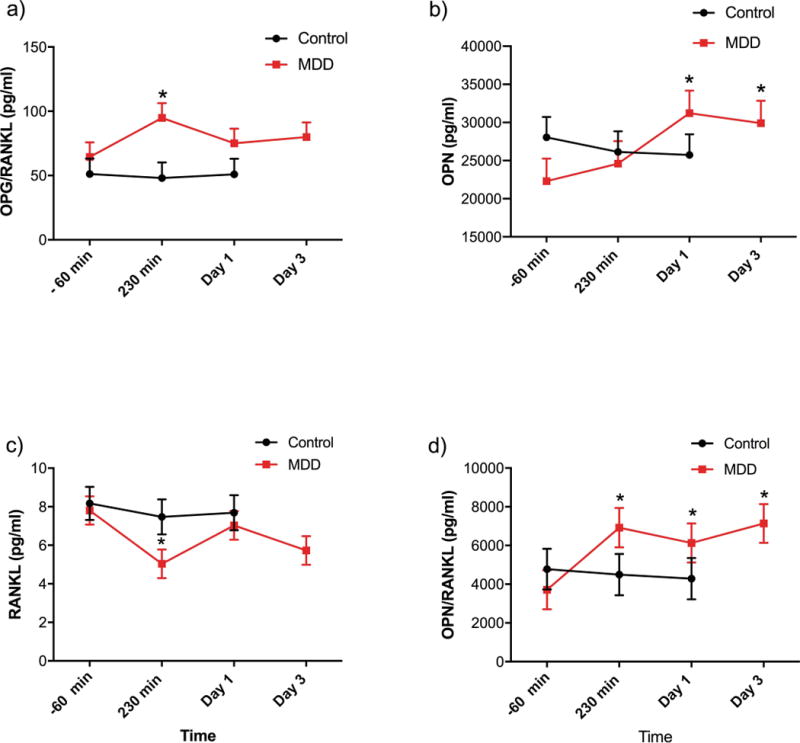
Patients with major depressive disorder (MDD) have clinically relevant, significant decreases in bone mineral density (BMD). We sought to determine if predictive markers of bone inflammation-the osteoprotegerin (OPG)-RANK-RANKL system or osteopontin (OPN)-play a role in the bone abnormalities associated with MDD and, if so, whether ketamine treatment corrected the abnormalities. The OPG-RANK-RANKL system plays the principal role in determining the balance between bone resorption and bone formation. RANKL is the osteoclast differentiating factor and diminishes BMD. OPG is a decoy receptor for RANKL, thereby increasing BMD. OPN is the bone glue that acts as a scaffold between bone tissues matrix composition to bind them together and is an important component of bone strength and fracture resistance. Twenty-eight medication-free inpatients with treatment-resistant MDD and 16 healthy controls (HCs) participated in the study. Peripheral bone marker levels and their responses to IV ketamine infusion in MDD patients and HCs were measured at four time points: at baseline, and post-infusion at 230 min, Day 1, and Day 3. Patients with MDD had significant decreases in baseline OPG/RANKL ratio and in plasma OPN levels. Ketamine significantly increased both the OPG/RANKL ratio and plasma OPN levels, and significantly decreased RANKL levels. Bone marker levels in HCs remained unaltered. We conclude that the OPG-RANK-RANKL system and the OPN system play important roles in the serious bone abnormalities associated with MDD. These data suggest that, in addition to its antidepressant effects, ketamine also has a salutary effect on a major medical complication of depressive illness.
患有重度抑郁症(MDD)的患者其骨矿物质密度(BMD)有明显下降,且具有临床相关性。我们试图确定骨炎症的预测标志物——骨保护素(OPG)-RANK-RANKL 系统或骨桥蛋白(OPN)是否在与 MDD 相关的骨异常中发挥作用,如果是这样,是否氯胺酮治疗可以纠正这些异常。OPG-RANK-RANKL 系统在决定骨吸收和骨形成之间的平衡方面起着主要作用。RANKL 是破骨细胞分化因子,会降低 BMD。OPG 是 RANKL 的诱饵受体,从而增加 BMD。OPN 是一种“骨胶”,充当骨组织基质成分之间的支架,将它们结合在一起,是骨强度和抗骨折能力的重要组成部分。28 名无药物治疗的、有抗药性 MDD 住院患者和 16 名健康对照者(HCs)参与了这项研究。在四个时间点测量了 MDD 患者和 HCs 的外周骨标志物水平及其对 IV 氯胺酮输注的反应:基线时,输注后 230 分钟,第 1 天和第 3 天。MDD 患者的 OPG/RANKL 比值和血浆 OPN 水平在基线时显著降低。氯胺酮显著增加了 OPG/RANKL 比值和血浆 OPN 水平,并显著降低了 RANKL 水平。HCs 的骨标志物水平保持不变。我们得出的结论是,OPG-RANK-RANKL 系统和 OPN 系统在与 MDD 相关的严重骨异常中起着重要作用。这些数据表明,除了其抗抑郁作用外,氯胺酮对抑郁疾病的主要医学并发症也有有益的影响。