Guo Zong Sheng, Liu Zuqiang, Kowalsky Stacy, Feist Mathilde, Kalinski Pawel, Lu Binfeng, Storkus Walter J, Bartlett David L
University of Pittsburgh Cancer Institute, Pittsburgh, PA, USA.
Department of Surgery, University of Pittsburgh School of Medicine, Pittsburgh, PA, USA.
Front Immunol. 2017 May 15;8:555. doi: 10.3389/fimmu.2017.00555. eCollection 2017.
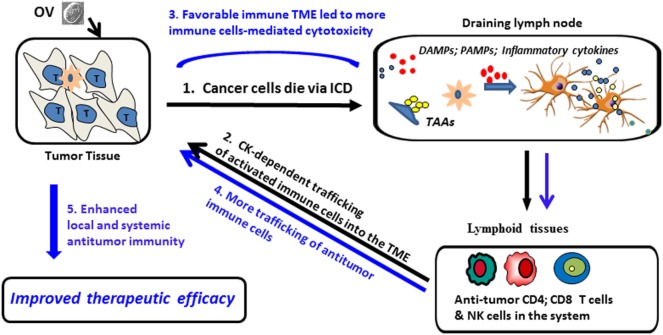
The concept of oncolytic virus (OV)-mediated cancer therapy has been shifted from an operational virotherapy paradigm to an immunotherapy. OVs often induce immunogenic cell death (ICD) of cancer cells, and they may interact directly with immune cells as well to prime antitumor immunity. We and others have developed a number of strategies to further stimulate antitumor immunity and to productively modulate the tumor microenvironment (TME) for potent and sustained antitumor immune cell activity. First, OVs have been engineered or combined with other ICD inducers to promote more effective T cell cross-priming, and in many cases, the breaking of functional immune tolerance. Second, OVs may be armed to express Th1-stimulatory cytokines/chemokines or costimulators to recruit and sustain the potent antitumor immunity into the TME to focus their therapeutic activity within the sites of disease. Third, combinations of OV with immunomodulatory drugs or antibodies that recondition the TME have proven to be highly promising in early studies. Fourth, combinations of OVs with other immunotherapeutic regimens (such as prime-boost cancer vaccines, CAR T cells; armed with bispecific T-cell engagers) have also yielded promising preliminary findings. Finally, OVs have been combined with immune checkpoint blockade, with robust antitumor efficacy being observed in pilot evaluations. Despite some expected hurdles for the rapid translation of OV-based state-of-the-art protocols, we believe that a cohort of these novel approaches will join the repertoire of standard cancer treatment options in the near future.
溶瘤病毒(OV)介导的癌症治疗概念已从操作性病毒疗法范式转变为免疫疗法。OV通常会诱导癌细胞发生免疫原性细胞死亡(ICD),并且它们也可能直接与免疫细胞相互作用以启动抗肿瘤免疫。我们和其他人已经开发了多种策略来进一步刺激抗肿瘤免疫,并有效调节肿瘤微环境(TME)以实现强大且持续的抗肿瘤免疫细胞活性。首先,对OV进行了工程改造或与其他ICD诱导剂联合使用,以促进更有效的T细胞交叉启动,并且在许多情况下,打破功能性免疫耐受。其次,可以使OV表达Th1刺激细胞因子/趋化因子或共刺激分子,以招募并维持强大的抗肿瘤免疫进入TME,从而将其治疗活性集中在疾病部位。第三,在早期研究中,OV与免疫调节药物或可重塑TME的抗体联合使用已被证明非常有前景。第四,OV与其他免疫治疗方案(如初免-加强癌症疫苗、CAR T细胞;配备双特异性T细胞衔接器)联合使用也产生了有前景的初步结果。最后,OV已与免疫检查点阻断联合使用,在初步评估中观察到了强大的抗肿瘤疗效。尽管基于OV的先进方案快速转化存在一些预期障碍,但我们相信,在不久的将来,这些新颖方法中的一部分将加入标准癌症治疗选择的行列。