Salgado Angelo Antunes, Barbosa Paulo Roberto Benchimol, Ferreira Alinne Gimenez, Reis Camila Aparecida de Souza Segrégio, Terra Carlos
Hospital Universitário Pedro Ernesto, Universidade Estadual do Rio de Janeiro, RJ, Brazil.
Arq Bras Cardiol. 2016 Dec;107(6):523-531. doi: 10.5935/abc.20160181.
There is still debate about the relationship between changes in ventricular repolarization on the surface electrocardiogram and cirrhosis severity.
To study the relationship between variables related to ventricular repolarization and the clinical severity of the cirrhotic disease.
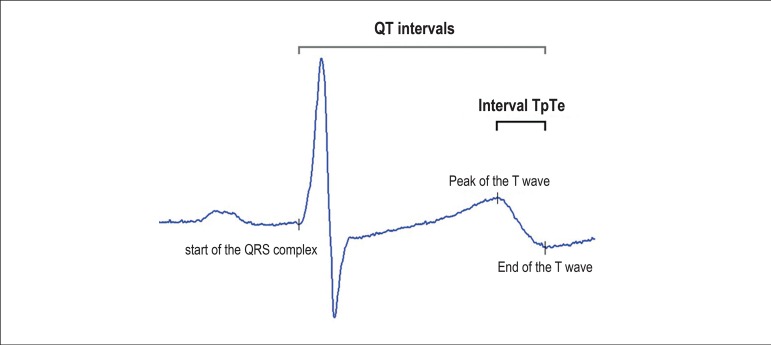
We selected 79 individuals with hepatic cirrhosis, classified according to the Child-Pugh-Turcotte criteria (Child A, B, and C). We measured the QT and corrected QT (QTc) intervals, and the interval between the peak and the end of the T wave (TpTe), and we identified their minimum, maximum, and mean values in the 12-lead electrocardiogram. We also calculated the dispersion of the QT (DQT) and QTc (DQTc) intervals.
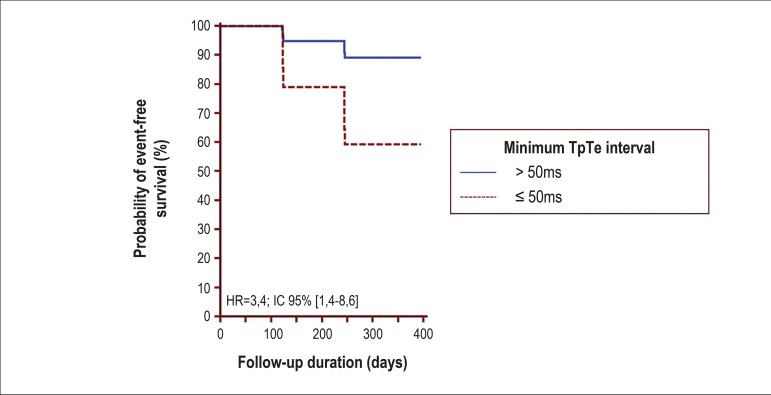
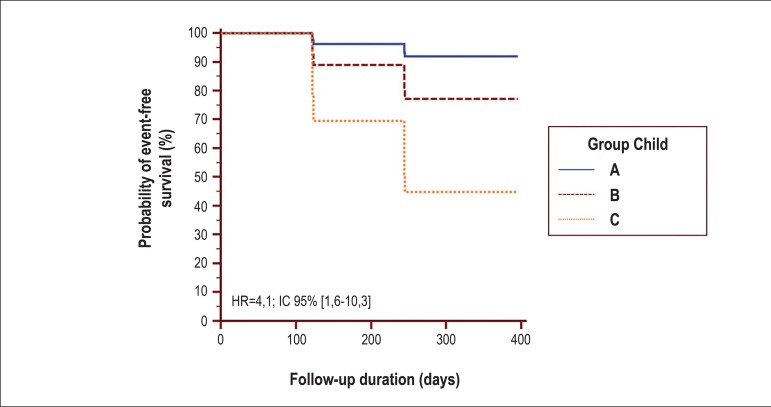
In 12 months of clinical follow-up, nine subjects underwent hepatic transplantation (Child A: 0 [0%]; Child B: 6 [23.1%]; Child C: 3 [18.8%]; p = 0.04) and 12 died (Child A: 3 [12.0%]; Child B: 4 [15.4%]; Child C: 5 [31.3%]; p = 0.002). No significant differences were observed between the cirrhotic groups related to the minimum, maximum, and mean values for the QT, QTc, TpTe, DQT, and DQTc intervals. A minimum TpTe interval ≤ 50 ms was a predictor for the composite endpoints of death or liver transplantation with a sensitivity of 90% and a specificity of 57% (p = 0.005). In the Cox multivariate analysis, the Child groups and a minimum TpTe of ≤ 50 ms were independent predictors of the composite endpoints.
The intervals QT, QTc, DQT, DQTc, and TpTe have similar distributions between different severity stages in cirrhotic disease. The TpTe interval proved to be a prognostic marker in subjects with cirrhosis, regardless of disease severity (NCT01433848).
关于体表心电图上心室复极变化与肝硬化严重程度之间的关系仍存在争议。
研究与心室复极相关的变量与肝硬化疾病临床严重程度之间的关系。
我们选取了79例肝硬化患者,根据Child-Pugh-Turcotte标准(Child A、B和C级)进行分类。我们测量了QT间期和校正QT间期(QTc),以及T波峰与终点之间的间期(TpTe),并确定了它们在12导联心电图中的最小值、最大值和平均值。我们还计算了QT间期离散度(DQT)和QTc间期离散度(DQTc)。
在12个月的临床随访中,9例患者接受了肝移植(Child A级:0例[0%];Child B级:6例[23.1%];Child C级:3例[18.8%];p = 0.04),12例患者死亡(Child A级:3例[12.0%];Child B级:4例[15.4%];Child C级:5例[31.3%];p = 0.002)。在肝硬化组之间,QT、QTc、TpTe、DQT和DQTc间期的最小值、最大值和平均值未观察到显著差异。TpTe间期最小值≤50 ms是死亡或肝移植复合终点的预测指标,敏感性为90%,特异性为57%(p = 0.005)。在Cox多因素分析中,Child分级组和TpTe最小值≤50 ms是复合终点的独立预测指标。
QT、QTc、DQT、DQTc和TpTe间期在肝硬化疾病不同严重程度阶段之间具有相似的分布。无论疾病严重程度如何,TpTe间期被证明是肝硬化患者的一个预后标志物(NCT01433848)。