Farrell Michelle E, Kennedy Kristen M, Rodrigue Karen M, Wig Gagan, Bischof Gérard N, Rieck Jennifer R, Chen Xi, Festini Sara B, Devous Michael D, Park Denise C
Center for Vital Longevity, School of Behavioral and Brain Sciences, University of Texas at Dallas, Dallas.
Multimodal Neuroimaging Group, Department of Nuclear Medicine, University Hospital Cologne, Cologne, Germany3Institute of Neuroscience and Medicine (INM-3), Cognitive Neuroscience Research Center, Jülich, Germany.
JAMA Neurol. 2017 Jul 1;74(7):830-838. doi: 10.1001/jamaneurol.2017.0892.
Presently, the clinical standard for reporting the results of an amyloid positron emission tomography scan is to assign a dichotomous rating of positive or negative for the presence of amyloid. In a 4-year longitudinal study, we investigated whether using a continuous measure of the magnitude of baseline amyloid burden would provide valuable information about the rate of future cognitive decline over the subsequent 4 years compared with a dichotomous measure in middle-aged and older adults.
To examine whether a continuous, dose-response relationship between amyloid burden and cognitive decline was present among middle-aged and older adults.
DESIGN, SETTING, AND PARTICIPANTS: This cohort study included 174 participants from the Dallas Lifespan Brain Study who were 40 to 89 years old at the beginning of the study, were cognitively normal at baseline (a Mini-Mental State Examination score of 26 or higher) with no history of neurological or psychiatric disorders, and had completed amyloid imaging ([18F]-florbetapir) at baseline and cognitive assessments at baseline and a 4-year follow-up. Continuous amyloid burden was measured as the mean cortical standardized uptake value ratio (SUVR) at baseline.
Linear mixed models assessed the effect of increasing baseline amyloid over time (SUVR × time interaction) on episodic memory, reasoning, processing speed, vocabulary, and Mini-Mental State Examination performance. Age, sex, education, apolipoprotein ε4, and the random effect of intercepts were included as covariates.
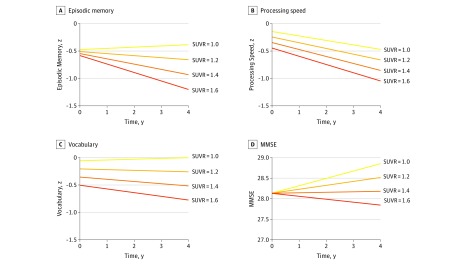
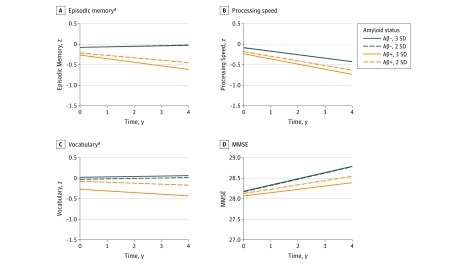
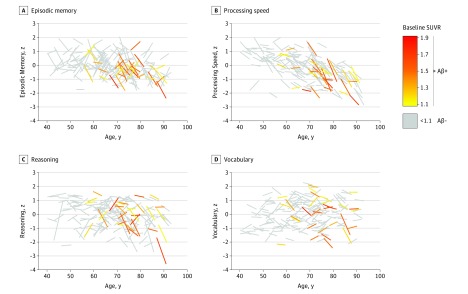
The mean (SD) age for all participants (n = 174) was 66.44 (11.74) years, and 65 participants (37%) were men. The primary analyses yielded significant SUVR × time interactions in episodic memory, processing speed, vocabulary, and Mini-Mental State Examination performance, but not in reasoning performance. Higher baseline SUVR projected greater cognitive decline over 4 years. When controlling for variance related to a dichotomized positive/negative classification, most effects on cognition remained. Dichotomized amyloid status alone yielded fewer significant effects of amyloid on cognitive decline than continuous SUVR. Among amyloid-positive participants, increasing baseline SUVR predicted an increasing decline in episodic memory, but other effects on cognition were more limited. Finally, higher baseline amyloid burden among middle-aged adults was related to changes in vocabulary, with the effect driven by 3 apolipoprotein ε4 homozygotes.
These results suggest that the magnitude of amyloid burden at baseline is associated with the rate of cognitive decline over 4 years and potentially provides important information about the rate of future cognitive decline that is not available from a dichotomous positive/negative categorization.
目前,报告淀粉样蛋白正电子发射断层扫描结果的临床标准是对淀粉样蛋白的存在进行阳性或阴性的二分法评级。在一项为期4年的纵向研究中,我们调查了与二分法测量相比,使用基线淀粉样蛋白负荷量的连续测量方法是否能为中年及老年人在随后4年中的未来认知衰退率提供有价值的信息。
研究中年及老年人中淀粉样蛋白负荷与认知衰退之间是否存在连续的剂量反应关系。
设计、地点和参与者:这项队列研究纳入了达拉斯寿命期脑研究中的174名参与者,他们在研究开始时年龄为40至89岁,基线时认知正常(简易精神状态检查表得分26分或更高),无神经或精神疾病史,并且在基线时完成了淀粉样蛋白成像([18F] - 氟代贝他吡)以及基线和4年随访时的认知评估。连续淀粉样蛋白负荷量通过基线时的平均皮质标准化摄取值比率(SUVR)来测量。
线性混合模型评估了随着时间推移基线淀粉样蛋白增加(SUVR×时间交互作用)对情景记忆、推理、处理速度、词汇和简易精神状态检查表表现的影响。年龄、性别、教育程度、载脂蛋白ε4以及截距的随机效应作为协变量纳入。
所有参与者(n = 174)的平均(标准差)年龄为66.44(11.74)岁,65名参与者(37%)为男性。主要分析在情景记忆、处理速度、词汇和简易精神状态检查表表现方面产生了显著的SUVR×时间交互作用,但在推理表现方面未产生。较高的基线SUVR预示着4年内更大的认知衰退。在控制与二分法阳性/阴性分类相关的方差时,对认知的大多数影响仍然存在。单独的二分法淀粉样蛋白状态对认知衰退的显著影响比连续的SUVR少。在淀粉样蛋白阳性参与者中,基线SUVR增加预示着情景记忆衰退加剧,但对认知的其他影响更有限。最后,中年成年人中较高的基线淀粉样蛋白负荷与词汇变化有关,这种影响由3名载脂蛋白ε4纯合子驱动。
这些结果表明,基线时淀粉样蛋白负荷量与4年内的认知衰退率相关,并可能提供关于未来认知衰退率的重要信息,而这是二分法阳性/阴性分类无法提供的。