King Abdullah International Medical Research Center and King Saud bin Abdulaziz University for Health Sciences, King Abdulaziz Medical City, Ministry of National Guard - Health Affairs, P. O. Box 22490, Mail code 3202, Riyadh, 11426, Saudi Arabia.
National Family Safety Program, King Abdulaziz Medical City, Ministry of National Guard- Health Affairs, Riyadh, Saudi Arabia.
Int J Equity Health. 2017 May 30;16(1):90. doi: 10.1186/s12939-017-0588-9.
Adverse Childhood Experiences (ACEs) have been linked to an increased risk of health and social problems throughout life. Studies on gender differences from developing countries are scarce. In this paper, we will examine gender variations in the types of reported ACEs and gender-specific relationships between cumulative ACEs and physical and mental health, and Risky Health Behaviors (RHB) in adulthood in the Kingdom of Saudi Arabia (KSA).
A cross sectional national study was conducted in all of the 13 regions in KSA in 2013 using the ACE- International Questionnaire (ACE-IQ). We used multivariate logistic regression to examine the relationship between 4 + ACEs and physical, mental health and RHBs for both men and women separately after adjusting for age, education, marital status and current employment.
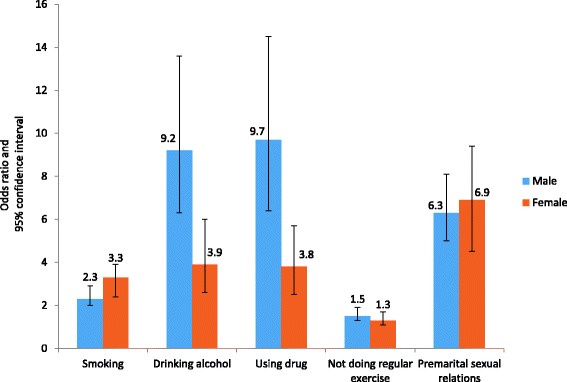
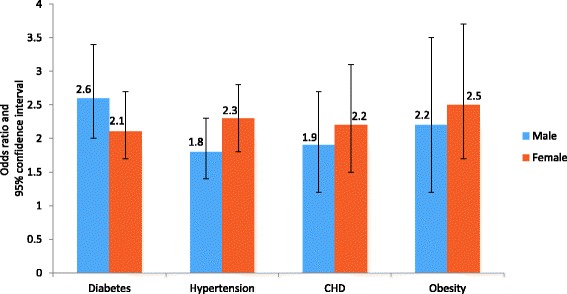
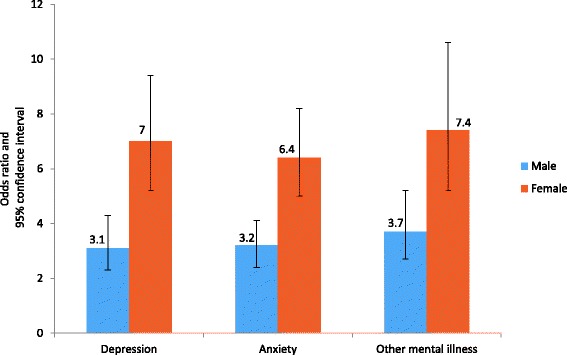
The total number of participants was 10,156 and women comprised 48% of the sample. The majority of respondents (80%) reported at least one ACE. Women had higher percentages of < =2 ACEs (65% vs 55%; p <0.05) while men were more likely to have 4+ ACEs (33% vs 25%; p < 0.05). When compared to participants with 0 ACE, men who reported 4+ ACEs were associated with the highest likelihood of using drugs (OR = 9.7; 95% CI: 6.4-14.5) and drinking alcohol (OR = 9.2; 95% CI: 6.3-13.6). On the other hand, women who experienced 4+ ACEs were associated with the highest likelihood of depression (OR = 7.0; 95% CI: 5.2-9.4), anxiety (OR = 6.4; 95% CI: 5.0-8.2) and other mental illnesses (OR = 7.4; 95% CI: 5.2-10.6). As for chronic diseases, abused men and women in childhood showed similarly a twofold increased risk of developing diabetes, hypertension, coronary heart disease and obesity when compared to non-abused participants.
Findings highlight the need to consider gender specific differences in the development of preventive strategies to address ACEs in KSA.
不良的童年经历(ACEs)与一生中健康和社会问题的风险增加有关。来自发展中国家的关于性别差异的研究很少。在本文中,我们将研究沙特阿拉伯王国(KSA)中报告的 ACE 类型的性别差异,以及累积 ACE 与成年时的身心健康和危险健康行为(RHB)之间的性别特异性关系。
2013 年,我们在 KSA 的 13 个地区进行了一项全国性的横断面研究,使用 ACE-国际问卷(ACE-IQ)。我们使用多变量逻辑回归,在调整年龄、教育、婚姻状况和当前就业状况后,分别为男性和女性检查 4+ACEs 与身体、心理健康和 RHBs 之间的关系。
共有 10156 名参与者,其中 48%为女性。大多数受访者(80%)报告至少有一个 ACE。女性报告的<=2 ACEs 的百分比较高(65%对 55%;p<0.05),而男性报告 4+ACEs 的可能性更大(33%对 25%;p<0.05)。与报告 0 ACE 的参与者相比,报告 4+ACEs 的男性更有可能使用毒品(OR=9.7;95%CI:6.4-14.5)和饮酒(OR=9.2;95%CI:6.3-13.6)。另一方面,经历 4+ACEs 的女性与患抑郁症(OR=7.0;95%CI:5.2-9.4)、焦虑症(OR=6.4;95%CI:5.0-8.2)和其他精神疾病(OR=7.4;95%CI:5.2-10.6)的可能性最高。至于慢性疾病,与未受虐待的参与者相比,童年时遭受虐待的男性和女性患糖尿病、高血压、冠心病和肥胖的风险同样增加了两倍。
研究结果强调需要考虑性别差异,制定预防策略,以解决 KSA 的 ACEs 问题。