Goedert Michel, Spillantini Maria Grazia
MRC Laboratory of Molecular Biology, Francis Crick Avenue, Cambridge, CB2 0QH, UK.
Department of Clinical Neurosciences, Clifford Allbutt Building, University of Cambridge, Hills Road, Cambridge, CB2 0AH, UK.
Mol Brain. 2017 May 30;10(1):18. doi: 10.1186/s13041-017-0298-7.
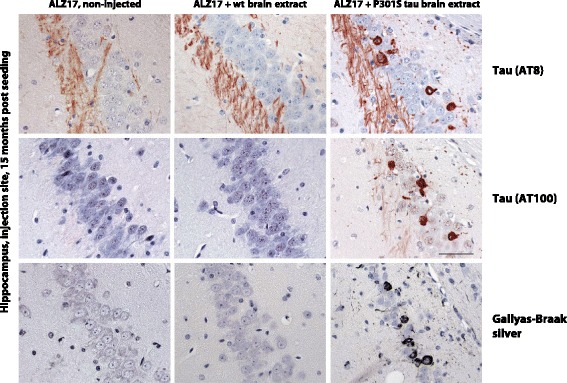
Since 2009, evidence has accumulated to suggest that Tau aggregates form first in a small number of brain cells, from where they propagate to other regions, resulting in neurodegeneration and disease. Propagation of Tau aggregates is often called prion-like, which refers to the capacity of an assembled protein to induce the same abnormal conformation in a protein of the same kind, initiating a self-amplifying cascade. In addition, prion-like encompasses the release of protein aggregates from brain cells and their uptake by neighbouring cells. In mice, the intracerebral injection of Tau inclusions induced the ordered assembly of monomeric Tau, followed by its spreading to distant brain regions. Short fibrils constituted the major species of seed-competent Tau. The existence of several human Tauopathies with distinct fibril morphologies has led to the suggestion that different molecular conformers (or strains) of aggregated Tau exist.
自2009年以来,越来越多的证据表明,Tau聚集体首先在少数脑细胞中形成,然后从这些细胞传播到其他区域,导致神经退行性变和疾病。Tau聚集体的传播通常被称为类朊病毒样传播,这是指组装好的蛋白质能够在同类蛋白质中诱导相同的异常构象,引发自我放大的级联反应。此外,类朊病毒样传播还包括蛋白质聚集体从脑细胞中释放并被邻近细胞摄取。在小鼠中,脑内注射Tau包涵体可诱导单体Tau有序组装,随后扩散到远处的脑区。短纤维是具有种子活性的Tau的主要种类。几种具有不同纤维形态的人类 Tau蛋白病的存在表明,聚集的Tau存在不同的分子构象(或毒株)。