Wang Steven J, Asthana Saurabh, van Zante Annemieke, Heaton Chase M, Phuchareon Janyaporn, Stein Leighton, Higuchi Saito, Kishimoto Tomoya, Chiu Charles Y, Olshen Adam B, McCormick Frank, Tetsu Osamu
Department of Otolaryngology-Head and Neck Surgery, School of Medicine, University of California, San Francisco, San Francisco, CA 94143, USA; UCSF Helen Diller Family Comprehensive Cancer Center, School of Medicine, University of California, San Francisco, San Francisco, CA 94143, USA.
UCSF Helen Diller Family Comprehensive Cancer Center, School of Medicine, University of California, San Francisco, San Francisco, CA 94143, USA.
Oral Oncol. 2017 Jun;69:1-10. doi: 10.1016/j.oraloncology.2017.03.020. Epub 2017 Apr 3.
The rising incidence of oral tongue squamous cell carcinoma (OTSCC) in patients who have never smoked and the paucity of knowledge of its biological behavior prompted us to develop a new cell line originating from a never-smoker.
Fresh tumor tissue of keratinizing OTSCC was collected from a 44-year-old woman who had never smoked. Serum-free media with a low calcium concentration were used in cell culture, and a multifaceted approach was taken to verify and characterize the cell line, designated UCSF-OT-1109.
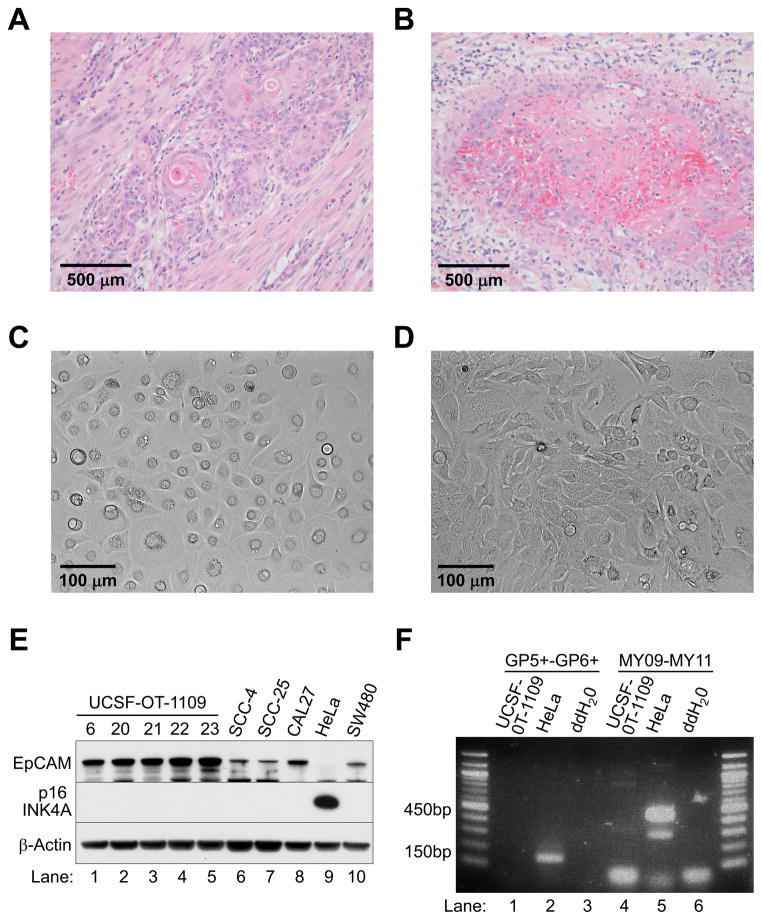
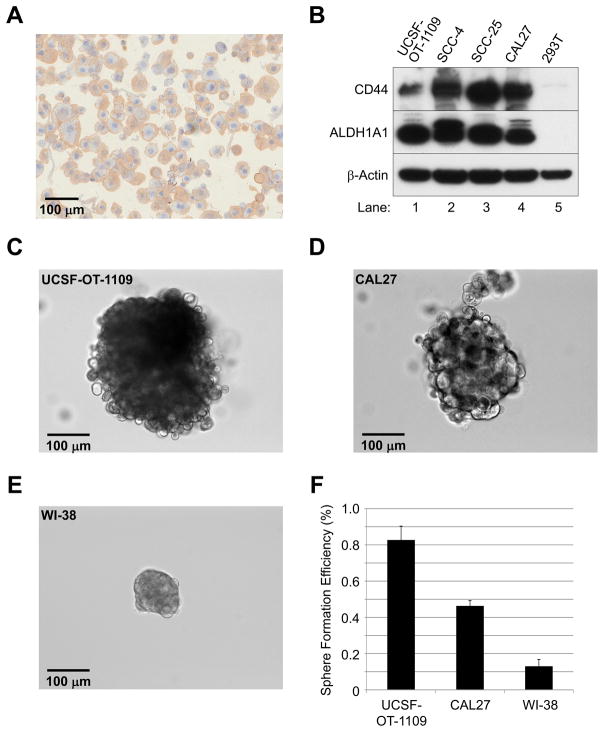
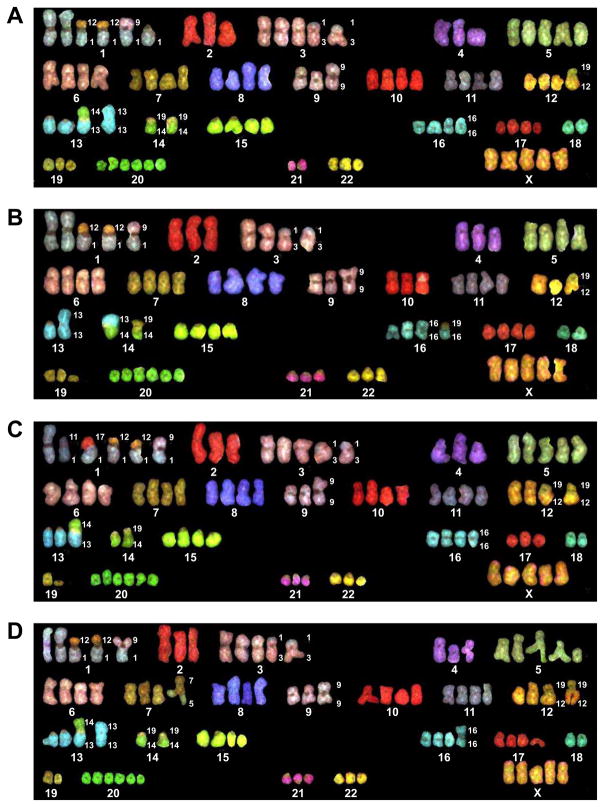
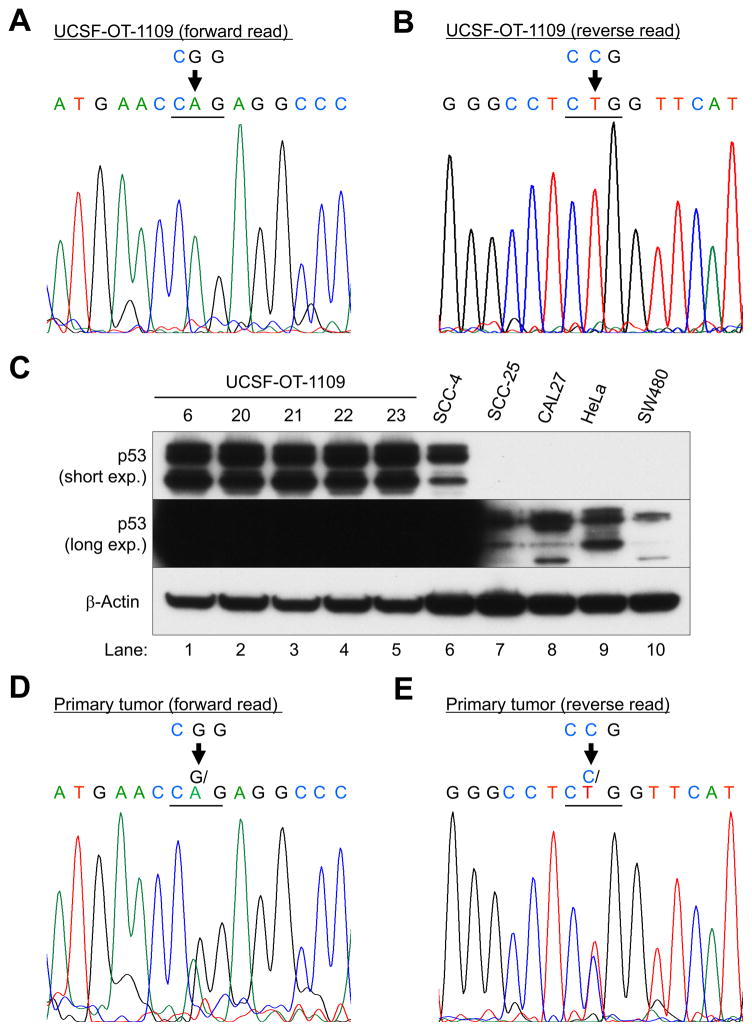
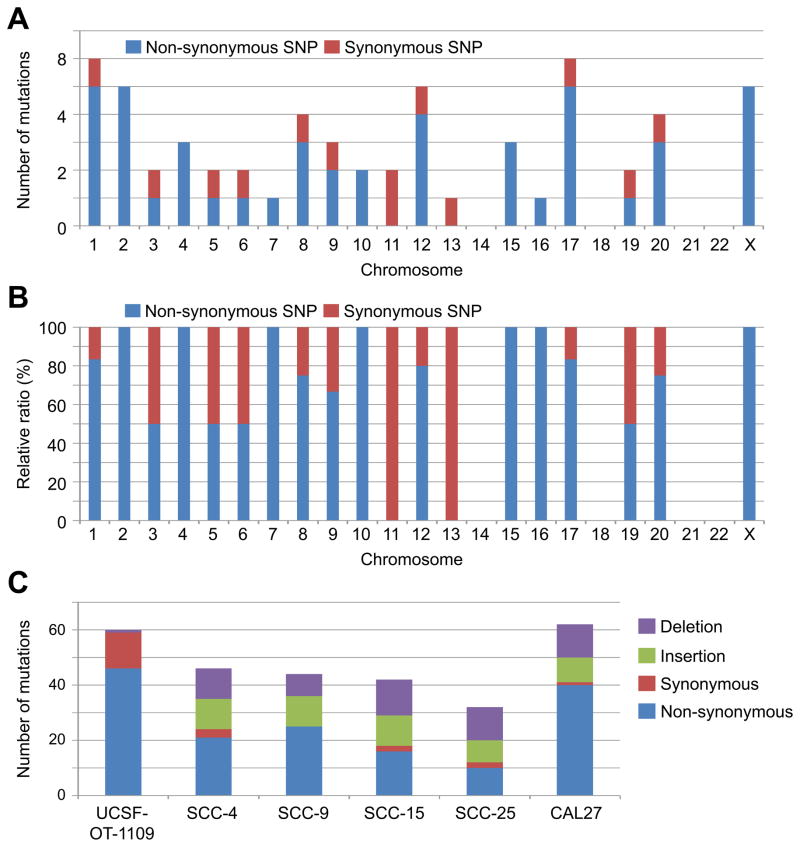
UCSF-OT-1109 was authenticated by STR DNA fingerprint analysis, presence of an epithelial marker EpCAM, absence of human papilloma virus (HPV) DNA, and SCC-specific microscopic appearance. Sphere-forming assays supported its tumorigenic potential. Spectral karyotype (SKY) analysis revealed numerical and structural chromosomal abnormalities. Whole-exome sequencing (WES) identified 46 non-synonymous and 13 synonymous somatic single-nucleotide polymorphisms (SNPs) and one frameshift deletion in the coding regions. Specifically, mutations of CDKN2A, TP53, SPTBN5, NOTCH2, and FAM136A were found in the databases. Copy number aberration (CNA) analysis revealed that the cell line loses chromosome 3p and 9p, but lacks amplification of 3q and 11q (as does HPV-negative, smoking-unrelated OTSCC). It also exhibits four distinctive focal amplifications in chromosome 19p, containing 131 genes without SNPs. Particularly, 52 genes showed >3- to 4-fold amplification and could be potential oncogenic drivers.
We have successfully established a novel OTSCC cell line from a never-smoking patient. UCSF-OT-1109 is potentially a robust experimental model of OTSCC in never-smokers.
从未吸烟患者口腔舌鳞状细胞癌(OTSCC)发病率的上升以及对其生物学行为了解的匮乏促使我们开发一种源自非吸烟者的新细胞系。
从一名44岁从未吸烟的女性身上收集角化OTSCC的新鲜肿瘤组织。细胞培养使用低钙浓度的无血清培养基,并采用多方面方法对命名为UCSF-OT-1109的细胞系进行验证和表征。
通过STR DNA指纹分析、上皮标志物EpCAM的存在、人乳头瘤病毒(HPV)DNA的缺失以及SCC特异性显微镜外观对UCSF-OT-1109进行了鉴定。成球试验支持其致瘤潜力。光谱核型分析(SKY)显示存在数值和结构染色体异常。全外显子测序(WES)在编码区鉴定出46个非同义及13个同义体细胞单核苷酸多态性(SNP)以及1个移码缺失。具体而言,在数据库中发现了CDKN2A、TP53、SPTBN5、NOTCH2和FAM136A的突变。拷贝数变异(CNA)分析表明该细胞系缺失3号染色体短臂和9号染色体短臂,但缺乏3号染色体长臂和11号染色体长臂的扩增(HPV阴性、与吸烟无关的OTSCC也是如此)。它在19号染色体短臂上还表现出四个独特的局灶性扩增,包含131个无SNP的基因。特别是,52个基因显示出>3至4倍的扩增,可能是潜在的致癌驱动因素。
我们成功地从一名非吸烟患者建立了一种新型OTSCC细胞系。UCSF-OT-1109可能是从不吸烟者中OTSCC的一个强大实验模型。