Zhu Kaihua, Li Liming, Wei Xuyong, Sui Xiaohong
School of Biomedical Engineering, Shanghai Jiao Tong UniversityShanghai, China.
Front Neurosci. 2017 May 16;11:250. doi: 10.3389/fnins.2017.00250. eCollection 2017.
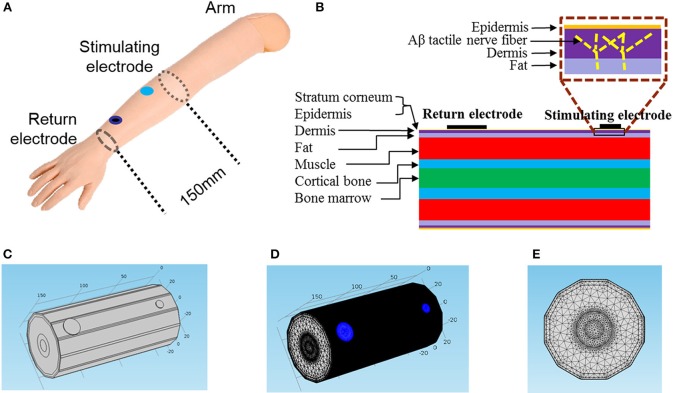
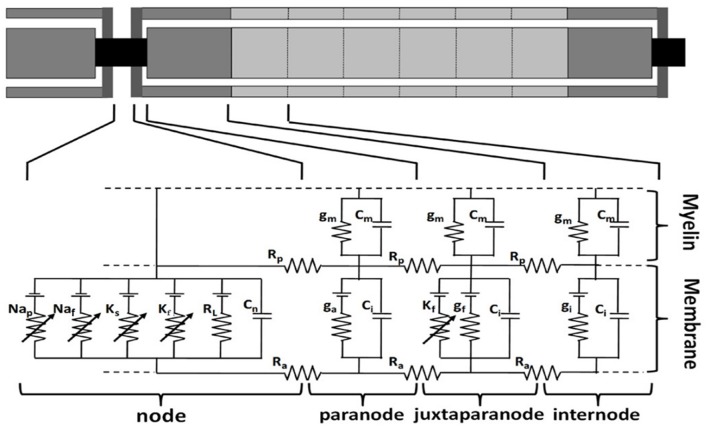
Tactile sensory feedback plays an important role in our daily life. Transcutaneous electrical nerve stimulation (TENS) is widely accepted to produce artificial tactile sensation. To explore the underlying mechanism of tactile sensation under TENS, this paper presented a novel 3D TENS computational model including an active Aβ tactile nerve fiber (TNF) model and a forearm finite element model with the fine-layered skin structure. The conduction velocity vs. fiber diameter and strength-duration relationships in this combined TENS model matched well with experimental data. Based on this validated TENS model, threshold current variation were further investigated under different stimulating electrode sizes with varied fiber diameters. The computational results showed that the threshold current intensity increased with electrode size, and larger nerve fibers were recruited at lower current intensities. These results were comparable to our psychophysical experimental data from six healthy subjects. This novel 3D TENS model would further guide the floorplan of the surface electrodes, and the stimulating paradigms for tactile sensory feedback.
触觉感觉反馈在我们的日常生活中起着重要作用。经皮电神经刺激(TENS)被广泛认为可产生人工触觉。为了探究TENS作用下触觉的潜在机制,本文提出了一种新型的三维TENS计算模型,该模型包括一个有源Aβ触觉神经纤维(TNF)模型和一个具有精细分层皮肤结构的前臂有限元模型。该组合TENS模型中的传导速度与纤维直径以及强度-时间关系与实验数据匹配良好。基于这个经过验证的TENS模型,进一步研究了在不同刺激电极尺寸和不同纤维直径下的阈值电流变化。计算结果表明,阈值电流强度随电极尺寸增大而增加,并且在较低电流强度下会募集到更大的神经纤维。这些结果与我们来自六名健康受试者的心理物理学实验数据相当。这种新型的三维TENS模型将进一步指导表面电极的布局规划以及触觉感觉反馈的刺激模式。