Nakamura Kae, Ding Long
Department of Physiology, Kansai Medical UniversityHirakata, Osaka, Japan.
Department of Neuroscience, University of PennsylvaniaPhiladelphia, PA, United States.
Front Neuroanat. 2017 May 16;11:43. doi: 10.3389/fnana.2017.00043. eCollection 2017.
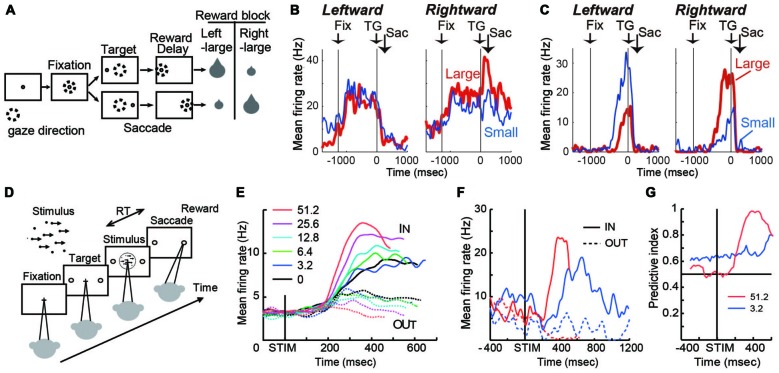
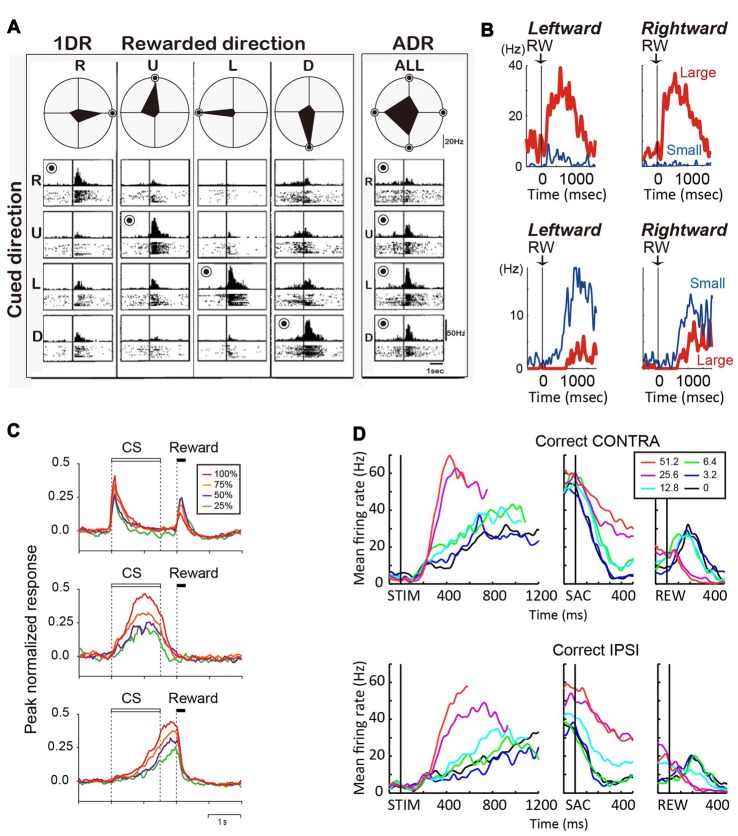
The striatum is an input channel of the basal ganglia and is well known to be involved in reward-based decision making and learning. At the macroscopic level, the striatum has been postulated to contain parallel functional modules, each of which includes neurons that perform similar computations to support selection of appropriate actions for different task contexts. At the single-neuron level, however, recent studies in monkeys and rodents have revealed heterogeneity in neuronal activity even within restricted modules of the striatum. Looking for generality in the complex striatal activity patterns, here we briefly survey several types of striatal activity, focusing on their usefulness for mediating behaviors. In particular, we focus on two types of behavioral tasks: reward-based tasks that use salient sensory cues and manipulate outcomes associated with the cues; and perceptual decision tasks that manipulate the quality of noisy sensory cues and associate all correct decisions with the same outcome. Guided by previous insights on the modular organization and general selection-related functions of the basal ganglia, we relate striatal activity patterns on these tasks to two types of computations: implementation of selection and evaluation. We suggest that a parsing with the selection/evaluation categories encourages a focus on the functional commonalities revealed by studies with different animal models and behavioral tasks, instead of a focus on aspects of striatal activity that may be specific to a particular task setting. We then highlight several questions in the selection-evaluation framework for future explorations.
纹状体是基底神经节的一个输入通道,众所周知它参与基于奖励的决策和学习。在宏观层面,有人提出纹状体包含并行的功能模块,每个模块都包含执行相似计算的神经元,以支持为不同任务情境选择适当的行动。然而,在单神经元层面,最近对猴子和啮齿动物的研究表明,即使在纹状体内受限的模块中,神经元活动也存在异质性。为了在复杂的纹状体活动模式中寻找共性,我们在此简要概述几种类型的纹状体活动,重点关注它们在介导行为方面的作用。特别是,我们关注两种类型的行为任务:使用显著感觉线索并操纵与线索相关结果的基于奖励的任务;以及操纵有噪声感觉线索的质量并将所有正确决策与相同结果相关联的感知决策任务。在前人对基底神经节的模块化组织和一般选择相关功能的见解指导下,我们将这些任务中的纹状体活动模式与两种类型的计算联系起来:选择的实施和评估。我们认为,用选择/评估类别进行剖析有助于关注不同动物模型和行为任务研究揭示的功能共性,而不是关注可能特定于特定任务设置的纹状体活动方面。然后,我们强调了选择 - 评估框架中未来探索的几个问题。