Finsterer Josef, Huber Johannes
Krankenanstalt Rudolfstiftung, Vienna, Austria.
Private Office, Vienna, Austria.
Case Rep Neurol. 2017 Apr 24;9(1):69-75. doi: 10.1159/000466686. eCollection 2017 Jan-Apr.
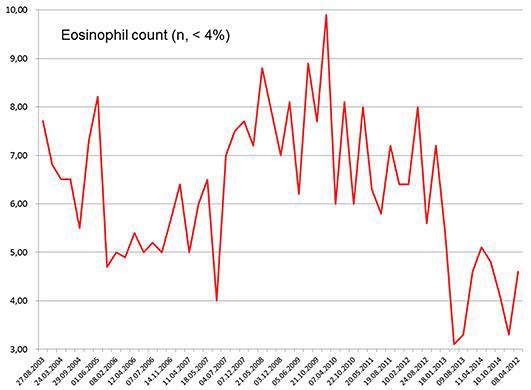
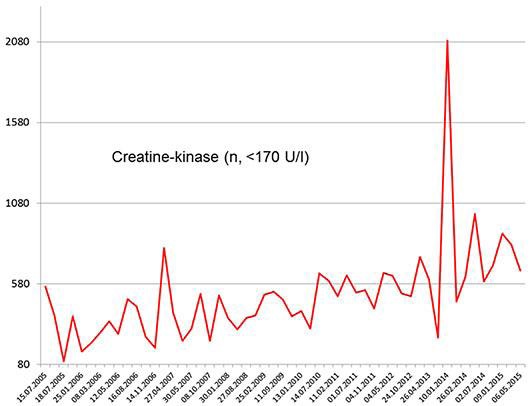
Eosinophilia has not been reported as a manifestation of a mitochondrial disorder (MID). Here, we report a patient with clinical features suggesting a MID and permanent eosinophilia, multisystem disease, and progressive hyper-creatine-kinase (CK)-emia for at least 10 years.
Methods applied included a clinical exam, blood chemical investigations, electrophysiological investigations, imaging, and invasive cardiological investigations. The patient was repeatedly followed up over several years. He required replacement cardiac surgery.
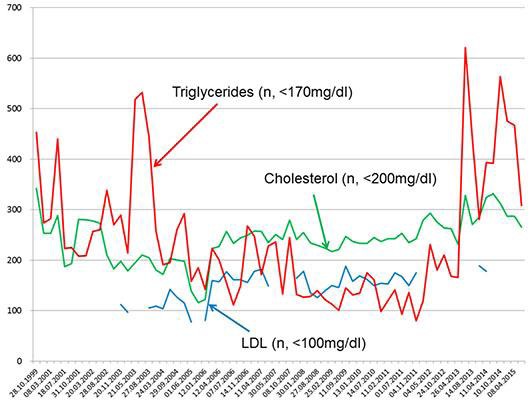
In a 57-year-old male, eosinophilia was first detected at the age of 44 years and has remained almost constantly present until today. In addition to eosinophilia, he developed progressive hyper-CK-emia at the age of 47 years. His history was further positive for hepatopathy, hyperlipidemia, hypothyroidism, renal insufficiency, spontaneous Achilles tendon rupture, double vision, exercise intolerance, muscle aching, mild hypoacusis, sensory neuropathy, seizures, and mitral insufficiency/stenosis requiring valve replacement therapy, oral anticoagulation, and pacemaker implantation. Based on the multisystem nature of his abnormalities and permanent hyper-CK-emia, a MID was suspected.
Eosinophilia can be associated with a MID with myopathy, possibly as a reaction to myofiber necrosis. If eosinophilia is associated with progressive hyper-CK-emia and multisystem disease, a MID should be suspected.
嗜酸性粒细胞增多症尚未被报道为线粒体疾病(MID)的一种表现形式。在此,我们报告一例患者,其临床特征提示患有MID,伴有持续性嗜酸性粒细胞增多症、多系统疾病以及至少10年的进行性高肌酸激酶(CK)血症。
所应用的方法包括临床检查、血液化学检查、电生理检查、影像学检查以及侵入性心脏检查。该患者在数年中接受了多次随访。他需要进行心脏置换手术。
在一名57岁男性中,嗜酸性粒细胞增多症于44岁时首次被检测到,至今几乎一直存在。除嗜酸性粒细胞增多症外,他在47岁时出现了进行性高CK血症。他的病史中还存在肝病、高脂血症、甲状腺功能减退、肾功能不全、自发性跟腱断裂、复视、运动不耐受、肌肉疼痛、轻度听力减退、感觉神经病变、癫痫发作以及二尖瓣关闭不全/狭窄,需要进行瓣膜置换治疗、口服抗凝治疗以及起搏器植入。基于其异常表现的多系统性质以及持续性高CK血症,怀疑患有MID。
嗜酸性粒细胞增多症可能与伴有肌病的MID相关,可能是对肌纤维坏死的一种反应。如果嗜酸性粒细胞增多症与进行性高CK血症及多系统疾病相关,则应怀疑患有MID。