Fan Chun Chieh, Brown Timothy T, Bartsch Hauke, Kuperman Joshua M, Hagler Donald J, Schork Andrew, Searcy Yvonne, Bellugi Ursula, Halgren Eric, Dale Anders M
Department of Cognitive Science, University of California San Diego, 9500 Gilman Drive, La Jolla, CA 92093, USA; Center for Multimodal Imaging and Genetics, University of California San Diego, School of Medicine, 9452 Medical Center Drive, La Jolla, CA 92093, USA.
Center for Multimodal Imaging and Genetics, University of California San Diego, School of Medicine, 9452 Medical Center Drive, La Jolla, CA 92093, USA; Department of Neurosciences, University of California San Diego, School of Medicine, 9500 Gilman Drive, La Jolla, CA 92037, USA; Center for Human Development, University of California San Diego, 9500 Gilman Dr., La Jolla, CA 92093, USA.
Neuroimage Clin. 2017 May 18;15:343-347. doi: 10.1016/j.nicl.2017.05.011. eCollection 2017.
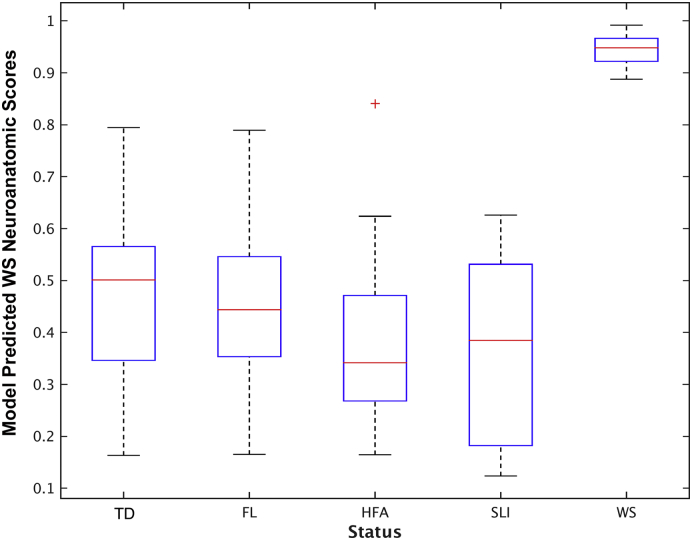
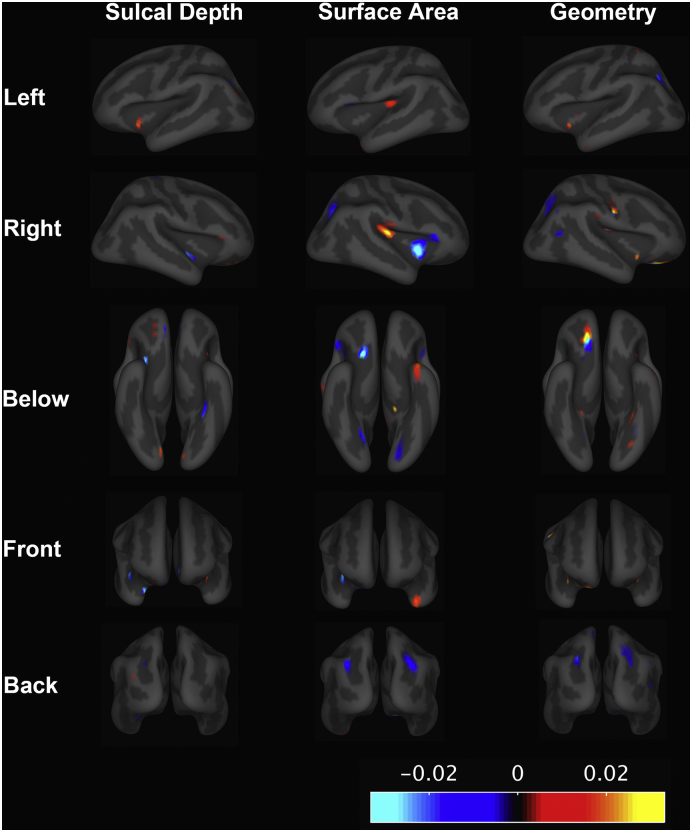
Williams Syndrome (WS) is a rare genetic disorder with unique behavioral features. Yet the rareness of WS has limited the number and type of studies that can be conducted in which inferences are made about how neuroanatomical abnormalities mediate behaviors. In this study, we extracted a WS-specific neuroanatomical profile from structural magnetic resonance imaging (MRI) measurements and tested its association with behavioral features of WS. Using a WS adult cohort (22 WS, 16 healthy controls), we modeled a sparse representation of a WS-specific neuroanatomical profile. The predictive performances are robust within the training cohort (10-fold cross-validation, AUC = 1.0) and accurately identify all WS individuals in an independent child WS cohort (seven WS, 59 children with diverse developmental status, AUC = 1.0). The WS-specific neuroanatomical profile includes measurements in the orbitofrontal cortex, superior parietal cortex, Sylvian fissures, and basal ganglia, and variability within these areas related to the underlying size of hemizygous deletion in patients with partial deletions. The profile intensity mediated the overall cognitive impairment as well as personality features related to hypersociability. Our results imply that the unique behaviors in WS were mediated through the constellation of abnormalities in cortical-subcortical circuitry consistent in child WS and adult WS. The robustness of the derived WS-specific neuroanatomical profile also demonstrates the potential utility of our approach in both clinical and research applications.
威廉姆斯综合征(WS)是一种具有独特行为特征的罕见遗传疾病。然而,WS的罕见性限制了能够进行的研究数量和类型,这些研究旨在推断神经解剖学异常如何介导行为。在本研究中,我们从结构磁共振成像(MRI)测量中提取了特定于WS的神经解剖学特征,并测试了其与WS行为特征的关联。使用一个WS成年队列(22名WS患者,16名健康对照),我们构建了特定于WS的神经解剖学特征的稀疏表示。预测性能在训练队列中表现稳健(10折交叉验证,AUC = 1.0),并准确识别了一个独立的儿童WS队列中的所有WS个体(7名WS患者,59名具有不同发育状态的儿童,AUC = 1.0)。特定于WS的神经解剖学特征包括眶额皮质、顶上叶皮质、外侧裂和基底神经节的测量,以及这些区域内与部分缺失患者半合子缺失的潜在大小相关的变异性。该特征强度介导了整体认知障碍以及与过度社交性相关的人格特征。我们的结果表明,WS中的独特行为是通过儿童WS和成人WS中一致的皮质 - 皮质下回路异常组合介导的。所推导的特定于WS的神经解剖学特征的稳健性也证明了我们的方法在临床和研究应用中的潜在效用。