Department of Medical Oncology, University of Groningen, University Medical Center Groningen, Groningen, The Netherlands.
Department of Surgery, University of Groningen, University Medical Center Groningen, Groningen, The Netherlands.
Ann Surg Oncol. 2017 Sep;24(9):2632-2638. doi: 10.1245/s10434-017-5897-0. Epub 2017 May 30.
In a Dutch phase II trial conducted between 2006 and 2010, short-course radiotherapy followed by systemic therapy with capecitabine, oxaliplatin, and bevacizumab as neoadjuvant treatment and subsequent radical surgical treatment of primary tumor and metastatic sites was evaluated. In this study, we report the long-term results after a minimum follow-up of 6 years.
Patients with histologically confirmed rectal adenocarcinoma with potentially resectable or ablatable metastases in liver or lungs were eligible. Follow-up data were collected for all patients enrolled in the trial. Overall and recurrence-free survival were calculated using the Kaplan-Meier method.
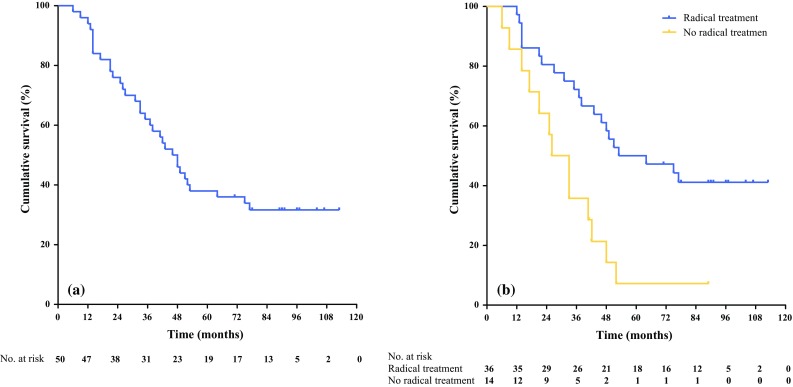
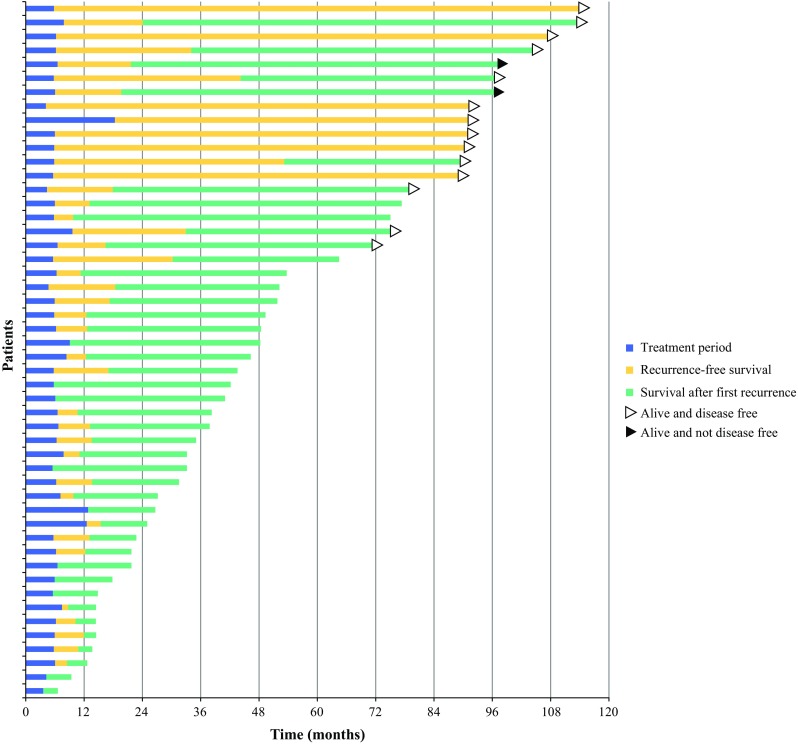
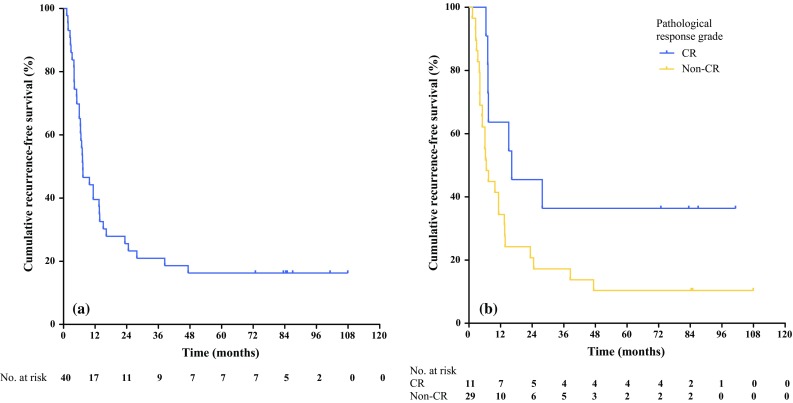
Follow-up data were available for all 50 patients. After a median follow-up time of 8.1 years (range 6.0-9.8), 16 patients (32.0%) were still alive and 14 (28%) were disease-free. The median overall survival was 3.8 years (range 0.5-9.4). From the 36 patients who received radical treatment, two (5.6%) had a local recurrence and 29 (80.6%) had a distant recurrence.
Long-term survival can be achieved in patients with primary metastatic rectal cancer after neoadjuvant radio- and chemotherapy. Despite a high number of recurrences, 32% of patients were alive after a median follow-up time of 8.1 years.
在 2006 年至 2010 年期间进行的一项荷兰二期临床试验中,短程放疗后系统治疗采用卡培他滨、奥沙利铂和贝伐单抗作为新辅助治疗,随后对原发肿瘤和转移部位进行根治性手术治疗。在这项研究中,我们报告了至少随访 6 年后的长期结果。
患有组织学证实的直肠腺癌且肝脏或肺部有潜在可切除或可消融转移灶的患者符合条件。对所有入组试验的患者进行了随访数据收集。使用 Kaplan-Meier 方法计算总生存和无复发生存率。
所有 50 名患者均获得随访数据。中位随访时间为 8.1 年(范围 6.0-9.8),16 名患者(32.0%)存活,14 名患者(28%)无疾病。中位总生存期为 3.8 年(范围 0.5-9.4)。在接受根治性治疗的 36 名患者中,有 2 名(5.6%)出现局部复发,29 名(80.6%)出现远处复发。
新辅助放化疗后,原发转移性直肠癌患者可获得长期生存。尽管复发率较高,但在中位随访时间为 8.1 年后,仍有 32%的患者存活。