
基因共表达网络揭示了预测浆液性卵巢癌分期和分级的共享模块。
Gene co-expression network reveals shared modules predictive of stage and grade in serous ovarian cancers.
作者信息
Sun Qian, Zhao Haiyue, Zhang Cong, Hu Ting, Wu Jianli, Lin Xingguang, Luo Danfeng, Wang Changyu, Meng Li, Xi Ling, Li Kezhen, Hu Junbo, Ma Ding, Zhu Tao
机构信息
Cancer Biology Research Center, Key Laboratory of the Ministry of Education, Tongji Hospital, Tongji Medical College, Huazhong University of Science and Technology, Wuhan, People's Republic of China.
出版信息
Oncotarget. 2017 Jun 27;8(26):42983-42996. doi: 10.18632/oncotarget.17785.
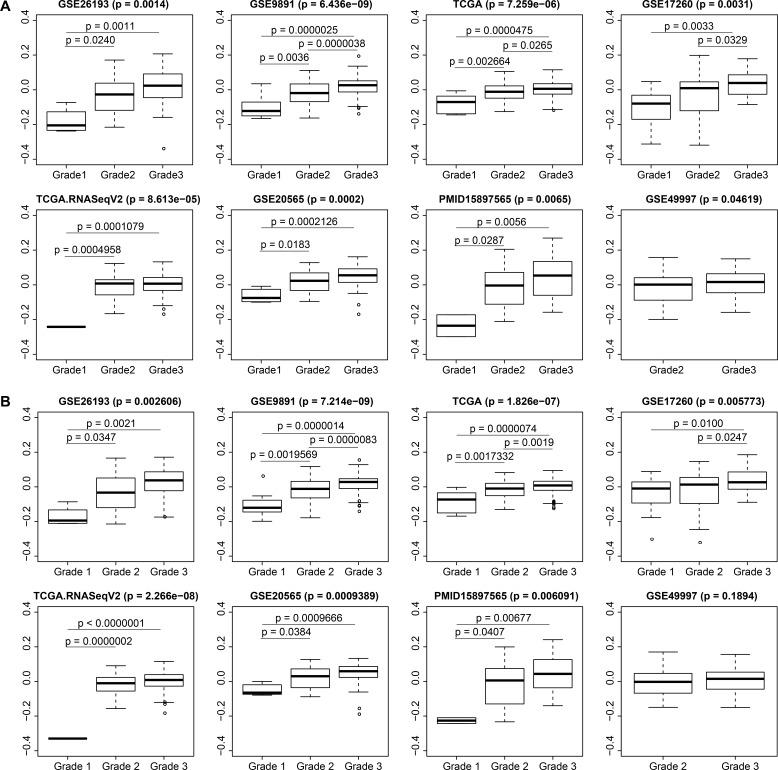
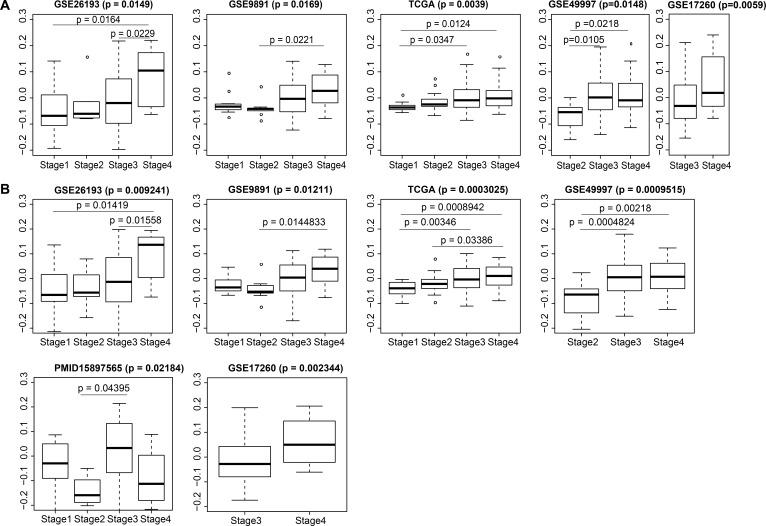
Serous ovarian cancer (SOC) is the most lethal gynecological cancer. Clinical studies have revealed an association between tumor stage and grade and clinical prognosis. Identification of meaningful clusters of co-expressed genes or representative biomarkers related to stage or grade may help to reveal mechanisms of tumorigenesis and cancer development, and aid in predicting SOC patient prognosis. We therefore performed a weighted gene co-expression network analysis (WGCNA) and calculated module-trait correlations based on three public microarray datasets (GSE26193, GSE9891, and TCGA), which included 788 samples and 10402 genes. We detected four modules related to one or more clinical features significantly shared across all modeling datasets, and identified one stage-associated module and one grade-associated module. Our analysis showed that MMP2, COL3A1, COL1A2, FBN1, COL5A1, COL5A2, and AEBP1 are top hub genes related to stage, while CDK1, BUB1, BUB1B, BIRC5, AURKB, CENPA, and CDC20 are top hub genes related to grade. Gene and pathway enrichment analyses of the regulatory networks involving hub genes suggest that extracellular matrix interactions and mitotic signaling pathways are crucial determinants of tumor stage and grade. The relationships between gene expression modules and tumor stage or grade were validated in five independent datasets. These results could potentially be developed into a more objective scoring system to improve prediction of SOC outcomes.
浆液性卵巢癌(SOC)是最致命的妇科癌症。临床研究揭示了肿瘤分期和分级与临床预后之间的关联。识别与分期或分级相关的共表达基因有意义的聚类或代表性生物标志物,可能有助于揭示肿瘤发生和癌症发展的机制,并有助于预测SOC患者的预后。因此,我们进行了加权基因共表达网络分析(WGCNA),并基于三个公共微阵列数据集(GSE26193、GSE9891和TCGA)计算了模块-性状相关性,这些数据集包含788个样本和10402个基因。我们检测到四个与所有建模数据集中显著共享的一种或多种临床特征相关的模块,并确定了一个与分期相关的模块和一个与分级相关的模块。我们的分析表明,MMP2、COL3A1、COL1A2、FBN1、COL5A1、COL5A2和AEBP1是与分期相关的顶级枢纽基因,而CDK1、BUB1、BUB1B、BIRC5、AURKB、CENPA和CDC20是与分级相关的顶级枢纽基因。对涉及枢纽基因的调控网络进行基因和通路富集分析表明,细胞外基质相互作用和有丝分裂信号通路是肿瘤分期和分级的关键决定因素。基因表达模块与肿瘤分期或分级之间的关系在五个独立数据集中得到了验证。这些结果有可能被开发成一个更客观的评分系统,以改善对SOC结局的预测。


 Zotero 插件